
We read your photo as:
Define monetary policy, fiscal policy, inflation, and credit creation. Provide one PNG example for each.
ScanSolve AI Answer
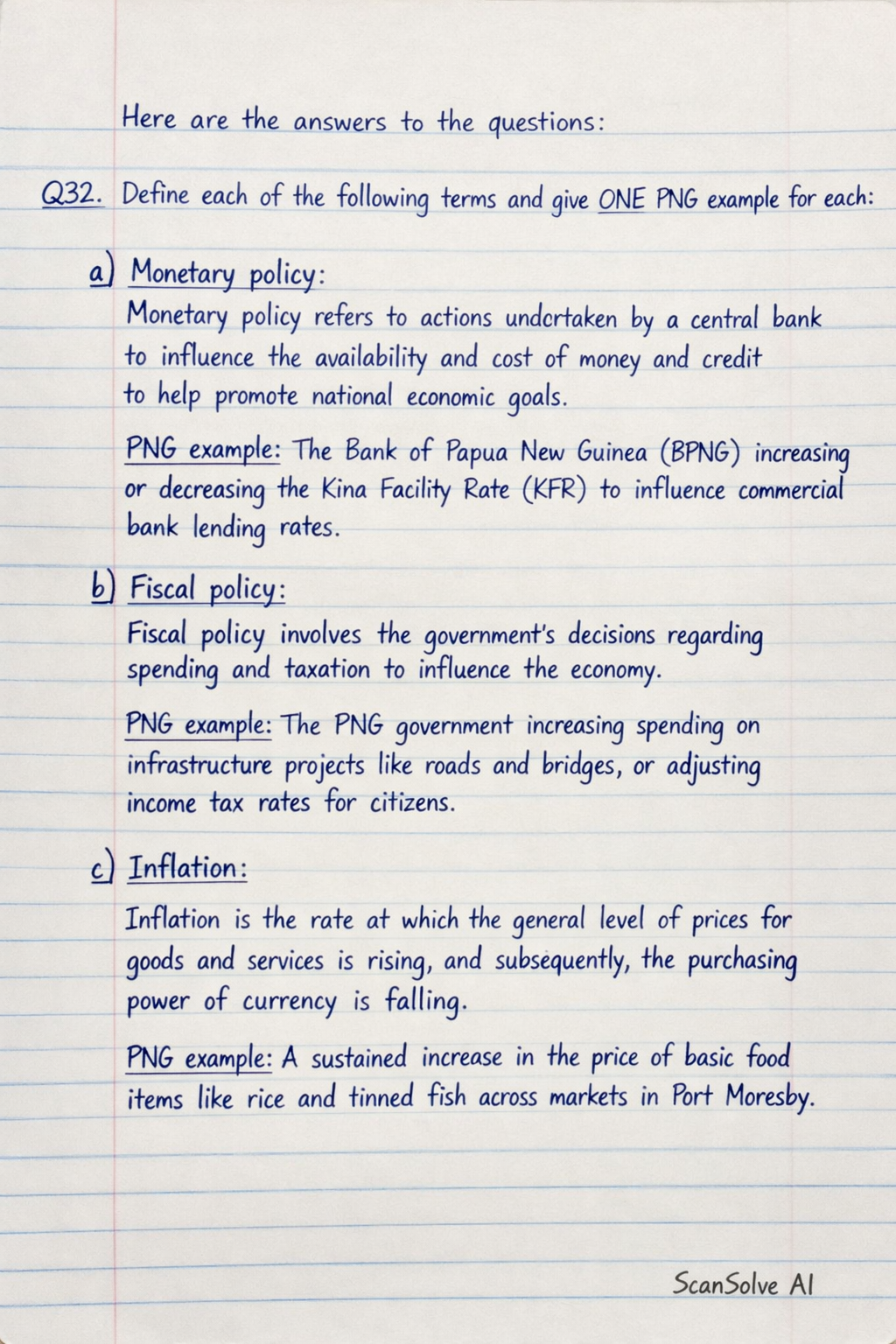
Here are the answers to the questions:
Q32. Define each of the following terms and give ONE PNG example for each:
a) Monetary policy:
Monetary policy refers to actions undertaken by a central bank to influence the availability and cost of money and credit to help promote national economic goals.
PNG example: The Bank of Papua New Guinea (BPNG) increasing or decreasing the Kina Facility Rate (KFR) to influence commercial bank lending rates.
b) Fiscal policy:
Fiscal policy involves the government's decisions regarding spending and taxation to influence the economy.
PNG example: The PNG government increasing spending on infrastructure projects like roads and bridges, or adjusting income tax rates for citizens.
c) Inflation:
Inflation is the rate at which the general level of prices for goods and services is rising, and subsequently, the purchasing power of currency is falling.
PNG example: A sustained increase in the price of basic food items like rice and tinned fish across markets in Port Moresby.
d) Credit creation:
Credit creation is the process by which commercial banks expand the money supply by making loans, which in turn creates new deposits.
PNG example: A commercial bank in PNG, like BSP Financial Group, lending money to a small business, which then deposits the funds into another account, increasing the money supply.
Q33. List and briefly explain the SIX instruments (tools) of monetary policy used by the Bank of Papua New Guinea (BPNG). For each instrument, state whether increasing/imposing it will EXPAND or CONTRACT the economy.
- Kina Facility Rate (KFR): This is the policy interest rate set by BPNG for overnight lending and borrowing between commercial banks.
- Increasing the KFR will CONTRACT the economy.
- Open Market Operations (OMOs): BPNG buys or sells government securities (e.g., Treasury Bills) in the open market to influence the money supply.
- Selling securities will CONTRACT the economy; buying securities will EXPAND the economy.
- Cash Reserve Requirement (CRR): This is the percentage of deposits that commercial banks are required to hold in reserve with BPNG.
- Increasing the CRR will CONTRACT the economy.
- Discount Window/Lending Rate: The interest rate at which commercial banks can borrow money directly from BPNG.
- Increasing the discount rate will CONTRACT the economy.
- Foreign Exchange Intervention: BPNG buys or sells foreign currency to influence the exchange rate and domestic money supply.
- Selling foreign currency (buying Kina) will CONTRACT the economy.
- Moral Suasion: BPNG uses persuasion and informal influence to encourage commercial banks to follow its policy objectives.
- This can be used to either EXPAND or CONTRACT the economy depending on the advice given.
Q34. Distinguish between RESTRICTIVE monetary policy and EXPANSIONARY monetary policy. For each type: (a) state its purpose, (b) identify when it would be used in PNG, and (c) give TWO specific policy actions.
-
Restrictive Monetary Policy:
- a) Purpose: To slow down economic growth, control inflation, and reduce the money supply.
- b) When used in PNG: When the economy is experiencing high inflation, rapid economic growth that is unsustainable, or an overheating economy.
- c) Two policy actions:
- Increase the Kina Facility Rate (KFR).
- Sell government securities through Open Market Operations.
-
Expansionary Monetary Policy:
- a) Purpose: To stimulate economic growth, increase employment, and expand the money supply.
- b) When used in PNG: When the economy is in a recession, experiencing high unemployment, or facing slow economic growth.
- c) Two policy actions:
- Decrease the Kina Facility Rate (KFR).
- Buy government securities through Open Market Operations.
Q35. Explain the FIVE types of unemployment. For each type, give a specific Papua New Guinea example.
- Frictional Unemployment: This is short-term unemployment that occurs when people are voluntarily between jobs, searching for new opportunities, or entering the workforce for the first time.
- PNG example: A recent university graduate in Port Moresby spending a few months looking for their first job in the public service or a private company.
- Structural Unemployment: This type of unemployment arises from a mismatch between the skills workers possess and the skills demanded by employers, often due to technological changes or shifts in the economy's structure.
- PNG example: Miners in a remote area becoming unemployed because a mine closes down, and their specialized mining skills are not easily transferable to other industries available in their region.
- Cyclical Unemployment: This is unemployment caused by a downturn in the overall economy or a recession, leading to reduced demand for goods and services and thus reduced demand for labor.
- PNG example: Workers in the construction sector being laid off during a period of economic slowdown when fewer new building projects are initiated due to reduced investment.
- Seasonal Unemployment: This occurs when people are unemployed at certain times of the year because their jobs are dependent on seasonal factors.
- PNG example: Workers employed in the tourism sector in coastal areas who might be out of work during the off-peak season when tourist arrivals are low.
- Real Wage (Classical) Unemployment: This occurs when real wages are kept above the market-clearing level, often due to minimum wage laws or strong union bargaining, leading to an excess supply of labor.
- PNG example: If a government-mandated minimum wage is set too high for certain entry-level jobs, some businesses might choose to hire fewer workers or automate tasks, leading to unemployment for those willing to work at a lower wage.
Still stuck on this one?
Ask a follow-up, and the answer starts from this question.
More Economics Questions
Handwritten Step-by-Step Solution
Get this as a handwritten image on WhatsApp — like a tutor wrote it for you.
Try on WhatsApp