
We read your photo as:
Table 2.2 represents Mr. Adebowale's annual income and the quantity of garri demanded. From Table 2.2, Calculate: i. co-efficient of income. ii. what type of goods is garri to Mr. Adebowale. Briefly explain four factors affecting elasticity of supply.
Economics
ScanSolve AI Answer
Step-by-step solution
3 stepshere's the solution to question 2.
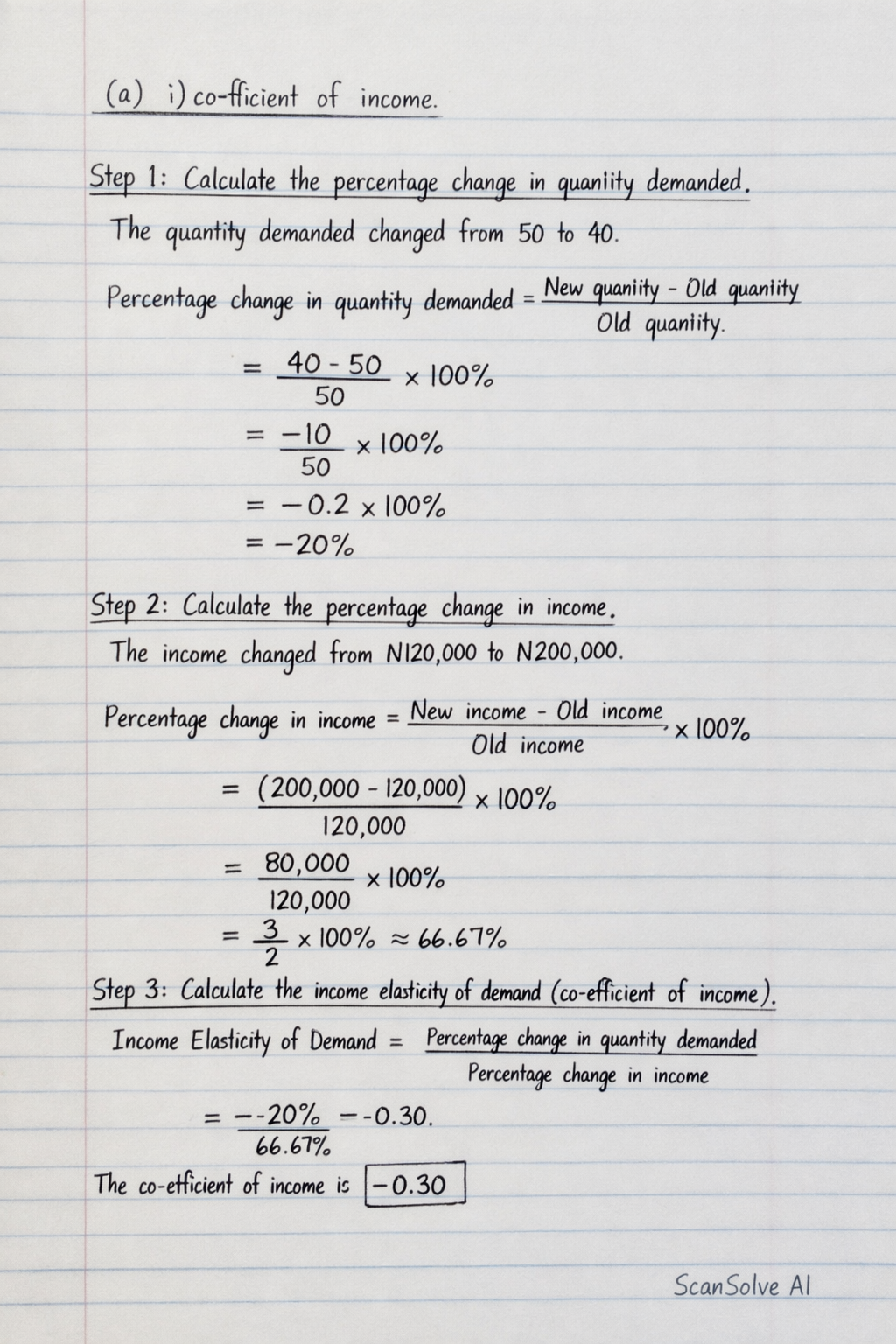
a) i) Co-efficient of income
Calculate the percentage change in quantity demanded.
The quantity demanded changed from 50 to 40.
Calculate the percentage change in income.
The income changed from N120,000 to N200,000.
Calculate the income elasticity of demand (co-efficient of income).
The co-efficient of income is .
a) ii) What type of goods is garri to Mr. Adebowale?
Since the income elasticity of demand is negative (), garri is an inferior good to Mr. Adebowale. This means that as his income increases, his demand for garri decreases.
b) Briefly explain four factors affecting elasticity of supply.
- Availability of inputs: If raw materials, labor, and capital are easily accessible, producers can quickly increase output, making supply more elastic. Scarcity of inputs leads to inelastic supply.
- Time horizon: In the short run, firms have limited ability to change production, so supply is often inelastic. Over the long run, firms can adjust capacity and technology, making supply more elastic.
- Storage capacity: Goods that can be stored easily and cheaply allow producers to hold inventory and adjust supply to market changes, resulting in more elastic supply. Perishable goods have inelastic supply.
- Mobility of factors of production: If resources like labor and machinery can be easily moved between different uses, producers can quickly shift production in response to price changes, leading to more elastic supply.
Was this helpful?
Still stuck on this one?
Ask a follow-up, and the answer starts from this question.
Got a different question?Ask your own question
More Economics Questions
QFrom Table 2.1, Calculate: i. co-efficient of income. ii. what type of goods is garri to Mr…QFrom Table 2.1, calculate: i. co-efficient of income. ii. what type of goods is garri to Mr…QUsing the table below, calculate the marginal and average products. Given that the values of A and B…QRefer to the table on the income Elasticity of Demand for Jasmine rice and Bestla Tin fish…QIncome(Rs.) 200. 240. 280. 320 Quantity. 50. 80. 100. 110 Calculate the income elasticity of…
Browse by topic:Microeconomics
Handwritten Step-by-Step Solution
Get this as a handwritten image on WhatsApp — like a tutor wrote it for you.
Try on WhatsApp