
We read your photo as:
Write short notes on: Library Financial Management, Various sections of Library & Information centres, Function of Library Committee, and Re-engineering.
Business/Management
ScanSolve AI Answer
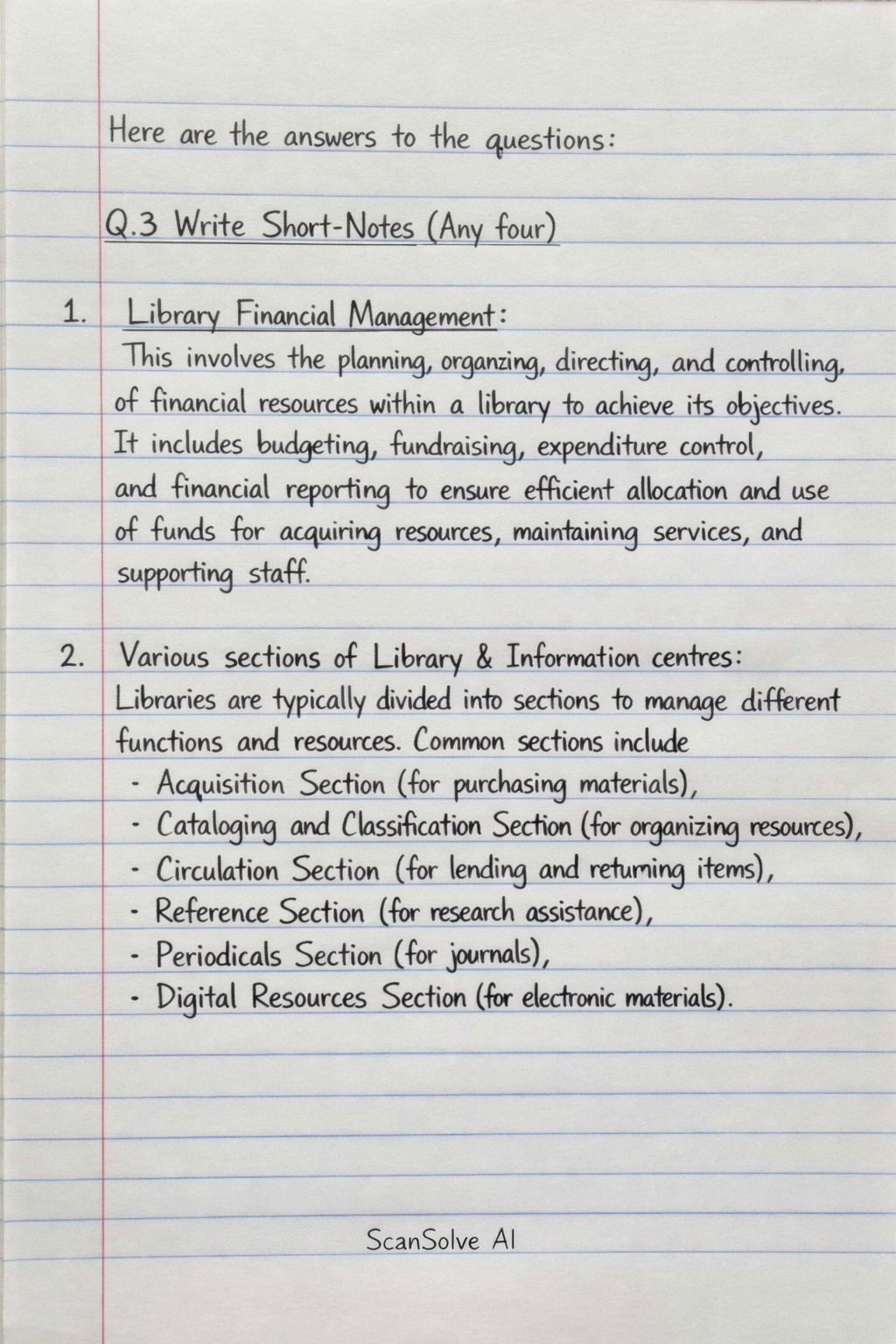
Here are the answers to the questions:
Q.3 Write Short-Notes (Any four)
- Library Financial Management: This involves the planning, organizing, directing, and controlling of financial resources within a library to achieve its objectives. It includes budgeting, fundraising, expenditure control, and financial reporting to ensure efficient allocation and use of funds for acquiring resources, maintaining services, and supporting staff.
- Various sections of Library & Information centres: Libraries are typically divided into sections to manage different functions and resources. Common sections include the Acquisition Section (for purchasing materials), Cataloging and Classification Section (for organizing resources), Circulation Section (for lending and returning items), Reference Section (for research assistance), Periodicals Section (for journals), and Digital Resources Section (for electronic materials).
- Function of Library Committee: A Library Committee acts as an advisory body, providing guidance and recommendations to the library administration and the parent institution. Its functions include formulating library policies, reviewing budget proposals, recommending new services or resources, ensuring user satisfaction, and promoting the library's role within the institution.
- Re-engineering: In a library context, re-engineering refers to the fundamental rethinking and radical redesign of library processes to achieve dramatic improvements in performance measures such as cost, quality, service, and speed. It often involves leveraging technology to streamline workflows, eliminate redundancies, and enhance the overall user experience.
Q.4 Discuss briefly any three questions of the following
- Application of various technologies in libraries for stock verification: Stock verification ensures the accuracy of a library's collection. Technologies used include Barcode Scanners for quick identification of items, RFID (Radio-Frequency Identification) Systems for rapid, simultaneous scanning of multiple items without direct line of sight, and Integrated Library Systems (ILS) which manage the inventory database and facilitate comparison of physical stock with digital records, significantly improving efficiency and accuracy.
Was this helpful?
Still stuck on this one?
Ask a follow-up, and the answer starts from this question.
Got a different question?Ask your own question
More Business/Management Questions
QDiscuss briefly any three questions of the following: Explain various methods and criteria for…QList functions of departments, qualities of office staff, functions of office equipment, and prepare…QDiscuss information organization and the roles of a librarian in the modern information environment.QProvide very short answers to the following questions regarding office management, records…QDraft a formal letter to the Headteacher requesting funds for new library resources.
Handwritten Step-by-Step Solution
Get this as a handwritten image on WhatsApp — like a tutor wrote it for you.
Try on WhatsApp