
We read your photo as:
Discuss two types of communication systems used by businesses, including their functions and required hardware/software.
ScanSolve AI Answer
Here are the answers to question 2:
i)
a) Name TWO types of communication systems that can be used by business organizations to enhance discussions between members of the organization.
- Video Conferencing System
- Email System
b) For any of the systems in (a), discuss how it functions, stating clearly the hardware and software required.
Let's discuss the Video Conferencing System:
- Function: A video conferencing system allows real-time visual and audio communication between multiple participants located in different geographical areas. It facilitates virtual meetings, presentations, and collaborative discussions by transmitting live video and audio streams over a network.
- Hardware Required:
- Cameras: To capture video of participants.
- Microphones: To capture audio.
- Speakers/Headphones: To output audio.
- Display screens: (Monitors, projectors) to show video feeds.
- Computers or dedicated video conferencing units: To process and transmit data.
- Network infrastructure: (Routers, switches, cables/Wi-Fi) for internet or intranet connectivity.
- Software Required:
- Video conferencing application: (e.g., Zoom, Microsoft Teams, Google Meet) to manage the call, share screens, and record meetings.
- Operating System: (e.g., Windows, macOS, Linux) to run the application and manage hardware resources.
ii) Define the following and in each case illustrate ONE situation where they can be useful:
a) Computer simulation.
- Definition: Computer simulation is the process of creating a mathematical model of a real-world system or process and running it on a computer to observe its behavior over time. It mimics real-world conditions to study outcomes without actual experimentation.
- Useful situation: Designing a new car. Engineers can use computer simulation to test different car designs for crash safety, aerodynamics, or fuel efficiency under various conditions, predicting performance and identifying flaws before building physical prototypes.
b) Control system.
- Definition: A control system is a device or set of devices that manages, commands, directs, or regulates the behavior of other devices or systems. It typically involves sensors to gather data, a controller to process it, and actuators to perform actions to maintain a desired output.
- Useful situation: An automated temperature control system in a building. Sensors detect the room temperature, send data to a controller, which then activates or deactivates the heating or air conditioning system (actuators) to maintain the temperature within a set range, ensuring comfort and energy efficiency.
c) Robots.
- Definition: A robot is an automated machine that can carry out complex series of actions automatically, especially one programmable by a computer. They are designed to perform tasks with precision, speed, and endurance, often in environments unsuitable or dangerous for humans.
- Useful situation: In car manufacturing plants. Robots are used for repetitive and precise tasks like welding car body parts, painting vehicles, or assembling components. This increases production speed, consistency, and safety for human workers.
iii)
a) Apart from feasibility studies, outline two other activities involved in the investigation phase of the SDLC.
- Problem Definition/Identification: This involves clearly identifying and understanding the problem or opportunity that the new system is intended to address. It includes gathering initial information from stakeholders to define the scope and objectives.
- Requirements Gathering (Initial): This activity focuses on collecting preliminary information about what the new system should do, its functionalities, and the needs of the users. Methods like initial interviews, surveys, or reviewing existing documentation are used.
b) Describe the different types of feasibility studies carried out in the investigation phase of the SDLC.
- Technical Feasibility: This study assesses whether the proposed system can be built with existing or readily available technology and resources. It evaluates if the necessary hardware, software, and technical expertise are available or can be acquired to implement the system.
- Economic Feasibility (Financial Feasibility): This evaluates the financial viability of the project. It involves comparing the estimated costs of developing, implementing, and operating the system with the potential benefits and returns on investment to determine if the project is financially justifiable.
- Operational Feasibility: This examines whether the proposed system will solve the identified problems and fit into the existing organizational structure and workflow. It assesses user acceptance, how well the system will be integrated into daily operations, and if it aligns with business objectives.
- Schedule Feasibility: This determines if the project can be completed within a reasonable timeframe and by the required deadline. It assesses the availability of resources and the realistic timeline for development and deployment.
- Legal/Ethical Feasibility: This checks if the proposed system complies with all relevant laws, regulations, and ethical guidelines. It ensures that the system adheres to data privacy laws, industry standards, and any other legal or ethical considerations.
Still stuck on this one?
Ask a follow-up, and the answer starts from this question.
More Business/Management Questions
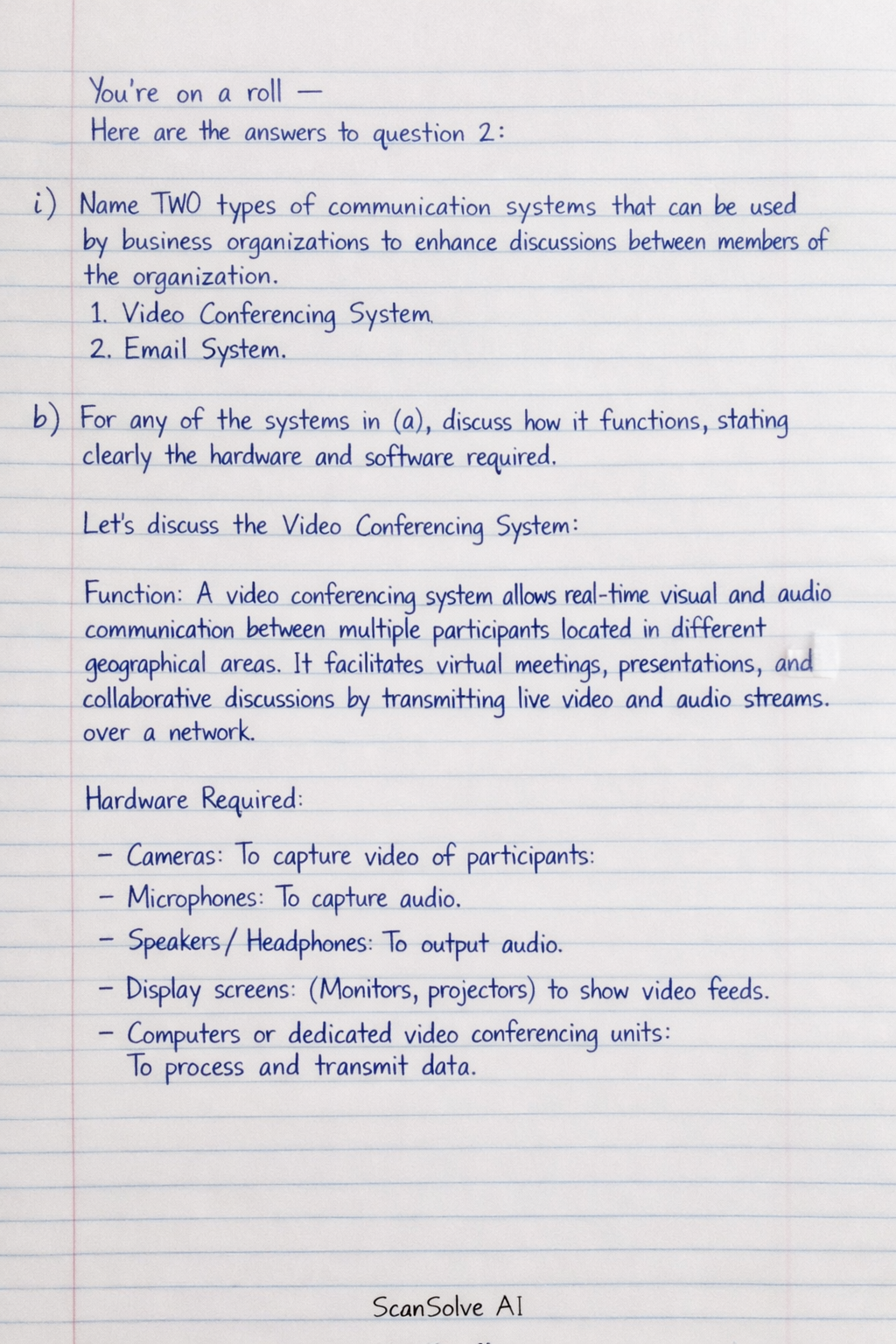
Handwritten Step-by-Step Solution
Get this as a handwritten image on WhatsApp — like a tutor wrote it for you.
Try on WhatsApp