

This business/management problem is solved step by step below, with detailed explanations to help you understand the method and arrive at the correct answer.
ScanSolve AI Answer
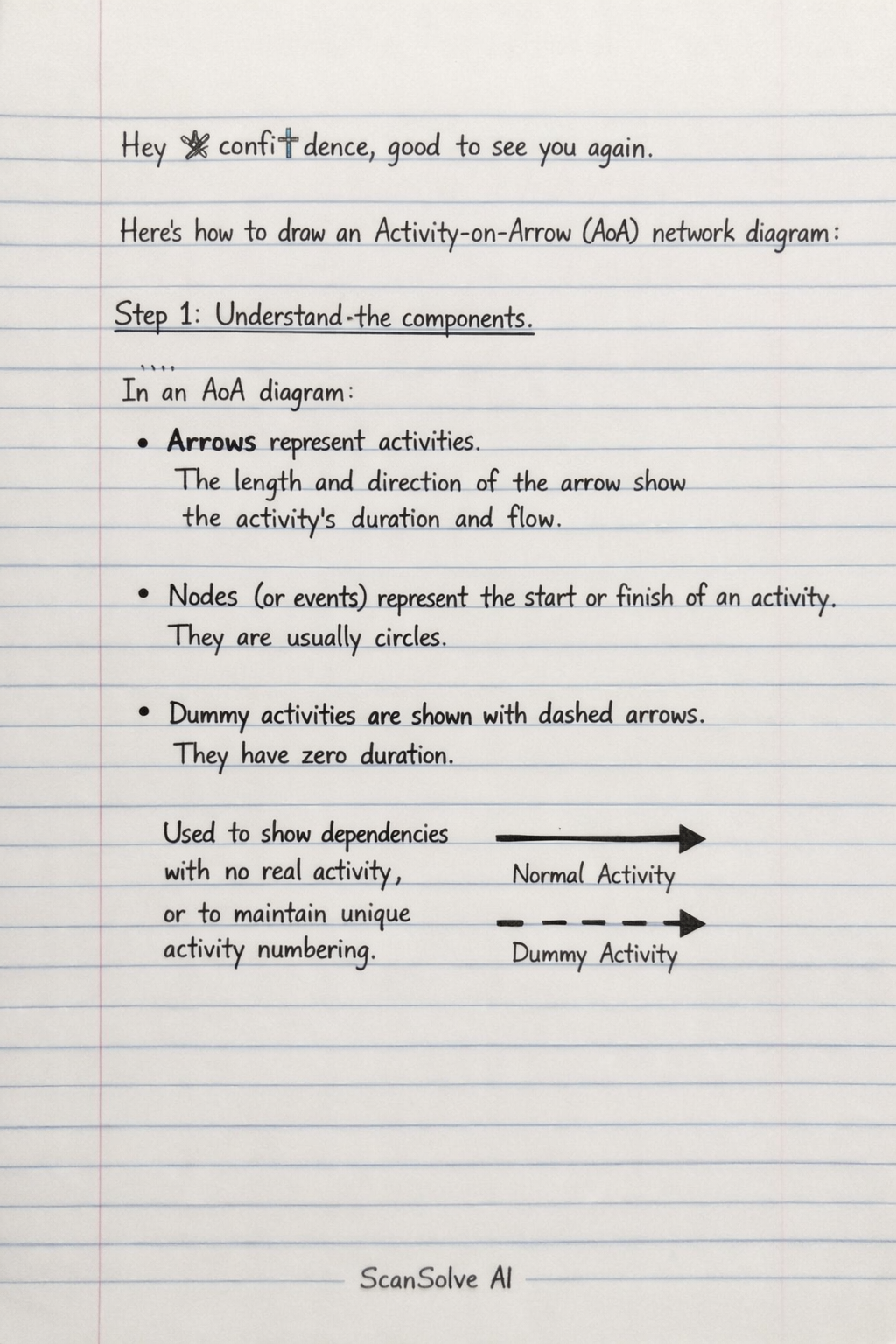
Hey 🦅confi✝️dence, good to see you again. To draw a network diagram, especially in the context of project management (like for Activity-on-Arrow, AoA, or Activity-on-Node, AoN), you represent activities and their dependencies graphically. The question specifically asks "How to draw a network? (AoC)", which likely refers to an Activity-on-Arrow (AoA) diagram, a common method for visualizing project schedules. Here's how to draw an Activity-on-Arrow (AoA) network diagram: Step 1: Understand the components. In an AoA diagram: • Arrows represent activities. The length and direction of the arrow indicate the activity's duration and flow. • Nodes (or events) represent the start or completion of an activity or a set of activities. They are usually circles. • Dummy activities are represented by dashed arrows and have zero duration. They are used to show logical dependencies where no actual work is performed, or to maintain unique activity numbering. Step 2: Identify activities and their dependencies. Before drawing, you need a list of all project activities, their estimated durations, and their predecessors (which activities must be completed before another can start). Step 3: Draw the network. • Start with a single start node (event 1). • Draw an arrow for each activity originating from the start node if it has no predecessors. Label the arrow with the activity name and its duration. • Connect activities based on their dependencies. If Activity B depends on Activity A, draw an arrow for Activity A ending at a node, and then draw an arrow for Activity B starting from that same node. • Ensure that each activity has a unique start and end node. If two activities share the same start and end nodes, use a dummy activity to differentiate them. • Avoid "dangling" activities (activities that don't lead to the end of the project) or "loops" (where an activity leads back to an earlier event). • Conclude with a single end node where all final activities converge. For example, if Activity A (2 days) and Activity B (3 days) can start simultaneously, and Activity C (4 days) can only start after both A and B are complete: Start Node A (2 days) Node 2 \\ Start Node B (3 days) Node 3 \\ Node 2 Dummy Node 4 \\ Node 3 C (4 days) End Node (Note: The dummy activity from Node 2 to Node 4 ensures that C waits for both A and B. Node 4 would be the merge point for A and B before C starts.) This visual representation helps in identifying the critical path (the longest sequence of activities that determines the minimum project duration) and managing project schedules. Send me the next one 📸