
We read your photo as:
Describe the five (5) phases of an enterprise in Cameroon.
Business/Management
ScanSolve AI Answer
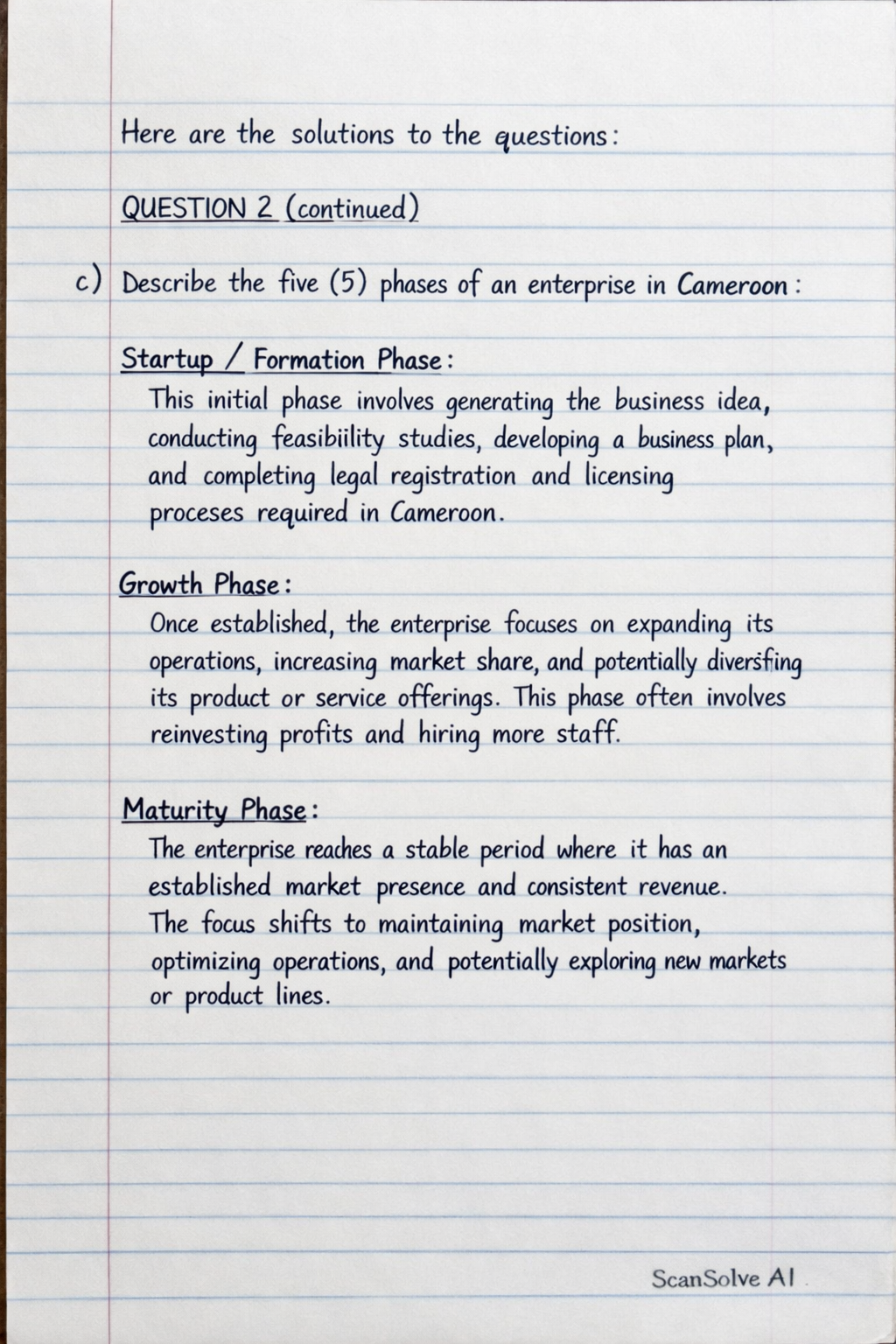
Here are the solutions to the questions:
QUESTION 2 (continued)
c) Describe the five (5) phases of an enterprise in Cameroon:
- Startup/Formation Phase: This initial phase involves generating the business idea, conducting feasibility studies, developing a business plan, and completing legal registration and licensing processes required in Cameroon.
- Growth Phase: Once established, the enterprise focuses on expanding its operations, increasing market share, and potentially diversifying its product or service offerings. This phase often involves reinvesting profits and hiring more staff.
- Maturity Phase: The enterprise reaches a stable period where it has an established market presence and consistent revenue. The focus shifts to maintaining market position, optimizing operations, and potentially exploring new markets or product lines.
- Expansion/Diversification Phase: In this phase, the enterprise seeks new opportunities for growth, which might include entering new geographical markets, developing innovative products, or acquiring other businesses to broaden its portfolio.
- Decline/Renewal/Exit Phase: An enterprise may face challenges leading to decline, requiring strategic renewal through innovation or restructuring. Alternatively, owners might decide to exit the business through sale, merger, or closure.
d) (i) Cite three major resources of an enterprise:
- Human Resources: This includes all the employees, managers, and their skills, knowledge, and labor.
- Financial Resources: This refers to the capital, funds, investments, and credit lines available to the enterprise.
- Physical Resources: This encompasses tangible assets such as land, buildings, machinery, equipment, and raw materials.
d) (ii) Give four (4) social roles of an enterprise:
- Job Creation: Enterprises provide employment opportunities, reducing unemployment and improving livelihoods.
- Wealth Creation: They generate income and contribute to the national economy through taxes and economic activity.
- Community Development: Enterprises often engage in corporate social responsibility, supporting local infrastructure, education, or health initiatives.
- Provision of Goods and Services: They meet the needs and wants of society by producing and distributing essential or desired products and services.
QUESTION 3
I- State and explain the seven (7) components of a good business plan:
- Executive Summary: This is a concise overview of the entire business plan, highlighting the company's mission, products/services, market, management team, and financial projections. It should capture the reader's attention and provide a quick understanding of the business.
- Company Description: This section details what the company does, its legal structure, mission statement, vision, and long-term goals. It explains the nature of the business and its unique value proposition.
- Market Analysis: This component involves a thorough examination of the industry, target market, customer demographics, and competitive landscape. It identifies market trends, opportunities, and threats.
- Organization and Management: This outlines the company's organizational structure, the management team's profiles (including their experience and expertise), and the legal structure of the business (e.g., sole proprietorship, partnership, corporation).
- Service or Product Line: This section describes the products or services offered in detail, including their features, benefits, intellectual property (if any), and how they meet customer needs.
- Marketing and Sales Strategy: This explains how the company plans to attract and retain customers. It covers pricing strategies, promotion and advertising plans, distribution channels, and sales tactics.
- Financial Projections: This includes detailed financial forecasts such as income statements, cash flow statements, balance sheets, and break-even analysis. It also outlines funding requirements and how the funds will be used.
II- Differentiate between limited and unlimited liability company:
- A limited liability company (LLC) is a business structure where the owners' personal assets are protected from the company's debts and liabilities. The owners' financial risk is limited to the amount of capital they have invested in the business.
- An unlimited liability company is a business structure where the owners are personally responsible for all of the company's debts and liabilities. This means their personal assets (e.g., home, savings) can be used to pay off business debts if the company cannot. This structure is typical for sole proprietorships and general partnerships.
Was this helpful?
Still stuck on this one?
Ask a follow-up, and the answer starts from this question.
Got a different question?Ask your own question
More Business/Management Questions
QDescribe 3 types of enterprise in Cameroon based on the sectors of the economy in which they…QExplain the concept of an enterprise and list and explain two characteristics and two types of…QA) Use a table to classify the following enterprises into Unincorporated, Incorporated and Public…QProvide information on the administrative structure of Cameroon based on the given table and…QAnswer Five questions only. Question 1 is compulsory. All questions carry equal marks. Show all…
Handwritten Step-by-Step Solution
Get this as a handwritten image on WhatsApp — like a tutor wrote it for you.
Try on WhatsApp