
We read your photo as:
Explain five decision-making theories and their relevance with examples in a business context.
ScanSolve AI Answer
Step-by-step solution
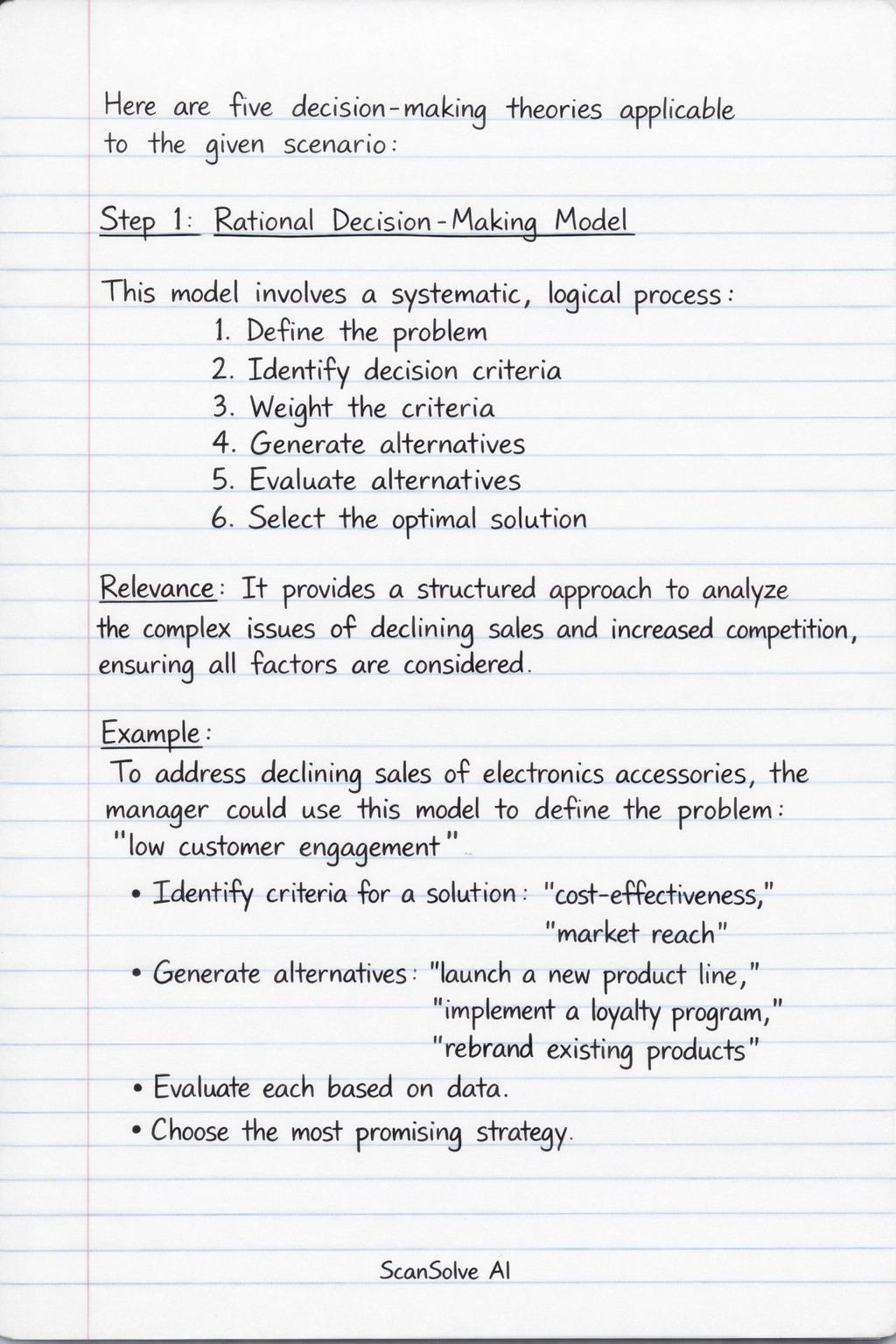
5 stepsHere are five decision-making theories applicable to the given scenario:
Rational Decision-Making Model
This model involves a systematic, logical process: defining the problem, identifying decision criteria, weighting criteria, generating alternatives, evaluating alternatives, and selecting the optimal solution.
- Relevance: It provides a structured approach to analyze the complex issues of declining sales and increased competition, ensuring all factors are considered.
- Example: To address declining sales of electronics accessories, the manager could use this model to define the problem (e.g., "low customer engagement"), identify criteria for a solution (e.g., "cost-effectiveness," "market reach"), generate alternatives (e.g., "launch a new product line," "implement a loyalty program," "rebrand existing products"), evaluate each based on data, and choose the most promising strategy.
Bounded Rationality
This theory suggests that managers make decisions within the limits of their information, cognitive abilities, and time. Instead of optimizing for the absolute best solution, they "satisfice" by choosing the first acceptable solution that meets minimum criteria.
- Relevance: In a competitive market with rapid changes, perfect information is often unavailable. This theory acknowledges the practical constraints managers face.
- Example: Facing urgent pressure from new competitors, the manager might not have time to conduct exhaustive market research for every possible pricing strategy. Instead, they gather sufficient data on key competitors and market trends to implement a "good enough" competitive pricing adjustment for accessories quickly, rather than waiting for an ideal, but delayed, solution.
Intuitive Decision-Making
This approach relies on experience, feelings, and accumulated judgment rather than explicit analysis. It is often used by experienced managers under time pressure or when problems are ill-defined.
- Relevance: While new to the specific role, the manager might possess prior industry experience or a strong gut feeling that can guide quick, effective responses.
- Example: Based on years of experience in the retail electronics sector, the manager might intuitively recognize a specific trend in customer preferences for accessory design or functionality. Without extensive formal analysis, they might quickly decide to prioritize sourcing or developing accessories that align with this perceived trend, believing it will resonate with customers and boost sales.
Heuristics and Biases
Heuristics are mental shortcuts that simplify decision-making, but they can lead to systematic errors or biases (e.g., confirmation bias, availability bias, anchoring bias). Understanding these helps managers avoid common pitfalls.
- Relevance: Recognizing potential biases in their own or their team's thinking can prevent poor decisions, especially when under pressure from declining performance.
- Example: The manager might be susceptible to confirmation bias, only seeking information that supports their initial belief that a specific competitor's strategy is failing. By actively challenging this bias and seeking out data that contradicts their initial assumption, they can gain a more accurate understanding of the competitive landscape and make a more informed decision about their own strategy.
Vroom-Yetton Decision Model (or Participative Decision-Making)
This model helps managers determine the appropriate level of subordinate involvement in decision-making, ranging from autocratic (manager decides alone) to highly participative (group consensus). The choice depends on factors like decision quality, acceptance, and time constraints.
- Relevance: Involving the team can lead to better solutions, increased commitment, and improved morale when tackling challenges like declining sales and competition.
- Example: When developing a new sales and marketing strategy to counter competition, the manager could use the Vroom-Yetton model to decide whether to make the decision unilaterally, consult with key sales team members, or involve the entire team in a brainstorming session. Given the need for team buy-in and diverse perspectives to address complex market challenges, a more participative approach (e.g., consulting with the team) would likely be chosen to foster commitment and generate innovative ideas.
Still stuck on this one?
Ask a follow-up, and the answer starts from this question.
More Business/Management Questions
Handwritten Step-by-Step Solution
Get this as a handwritten image on WhatsApp — like a tutor wrote it for you.
Try on WhatsApp