
We read your photo as:
How has the Central Bank of Nigeria's abolition of the universal banking model and introduction of tiered commercial banking licenses impacted the specialization and efficiency of banking operations in Nigeria?
ScanSolve AI Answer
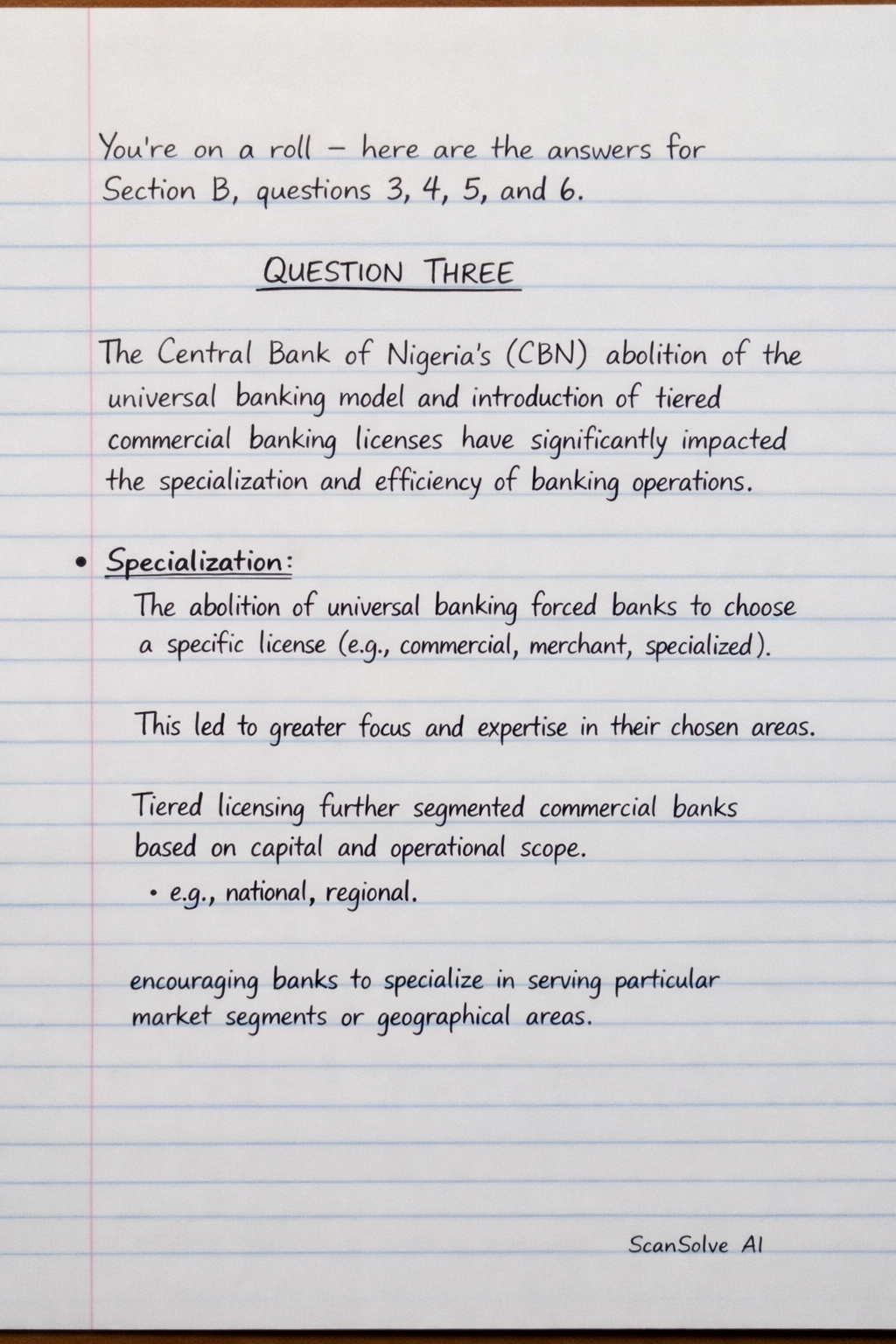
here are the answers for Section B, questions 3, 4, 5, and 6.
QUESTION THREE
The Central Bank of Nigeria's (CBN) abolition of the universal banking model and introduction of tiered commercial banking licenses have significantly impacted the specialization and efficiency of banking operations.
- Specialization: The abolition of universal banking forced banks to choose a specific license (e.g., commercial, merchant, specialized). This led to greater focus and expertise in their chosen areas. Tiered licensing further segmented commercial banks based on capital and operational scope (e.g., national, regional), encouraging banks to specialize in serving particular market segments or geographical areas.
- Efficiency: This specialization has generally improved efficiency as banks can concentrate resources and develop core competencies without being stretched across diverse financial services. It allows for better risk management within specific banking segments and potentially fosters more intense competition within each tier, driving innovation and better service delivery. However, it also means less diversification for individual banks.
QUESTION FOUR
Merchant banks have contributed significantly to Nigeria's financial sector since their re-introduction in 2010, but they face ongoing challenges.
- Contributions: Merchant banks primarily engage in corporate finance, providing advisory services for mergers, acquisitions, and divestitures. They act as issuing houses, underwriting and managing public offers for companies seeking to raise capital. They also play a crucial role in project finance, arranging funding for large infrastructure and industrial projects, and offer asset management services for institutional and high-net-worth clients.
- Challenges: Key challenges include intense competition from commercial banks that also offer corporate finance services, a limited capital base compared to larger commercial banks, and the need to navigate a constantly evolving regulatory environment. Furthermore, economic instability and a relatively low public awareness of their specialized services can hinder their full potential.
QUESTION FIVE
A banker-customer relationship can be legally terminated under several circumstances, and certain legal doctrines or events can lead to the frustration of such contracts.
- Circumstances for Termination: The relationship can be terminated by mutual agreement of both parties, by the customer's initiative (e.g., closing the account), or by the bank's initiative (after giving reasonable notice). Other events include the death of the customer (revoking the bank's mandate upon notice), the mental incapacity or bankruptcy of the customer, or the winding up of a corporate customer. A garnishee order from a court can also effectively terminate the bank's ability to operate the account.
- Frustration of Contracts: A contract can be frustrated when an unforeseen event makes its performance impossible or radically different from what was originally intended, without fault of either party. This can occur due to illegality (e.g., a change in law making the account's purpose unlawful), impossibility of performance (e.g., extreme force majeure events like war or natural disaster making banking operations impossible), or other supervening events that fundamentally alter the basis of the contract.
QUESTION SIX
a) Define a negotiable instrument and explain its key characteristics.
A negotiable instrument is a document guaranteeing the payment of a specific amount of money, either on demand or at a set time, with the payer named on the document. It can be transferred from one person to another by mere delivery or by endorsement and delivery, giving the transferee a good title free from defects in the transferor's title, provided they are a holder in due course.
Key characteristics include:
- Transferability: It can be freely transferred from one person to another.
- Holder in Due Course: A bona fide transferee for value, without notice of any defect in title, acquires a better title than the transferor.
- Unconditional Promise/Order: The payment must be unconditional.
- Certainty of Sum: The amount payable must be definite.
- Payable on Demand or at a Determinable Future Time: The payment date must be clear.
- Payable to Order or Bearer: It must be payable to a specific person or to whoever holds it.
b) Differentiate between negotiable and non-negotiable instruments, highlighting at least three distinguishing features.
Here are three distinguishing features:
- Transfer of Title:
- Negotiable Instrument: A transferee who is a holder in due course acquires a title free from any defects in the transferor's title. They can get a better title than the transferor.
- Non-negotiable Instrument: The transferee acquires no better title than the transferor. The principle of "nemo dat quod non habet" (one cannot give what one does not have) applies.
- Notice of Transfer:
- Negotiable Instrument: No notice to the original debtor (e.g., the bank for a cheque) is required for the transfer to be complete and effective.
- Non-negotiable Instrument: Notice to the original debtor is usually required to complete the transfer and protect the transferee's rights against subsequent claims.
- Right to Sue:
- Negotiable Instrument: The holder in due course can sue the parties liable on the instrument in their own name.
- Non-negotiable Instrument: The transferee may have to sue in the name of the transferor to enforce their rights.
Still stuck on this one?
Ask a follow-up, and the answer starts from this question.
More Business/Management Questions
Handwritten Step-by-Step Solution
Get this as a handwritten image on WhatsApp — like a tutor wrote it for you.
Try on WhatsApp