
We read your photo as:
With a suitable diagram, determine producer and consumer surpluses for a product characterized by D = 80−P, S=2P−100. Calculate the deadweight loss of imposing a per unit tax of £7.50.
ScanSolve AI Answer
Answers
2 partsb)
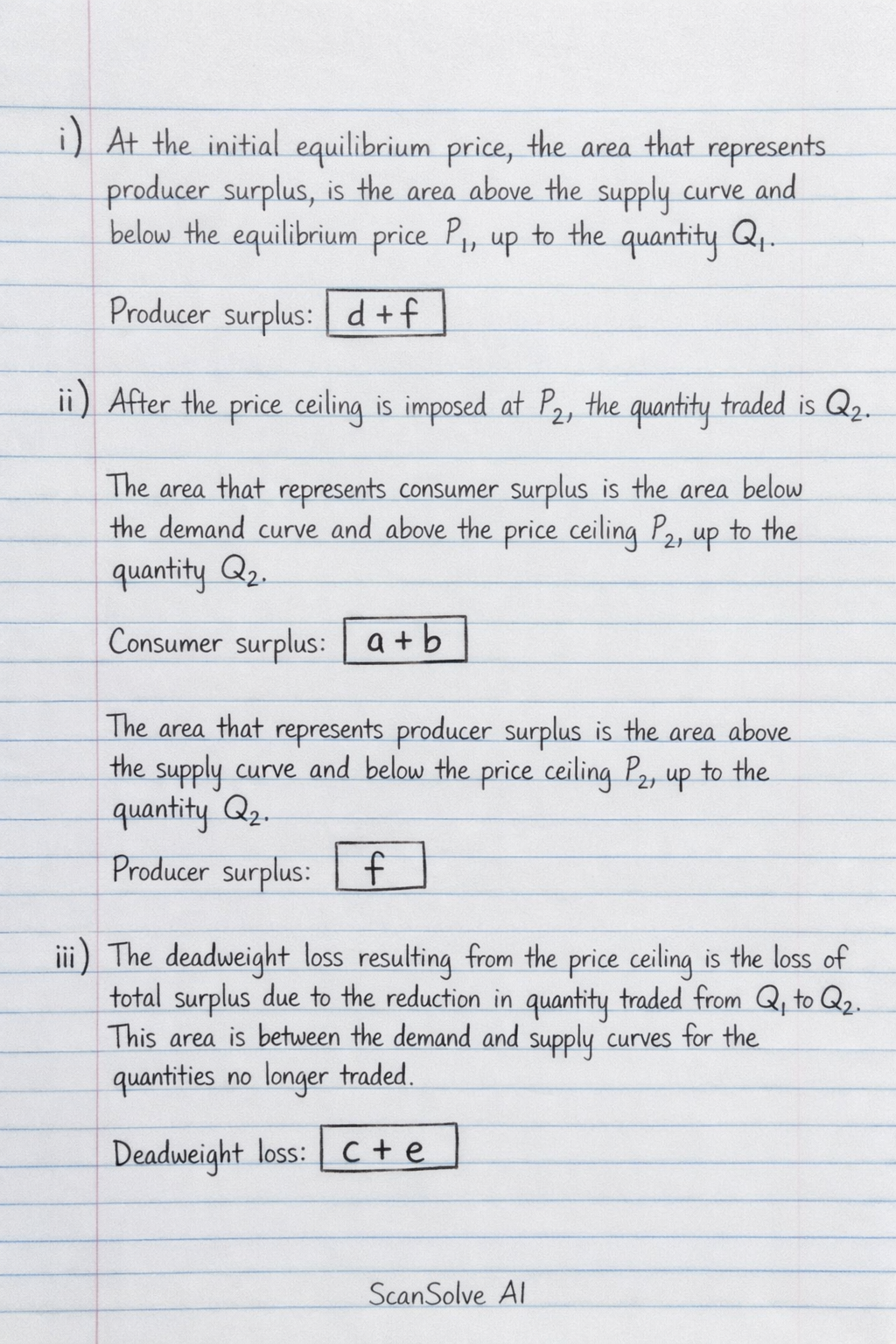
i) At the initial equilibrium price, the area that represents producer surplus is the area above the supply curve and below the equilibrium price , up to the quantity .
Producer surplus:
ii) After the price ceiling is imposed at , the quantity traded is .
The area that represents consumer surplus is the area below the demand curve and above the price ceiling , up to the quantity .
Consumer surplus:
The area that represents producer surplus is the area above the supply curve and below the price ceiling , up to the quantity .
Producer surplus:
iii) The deadweight loss resulting from the price ceiling is the loss of total surplus due to the reduction in quantity traded from to . This area is between the demand and supply curves for the quantities no longer traded.
Deadweight loss:
Try one yourself
A new problem that tests the same skill.
Still stuck on this one?
Ask a follow-up, and the answer starts from this question.
More Economics Questions
Handwritten Step-by-Step Solution
Get this as a handwritten image on WhatsApp — like a tutor wrote it for you.
Try on WhatsApp