
We read your photo as:
Explain (4) differences between Capitalist and economic systems.
Economics
ScanSolve AI Answer
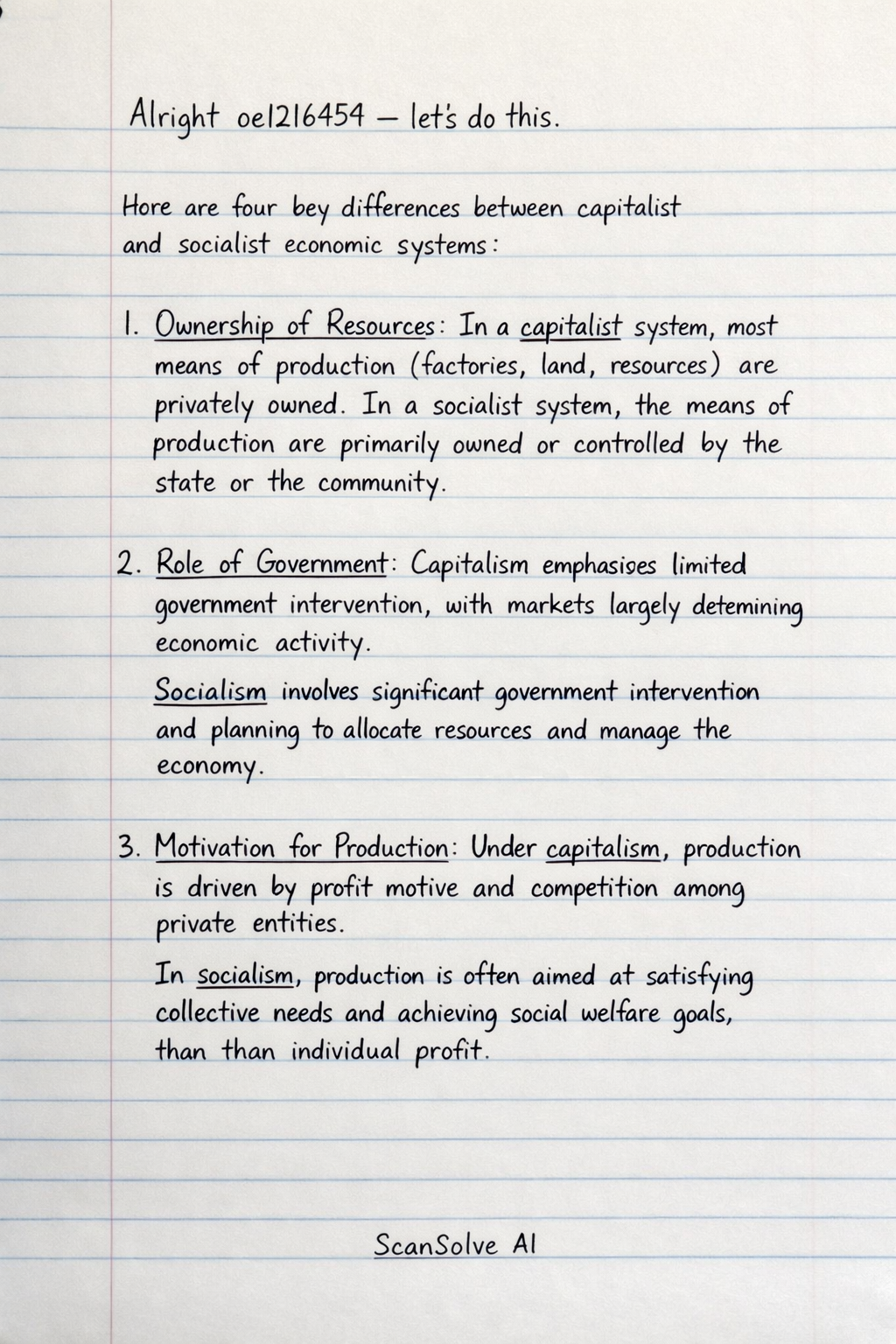
Here are four key differences between capitalist and socialist economic systems:
- Ownership of Resources: In a capitalist system, most means of production (factories, land, resources) are privately owned. In a socialist system, the means of production are primarily owned or controlled by the state or the community.
- Role of Government: Capitalism emphasizes limited government intervention, with markets largely determining economic activity. Socialism involves significant government intervention and planning to allocate resources and manage the economy.
- Motivation for Production: Under capitalism, production is driven by profit motive and competition among private entities. In socialism, production is often aimed at satisfying collective needs and achieving social welfare goals, rather than individual profit.
- Distribution of Wealth: Capitalism typically results in greater income inequality, as wealth is distributed based on market forces and individual success. Socialism aims for a more equitable distribution of wealth and income, often through social programs and progressive taxation.
Was this helpful?
Still stuck on this one?
Ask a follow-up, and the answer starts from this question.
Got a different question?Ask your own question
More Economics Questions
QExplain capitalism and socialism, stating four characteristics of each.QIdentify the type of economic system described in each scenario and explain why.QList two advantages and two disadvantages of Capitalism.QWhich of the following options is a distinctive feature of capitalism?QResearch two countries, one with a Command Economic System and one with a Free Market Economic…
Handwritten Step-by-Step Solution
Get this as a handwritten image on WhatsApp — like a tutor wrote it for you.
Try on WhatsApp