
We read your photo as:
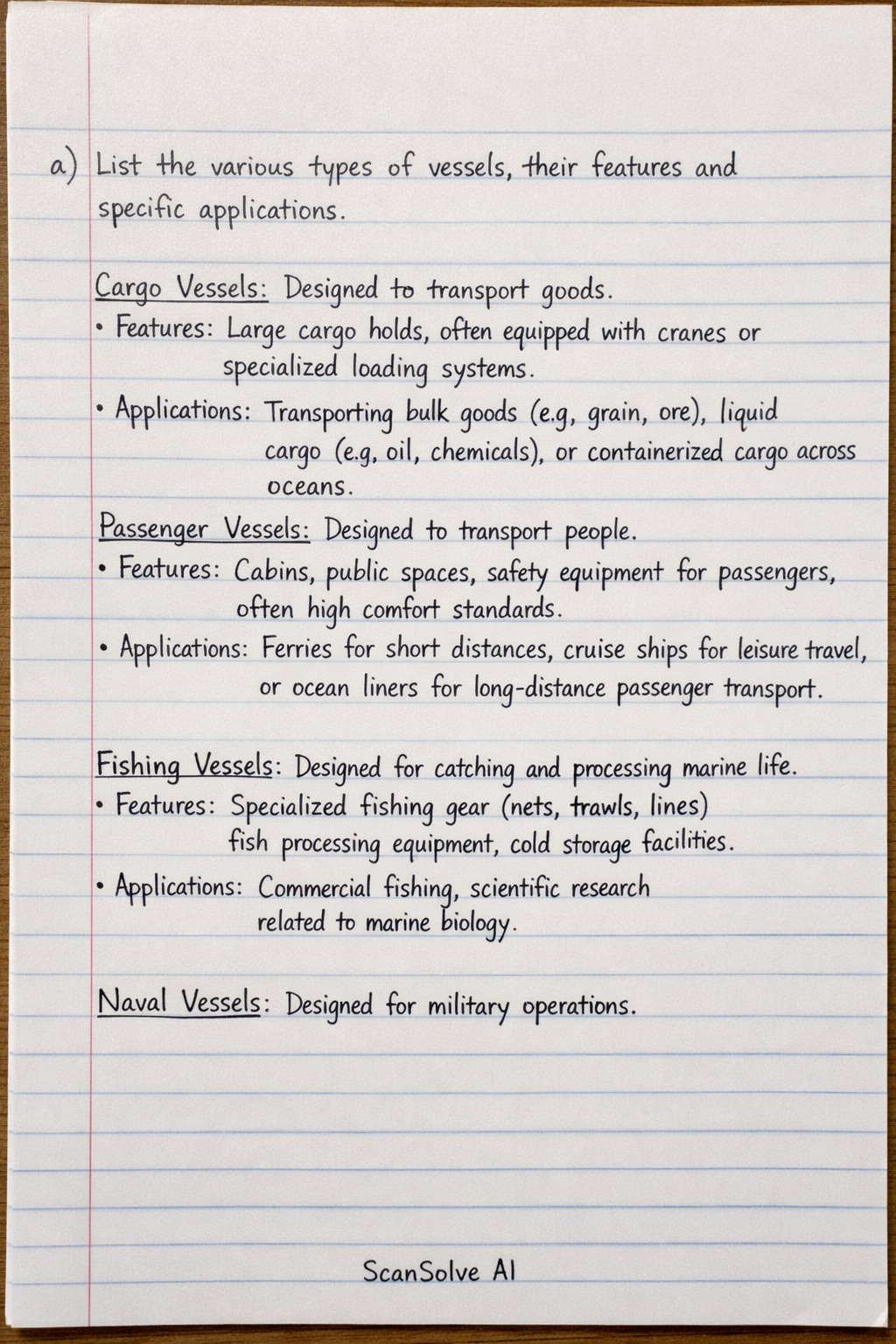
List the various types of vessels, their features and specific applications.
Business/Management
ScanSolve AI Answer
a) List the various types of vessels, their features and specific applications.
- Cargo Vessels: Designed to transport goods.
- Features: Large cargo holds, often equipped with cranes or specialized loading systems.
- Applications: Transporting bulk goods (e.g., grain, ore), liquid cargo (e.g., oil, chemicals), or containerized cargo across oceans.
- Passenger Vessels: Designed to transport people.
- Features: Cabins, public spaces, safety equipment for passengers, often high comfort standards.
- Applications: Ferries for short distances, cruise ships for leisure travel, or ocean liners for long-distance passenger transport.
- Fishing Vessels: Designed for catching and processing marine life.
- Features: Specialized fishing gear (nets, trawls, lines), fish processing equipment, cold storage facilities.
- Applications: Commercial fishing, scientific research related to marine biology.
- Naval Vessels: Designed for military operations.
- Features: Armament, advanced navigation and communication systems, high speed, stealth capabilities.
- Applications: Defense, patrol, combat, humanitarian aid, and power projection.
- Tugs: Small, powerful vessels.
- Features: High power-to-size ratio, strong towing winches, robust construction.
- Applications: Assisting larger vessels in ports, towing barges, salvage operations.
b) State the features and applications of different containers.
- Standard Dry Containers:
- Features: Enclosed, weather-tight, made of steel or aluminum, available in standard lengths (e.g., 20ft, 40ft).
- Applications: Transporting general cargo that does not require temperature control, such as electronics, textiles, and manufactured goods.
- Refrigerated Containers (Reefers):
- Features: Insulated, equipped with a refrigeration unit to maintain specific temperatures (frozen or chilled).
- Applications: Transporting perishable goods like fruits, vegetables, meat, dairy products, and pharmaceuticals.
- Open Top Containers:
- Features: No rigid roof, covered by a tarpaulin, allowing for loading from the top.
- Applications: Transporting oversized cargo or cargo that cannot be loaded through end doors, such as machinery, timber, or heavy equipment.
- Flat Rack Containers:
- Features: No side walls or roof, sometimes with collapsible end walls, forming a flat base.
- Applications: Transporting oversized, heavy, or irregularly shaped cargo like vehicles, large pipes, or construction materials.
- Tank Containers (Tanktainers):
- Features: A cylindrical tank mounted within a standard frame, designed to carry liquids or gases.
- Applications: Transporting bulk liquids (e.g., chemicals, oils, food-grade liquids) and gases safely.
c) List the special vessels and offshore servicing units and explain what you know about high-speed craft.
-
Special Vessels:
- Cable-laying vessels: Used for laying and repairing submarine communication and power cables.
- Dredgers: Used for excavating and removing sediment from seabeds to maintain or create navigable channels.
- Research vessels: Equipped for scientific studies of the ocean, marine life, and seabed.
- Icebreakers: Designed to break through ice to create navigable paths for other vessels.
- Heavy-lift vessels: Capable of transporting extremely large and heavy cargo, such as oil rigs or large modules.
-
Offshore Servicing Units:
- Anchor Handling Tug Supply (AHTS) vessels: Used for handling anchors for drilling rigs, towing, and supplying offshore platforms.
- Platform Supply Vessels (PSVs): Transport supplies, equipment, and personnel to offshore oil and gas platforms.
- Diving Support Vessels (DSVs): Provide support for underwater diving operations, often equipped with saturation diving systems.
- Offshore Construction Vessels (OCVs): Used for the installation and maintenance of offshore structures.
- Floating Production Storage and Offloading (FPSO) units: Process, store, and offload oil and gas produced from subsea wells.
-
High-Speed Craft (HSC):
- High-Speed Craft are vessels capable of operating at high speeds, typically defined by specific regulations (e.g., IMO HSC Code) or a high speed-to-length ratio. They are designed to achieve significantly higher speeds than conventional displacement vessels.
- Features: They often employ lightweight construction materials (like aluminum alloys or composite materials) and advanced hull forms such as catamarans, trimarans, hydrofoils, or air-cushion vehicles (hovercraft) to reduce hydrodynamic resistance. They are powered by powerful engines, often gas turbines or high-output diesel engines.
- Applications: HSCs are commonly used as fast ferries for passenger transport, patrol boats for maritime security, military craft for rapid deployment, and search and rescue vessels where quick response times are critical. Their design prioritizes speed and efficiency at high velocities, often at the expense of cargo capacity or heavy-weather performance compared to conventional ships.
Was this helpful?
Still stuck on this one?
Ask a follow-up, and the answer starts from this question.
Got a different question?Ask your own question
More Business/Management Questions
QClassify different types of vessels based on their design, features, and applications.QDescribe the features and applications of five different types of ships.QDifferent types of tubes use for blood collection, their content and functionQExplain the structure and function of arteries and veins, the role of valves, the detection of…QThe student was asked to identify blood vessels based on their function, factors affecting enzyme…
Handwritten Step-by-Step Solution
Get this as a handwritten image on WhatsApp — like a tutor wrote it for you.
Try on WhatsApp