
We read your photo as:
Match Column A with Column B: 1.1 Voluntary hours, 1.2 Take-home pay, 1.3 Employer pension contribution, 1.4 Employee pension deduction, 1.5 Total employee cost, 1.6 Standard hours.
ScanSolve AI Answer
Here are the matches for Column A with Column B:
-
1.1 The number of hours that is voluntary and must be agreed upon by both employer and employee. This describes work done beyond regular hours, requiring mutual agreement.
-
1.2 The amount the employee earns after all deductions have been made. This is the take-home pay after all withholdings.
-
1.3 The amount the business pays over to the Pension Fund and is additional expense to the business. This is the employer's portion of the pension fund payment.
-
1.4 The amount that the business deducts from the Gross Salaries of employees and pays it over to the Pension Fund. This is the employee's portion of the pension fund, withheld from their gross pay.
-
1.5 Gross salary/wages plus employers contributions. This represents the total cost an employer incurs for an employee, including their gross pay and additional benefits.
-
1.6 Number of working hours/days stipulated in the employee's contract. These are the standard, agreed-upon working hours.
-
1.7 The direct expense to the business for employing staff. This is the overall cost incurred by the business for its employees.
Note: Option A (Gross Salary) is not used in this matching exercise, and Option G (Cost to Company) is used for both 1.5 and 1.7 as both statements accurately define aspects of Cost to Company.
Still stuck on this one?
Ask a follow-up, and the answer starts from this question.
More Business/Management Questions
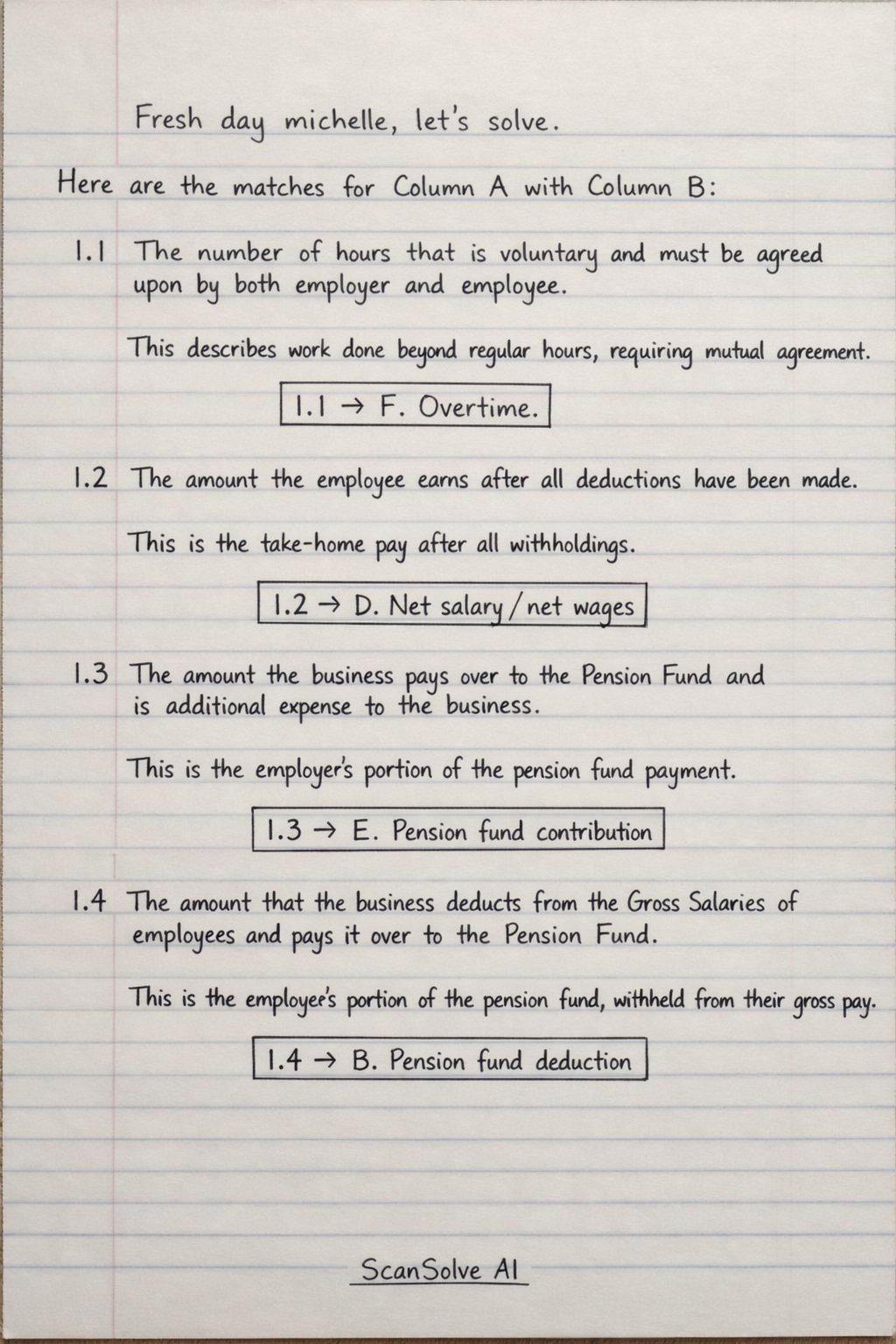
Handwritten Step-by-Step Solution
Get this as a handwritten image on WhatsApp — like a tutor wrote it for you.
Try on WhatsApp