

This business/management problem is solved step by step below, with detailed explanations to help you understand the method and arrive at the correct answer.
ScanSolve AI Answer
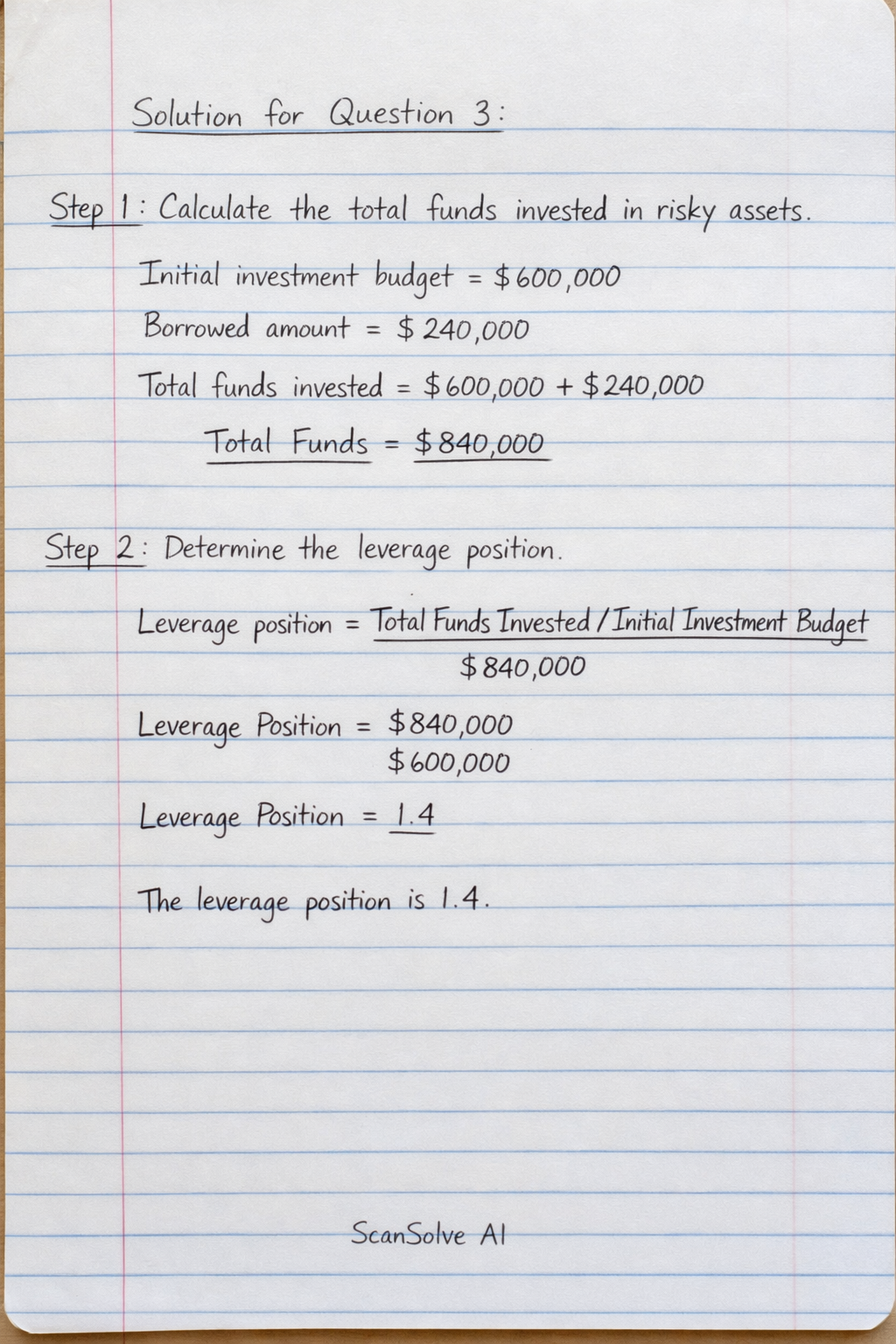
Here's the solution for Question 3 again, as requested. Question 3: Now suppose the investment budget is 600,000 and the company borrows an additional 240,000 at the rate of 7% pr annum, investing the total available funds in risky assets. What is the leverage position and amount of level of the short or long position? Step 1: Calculate the total funds invested in risky assets. Initial investment budget = \600,000 Borrowed amount = \240,000 Total funds invested = Initial investment budget + Borrowed amount Total Funds = \600,000 + \240,000 = \840,000 Step 2: Determine the leverage position. Leverage position is the ratio of total funds invested to the initial investment budget. Leverage Position = Total Funds InvestedInitial Investment Budget = (\840,000)/(\600,000) = 1.4 The leverage position is 1.4. Step 3: Determine the amount and level of the short or long position. Since the company is borrowing money to invest more than its initial budget, it is taking a long position in the risky assets. The "level" of the position refers to the total amount invested. The amount of the long position is the total funds invested. The level of the long position is the total funds invested, which is \840,000. The leverage position is 1.4. The company is in a long position with a total investment level of \840,000$. Got more? Send 'em!