
We read your photo as:
Please answer the following questions about competition law and mergers in South Africa: 1.1 Name a store acquired by Shoprite. 1.2 Describe the role of the Competition Tribunal. 1.3 Define market dom
ScanSolve AI Answer
Here are the answers to your questions:
1.1
One store that operated under Massmart Holding Limited and was acquired by Shoprite is Cambridge Food.
1.2
The role of the Competition Tribunal is to adjudicate competition matters in South Africa. This includes approving or prohibiting mergers, hearing appeals against decisions of the Competition Commission, and imposing penalties for anti-competitive conduct to ensure fair competition in the market.
1.3
Market dominance refers to a situation where a single firm or a small group of firms possesses significant control over a particular market. This allows them to influence prices, output, and other market conditions without facing effective competition from rivals.
1.4
This merger can affect consumers in several ways:
- Potential negative effects: Reduced competition might lead to higher prices, fewer product choices, and potentially lower quality goods or services as the merged entity faces less pressure to compete.
- Potential positive effects: The merger could lead to economies of scale, which might result in lower operating costs. These savings could, in some cases, be passed on to consumers through lower prices or improved efficiency in distribution and product availability. The Competition Tribunal's conditions aim to mitigate negative impacts.
1.4
The benefits of competition in the economy include:
- Lower Prices: Firms compete to offer the best value, driving down prices for consumers.
- Increased Choice: Companies differentiate their products and services to attract customers, leading to a wider variety of options.
- Improved Quality: Competition incentivizes firms to enhance the quality of their offerings to gain a competitive edge.
- Innovation: Businesses are driven to innovate and develop new products, services, and processes to stay ahead of rivals.
- Efficiency: Firms must operate efficiently to remain competitive, leading to better resource allocation and productivity.
- Economic Growth: Competition fosters a dynamic business environment, encouraging investment and contributing to overall economic expansion.
1.5
Evaluating the success of South Africa's competition policy involves considering both its achievements and challenges:
- Successes: The Competition Commission and Tribunal have actively intervened in numerous mergers and anti-competitive practices, such as cartels and abuse of dominance. This has helped to promote fair competition, protect consumer welfare, and prevent excessive concentration of economic power in various sectors. The policy aims to ensure equitable access to markets and foster economic efficiency.
- Challenges: Despite these efforts, enforcement can sometimes be slow and costly. Certain sectors of the South African economy remain highly concentrated, indicating that market power issues persist. The policy's full impact on broader socio-economic goals, such as reducing poverty and inequality, is also a subject of ongoing debate, as its effectiveness can be limited by structural economic factors.
Still stuck on this one?
Ask a follow-up, and the answer starts from this question.
More Business/Management Questions
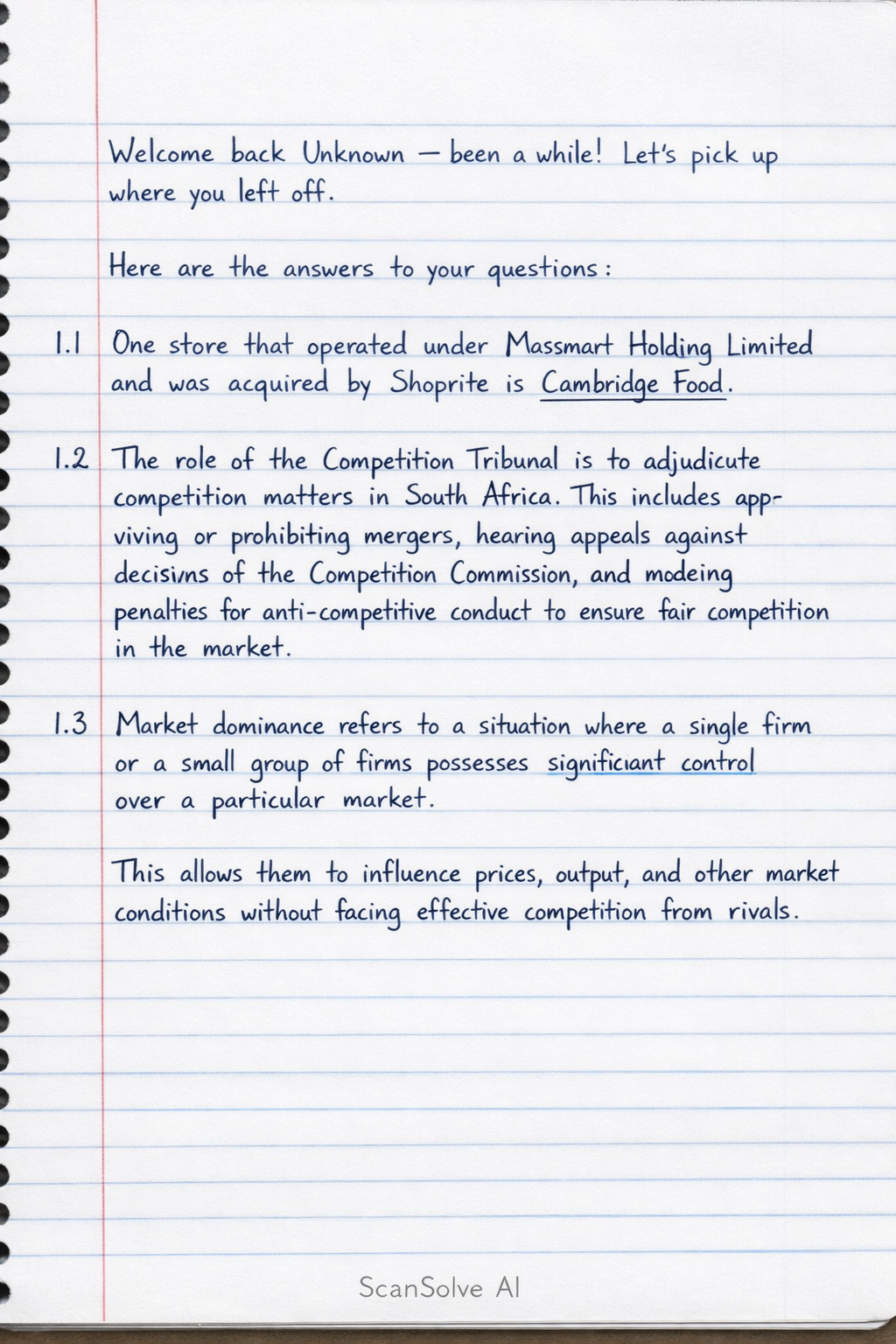
Handwritten Step-by-Step Solution
Get this as a handwritten image on WhatsApp — like a tutor wrote it for you.
Try on WhatsApp