
We read your photo as:
Explain the role of the competition commission, describe cartel, and identify retail giants suspected of anti-competitive behaviour in South Africa.
ScanSolve AI Answer
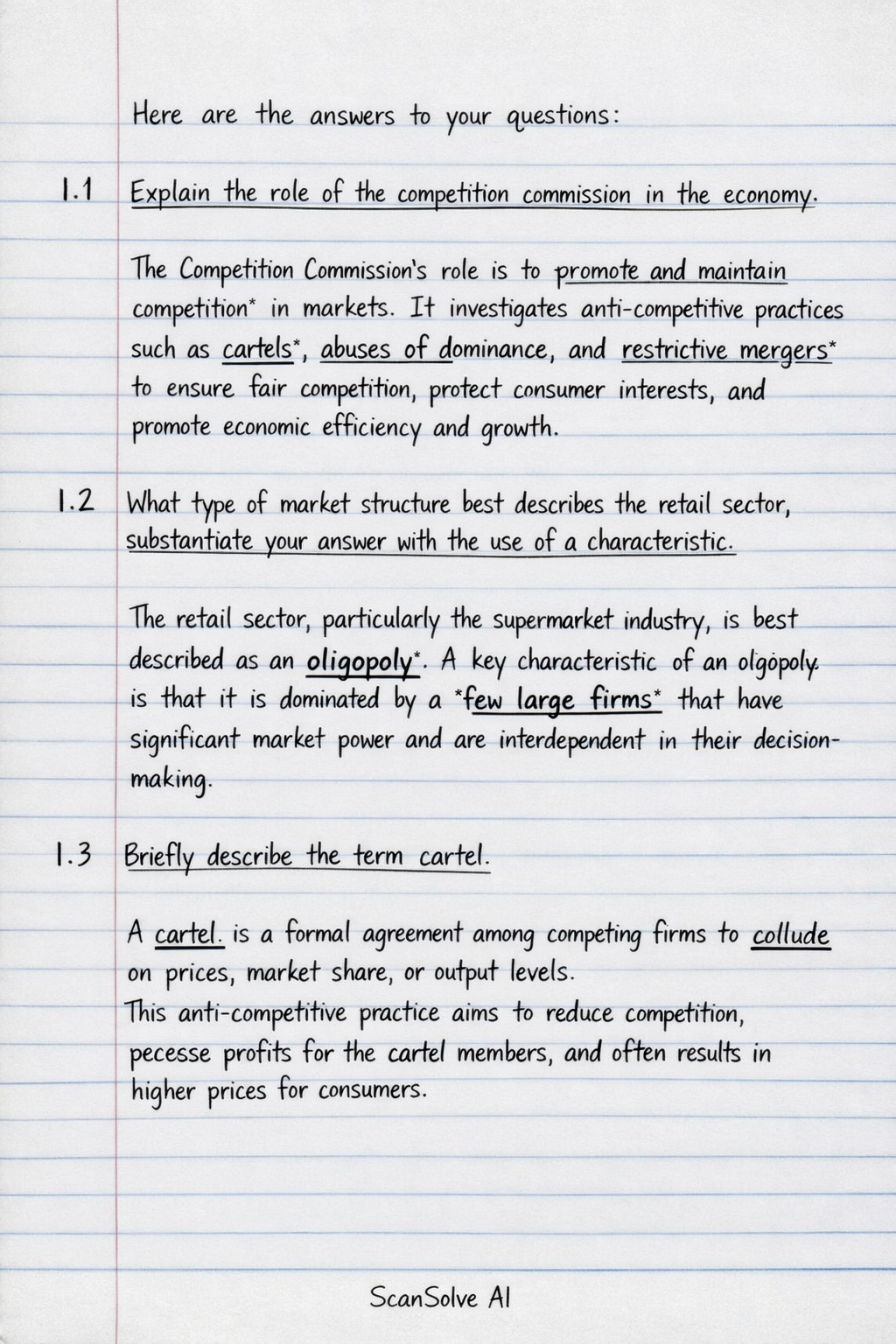
Here are the answers to your questions:
1.1 Explain the role of the competition commission in the economy.
The Competition Commission's role is to promote and maintain competition in markets. It investigates anti-competitive practices such as cartels, abuses of dominance, and restrictive mergers to ensure fair competition, protect consumer interests, and promote economic efficiency and growth.
1.2 What type of market structure best describes the retail sector, substantiate your answer with the use of a characteristic.
The retail sector, particularly the supermarket industry, is best described as an oligopoly. A key characteristic of an oligopoly is that it is dominated by a few large firms that have significant market power and are interdependent in their decision-making.
1.3 Briefly describe the term cartel.
A cartel is a formal agreement among competing firms to collude on prices, market share, or output levels. This anti-competitive practice aims to reduce competition, increase profits for the cartel members, and often results in higher prices for consumers.
1.4 According to your research, what are the retail giants that are suspected of anti-competitive behaviour?
Based on various reports and investigations by the South African Competition Commission, retail giants such as Shoprite, Pick n Pay, Spar, and Woolworths have been suspected of anti-competitive behaviour, particularly concerning supplier agreements and pricing practices in the food market.
1.5 How do practices like price fixing contribute to food insecurity for the household?
Price fixing directly contributes to food insecurity by artificially inflating the prices of essential food items. This means that households, especially those with low incomes, have to spend a larger proportion of their budget on food, leaving less for other necessities. Higher food prices reduce the purchasing power of households, making nutritious food less affordable and accessible. Consequently, families may be forced to buy cheaper, less nutritious alternatives, leading to malnutrition and poorer health outcomes. For the most vulnerable households, price fixing can push food completely out of reach, exacerbating hunger and deepening poverty, thereby increasing overall food insecurity.
1.6 Analyse strategies that can be used by retailers to increase their market share in the economy.
Retailers employ various strategies to increase their market share. One common approach is competitive pricing, where they offer lower prices, discounts, or promotions to attract price-sensitive customers. Another strategy is product differentiation, which involves offering unique products, superior quality, or a wider variety of goods to stand out from competitors. Extensive marketing and advertising campaigns are crucial for building brand awareness and customer loyalty. Improving customer service and creating a positive shopping experience can also retain existing customers and attract new ones through word-of-mouth. Retailers may also pursue geographic expansion by opening new stores in underserved areas or expanding their online presence through e-commerce platforms. Furthermore, mergers and acquisitions allow retailers to quickly gain market share by acquiring smaller competitors. Finally, implementing loyalty programs and innovating with new technologies (e.g., self-checkout, delivery services) can enhance customer engagement and convenience, thereby increasing market share.
Still stuck on this one?
Ask a follow-up, and the answer starts from this question.
More Economics Questions
Handwritten Step-by-Step Solution
Get this as a handwritten image on WhatsApp — like a tutor wrote it for you.
Try on WhatsApp