
We read your photo as:
Define organisational structure and explain its importance. Also, define void, voidable, misrepresentation, implied terms, and express terms in contract law.
ScanSolve AI Answer
here are the answers from the image:
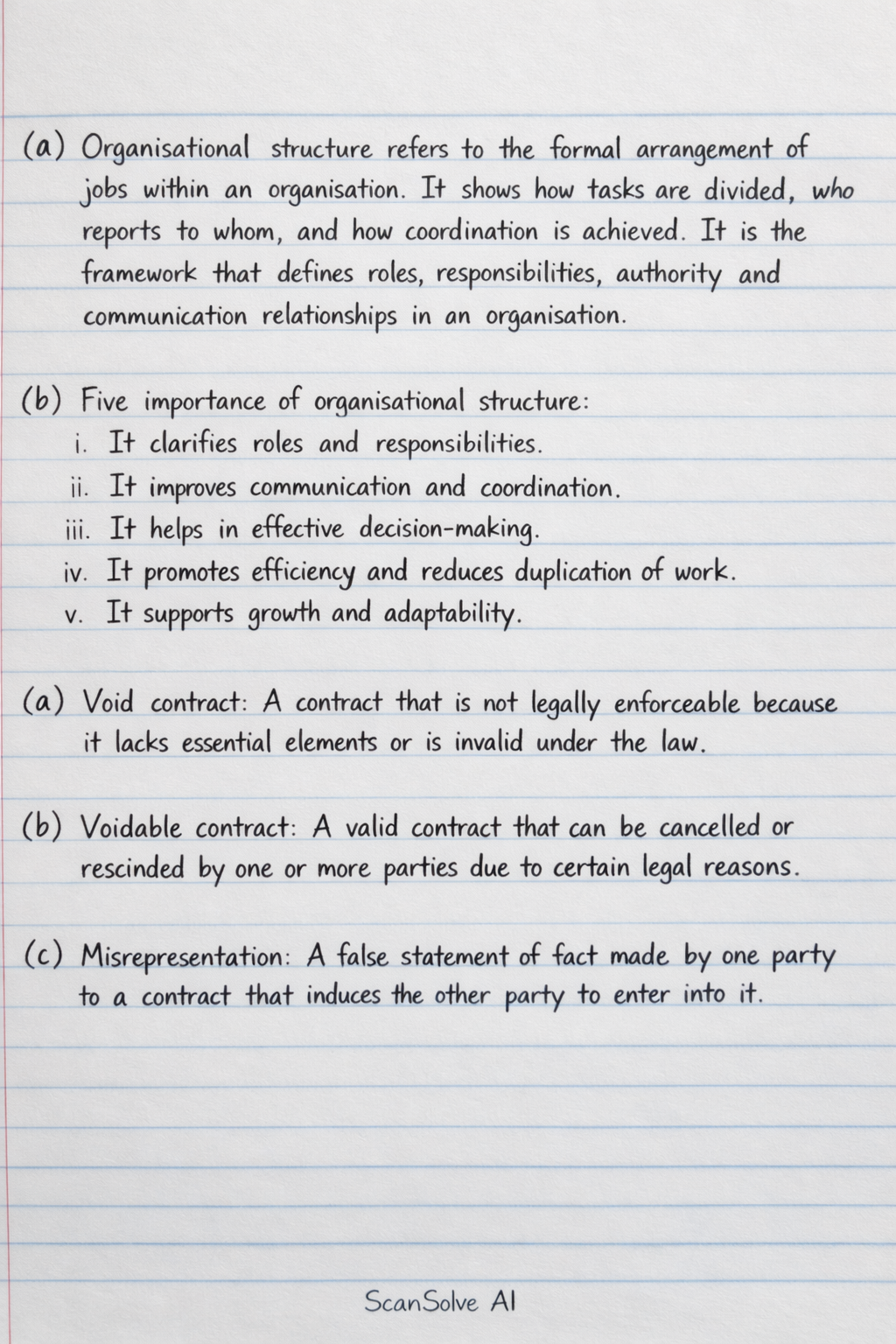
2. (a) Organisational structure refers to the formal arrangement of jobs within an organisation. It shows how tasks are divided, who reports to whom, and how coordination is achieved. It is the framework that defines roles, responsibilities, authority and communication relationships in an organisation.
2. (b) Five importance of organisational structure:
i. It clarifies roles and responsibilities.
ii. It improves communication and coordination.
iii. It helps in effective decision-making.
iv. It promotes efficiency and reduces duplication of work.
v. It supports growth and adaptability.
3. (a) Void contract: A contract that is not legally enforceable because it lacks essential elements or is invalid under the law.
3. (b) Voidable contract: A valid contract that can be cancelled or rescinded by one or more parties due to certain legal reasons.
3. (c) Misrepresentation: A false statement of fact made by one party to a contract that induces the other party to enter into it.
3. (d) Implied terms: Terms that are not expressly stated in a contract but are considered to be included by law or based on the nature of the contract.
3. (e) Express terms: Terms that are clearly and explicitly stated in the contract by the parties.
4. (a) A tax is a compulsory levy imposed by the government on individuals or organisations to raise revenue for public purposes.
4. (b) Four problems in tax collection:
i. Tax evasion and avoidance.
ii. Lack of adequate records and information.
iii. High cost of tax collection.
iv. Corruption and inefficiency among tax officials.
5. (a) A small business is a business enterprise that is independently owned and operated, employs a small number of people and has limited financial resources.
5. (b) Four reasons for the growth of small-scale businesses in developing economies:
i. They require low capital and are easy to start.
ii. They create employment opportunities.
iii. They utilise local resources and raw materials.
iv. They contribute to economic growth and income distribution.
6. (a) Promotion in marketing refers to the activities used to inform, persuade and remind customers about a product with the aim of increasing sales.
6. (b) Six importance of promoting a product:
i. It creates awareness about the product.
ii. It stimulates demand and increases sales.
iii. It differentiates the product from competitors.
iv. It builds and maintains customer loyalty.
v. It provides information about product features and benefits.
vi. It supports the introduction of new products.
7. Differences between a private limited company and a public limited company:
| Private Limited Company | Public Limited Company |
|---|---|
| i. Membership is limited to a maximum of 50 members. | i. Membership is not limited. |
| ii. Shares cannot be offered to the public. | ii. Shares can be offered to the public. |
| iii. Transfer of shares is restricted. | iii. Transfer of shares is freely allowed. |
| iv. Minimum capital is relatively lower. | iv. Minimum capital is relatively higher. |
| v. Prospectus is not required. | v. Prospectus is required. |
8. (a) A computer is an electronic device that accepts data as input, processes it according to instructions, stores it and produces information as output.
8. (b) Six uses of computers in business organisations:
i. Data processing and record keeping.
ii. Accounting and financial management.
iii. Communication (e-mail, internet, video conferencing).
iv. Inventory and stock control.
v. Marketing and sales analysis.
vi. Decision making and management information systems.
Still stuck on this one?
Ask a follow-up, and the answer starts from this question.
More Business/Management Questions
Handwritten Step-by-Step Solution
Get this as a handwritten image on WhatsApp — like a tutor wrote it for you.
Try on WhatsApp