
We read your photo as:
Explain organisational structure, organisational chart, void contract, and voidable contract. Discuss the importance of organisational structure.
ScanSolve AI Answer
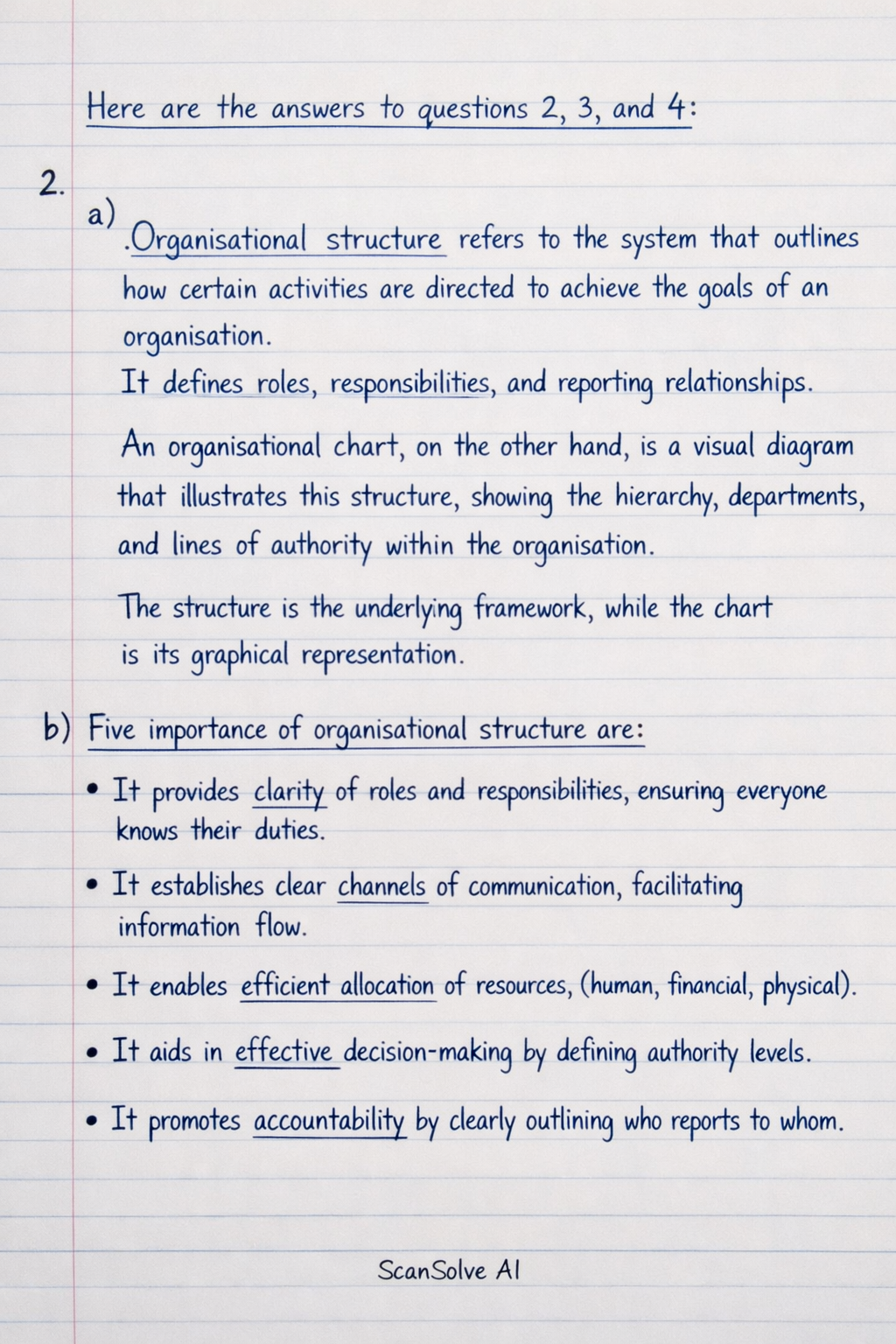
Here are the answers to questions 2, 3, and 4:
2.
a) Organisational structure refers to the system that outlines how certain activities are directed to achieve the goals of an organization. It defines roles, responsibilities, and reporting relationships. An organisational chart, on the other hand, is a visual diagram that illustrates this structure, showing the hierarchy, departments, and lines of authority within the organization. The structure is the underlying framework, while the chart is its graphical representation.
b) Five importance of organisational structure are:
- It provides clarity of roles and responsibilities, ensuring everyone knows their duties.
- It establishes clear channels of communication, facilitating information flow.
- It enables efficient allocation of resources (human, financial, physical).
- It aids in effective decision-making by defining authority levels.
- It promotes accountability by clearly outlining who reports to whom.
3.
a) A void contract is a contract that is invalid from its inception and cannot be enforced by law. It lacks one or more essential elements required for a valid contract, such as legality or capacity.
b) A voidable contract is a contract that is initially valid but can be legally cancelled or rejected by one or both parties due to a defect, such as fraud, duress, or misrepresentation.
c) Misrepresentation occurs when one party makes a false statement of a material fact to another party, which induces the other party to enter into a contract.
d) Implied terms are terms that are not explicitly stated in a contract but are understood to be part of it, either by law, custom, or the conduct of the parties involved.
e) Express terms are terms that are clearly and explicitly stated, either orally or in writing, by the parties when forming a contract.
4.
a) A tax is a compulsory financial charge or other levy imposed on a taxpayer by a governmental organization to fund public expenditures and government operations.
b) Four problems in tax collection are:
- Tax Evasion and Avoidance: Many individuals and businesses illegally avoid paying taxes or legally minimize their tax liability, leading to significant revenue loss for the government.
- Corruption: Misappropriation of collected tax funds by officials can undermine public trust and reduce the actual revenue available for public services.
- High Cost of Collection: The administrative expenses involved in collecting taxes, including staffing, technology, and enforcement, can be substantial, especially in economies with large informal sectors.
- Lack of Public Awareness: Many taxpayers may not fully understand their tax obligations, the importance of paying taxes, or how the tax system works, leading to non-compliance.
Still stuck on this one?
Ask a follow-up, and the answer starts from this question.
More Business/Management Questions
Handwritten Step-by-Step Solution
Get this as a handwritten image on WhatsApp — like a tutor wrote it for you.
Try on WhatsApp