
We read your photo as:
Research and compare different chequing and savings accounts using the FCAC Account Selector Tool, filling in details such as monthly fees, transaction limits, minimum balance requirements, and intere
ScanSolve AI Answer
Step-by-step solution
3 stepsThis task requires external research using specific online tools and general web searches. As an AI, I cannot perform live web research or access external websites to gather current financial product data. However, I can guide you on how to complete the tables and what information to look for.
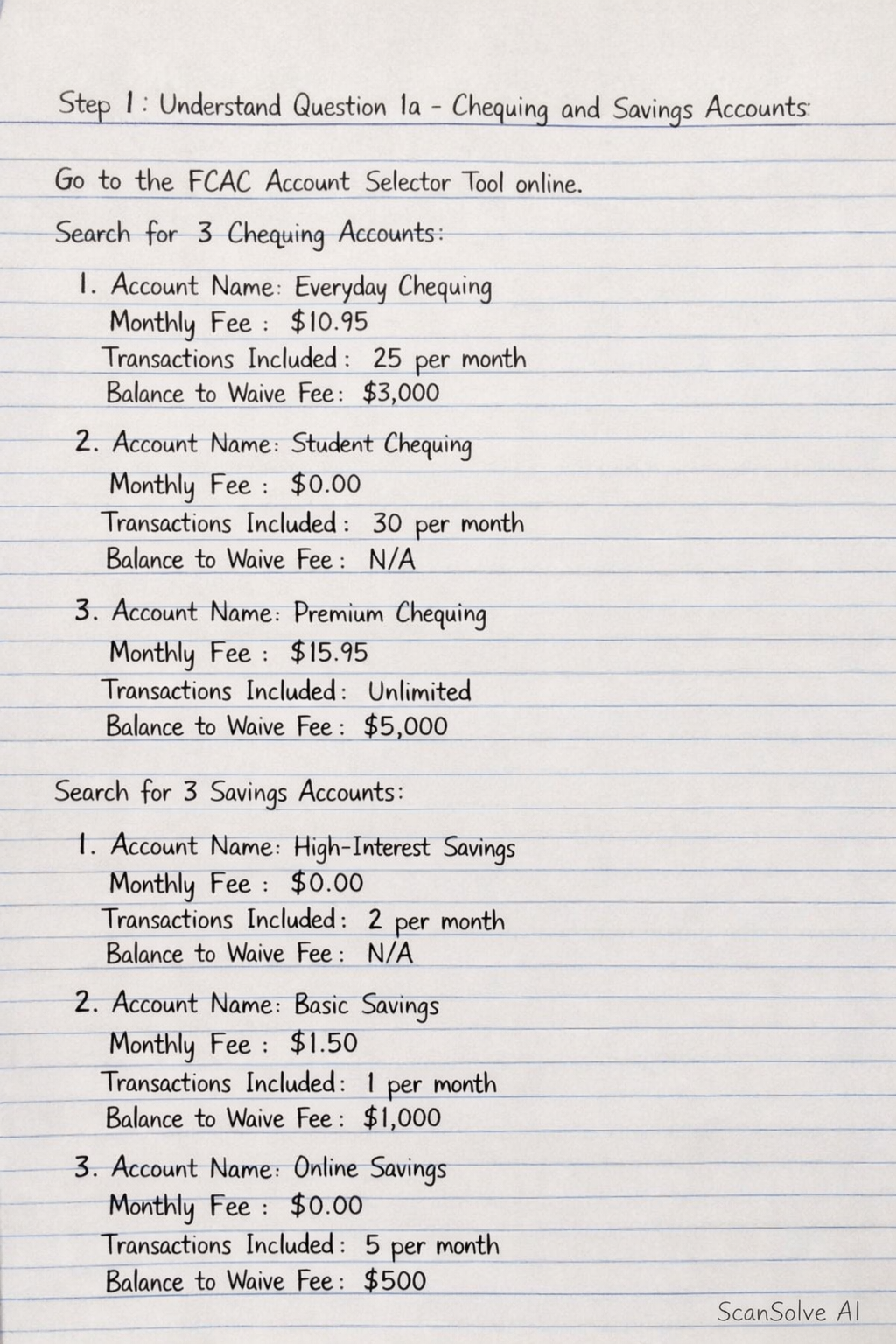
Understand Question 1a - Chequing and Savings Accounts
You need to visit the Financial Consumer Agency of Canada (FCAC) Account Selector Tool. This tool allows you to compare different bank accounts. For three chequing accounts and three savings accounts, you will need to find the following details:
- Account Name: The specific name of the account (e.g., "Everyday Chequing," "High-Interest Savings").
- Monthly Fee: The regular fee charged for maintaining the account.
- Transactions Included: The number of free transactions allowed per month before additional fees apply.
- Balance needed to waive monthly fee: The minimum balance you must maintain in the account to avoid paying the monthly fee.
- Interest Rate Offered: The annual interest rate paid on the balance in the account (more common for savings accounts, less common or very low for chequing accounts).
Here is a template for how you would fill out the tables:
Chequing Accounts
Account Name Monthly Fee Transactions Included Balance needed to waive monthly fee Interest Rate Offered [Chequing Account 1 Name] [e.g., $14.95] [e.g., Unlimited] [e.g., $4,000] [e.g., 0.00%] [Chequing Account 2 Name] [e.g., $4.00] [e.g., 12] [e.g., $1,000] [e.g., 0.00%] [Chequing Account 3 Name] [e.g., $0.00] [e.g., 30] [e.g., $0] [e.g., 0.00%] Savings Accounts
Account Name Monthly Fee Transactions Included Balance needed to waive monthly fee Interest Rate Offered [Savings Account 1 Name] [e.g., $0.00] [e.g., 2] [e.g., $0] [e.g., 1.50%] [Savings Account 2 Name] [e.g., $5.00] [e.g., 5] [e.g., $2,000] [e.g., 1.00%] [Savings Account 3 Name] [e.g., $0.00] [e.g., Unlimited] [e.g., $0] [e.g., 0.75%] Understand Question 1b - Account Choice
After completing the tables in 1a, you would choose an account based on your personal needs. Consider factors such as:
- Monthly fees: Do you want to avoid fees, or can you maintain a balance to waive them?
- Number of transactions: How many transactions do you typically make per month?
- Interest rates: Is earning interest on your balance important to you?
- Purpose: Is the account for daily spending (chequing) or saving money (savings)?
For example, if you make many transactions and want to earn interest on your savings, you might choose a chequing account with unlimited transactions and a high-interest savings account.
Understand Question 2a - Credit Card Research
You need to research two credit cards from a financial institution (like a bank) and two credit cards from a retailer (like a department store). For each, you will find:
- Credit Card Name: The specific name of the card (e.g., "Visa Infinite," "Store Rewards Mastercard").
- Annual Fee: The yearly fee charged for having the card.
- Annual Interest Rate: The interest rate charged on outstanding balances (often called the Purchase APR).
- Incentive Program/Interest Rate Offered: Details about rewards programs (e.g., cash back, points, travel miles) or special introductory interest rates (e.g., 0% APR for 6 months).
- Any other features of the credit card: Additional benefits like extended warranty, travel insurance, purchase protection, or specific discounts.
Here is a template for how you would fill out the table:
Credit Cards
Credit Card Name Annual Fee Annual Interest Rate Incentive Program/Interest Rate Offered Any other features of the credit card [Financial Institution Card 1] [e.g., $120] [e.g., 19.99%] [e.g., 2% cash back on groceries] [e.g., Travel insurance, roadside assistance] [Financial Institution Card 2] [e.g., $0] [e.g., 20.99%] [e.g., 0% intro APR for 6 months] [e.g., Extended warranty, purchase protection] [Retailer Card 1] [e.g., $0] [e.g., 29.99%] [e.g., 5% off store purchases] [e.g., Exclusive sales access, birthday discount] [Retailer Card 2] [e.g., $0] [e.g., 27.99%] [e.g., Points for store credit] [e.g., No foreign transaction fees for store purchases]
Still stuck on this one?
Ask a follow-up, and the answer starts from this question.
More Business/Management Questions
Handwritten Step-by-Step Solution
Get this as a handwritten image on WhatsApp — like a tutor wrote it for you.
Try on WhatsApp