
We read your photo as:
Sketch four standard symbols for cold/hot water supply systems and state four types of pipe materials a plumber uses.
Business/Management
ScanSolve AI Answer
SECTION A
1. A plumber is preparing working drawing for a project. Sketch four standard symbols that can be included in the drawings of cold/hot water supply systems (2 marks)
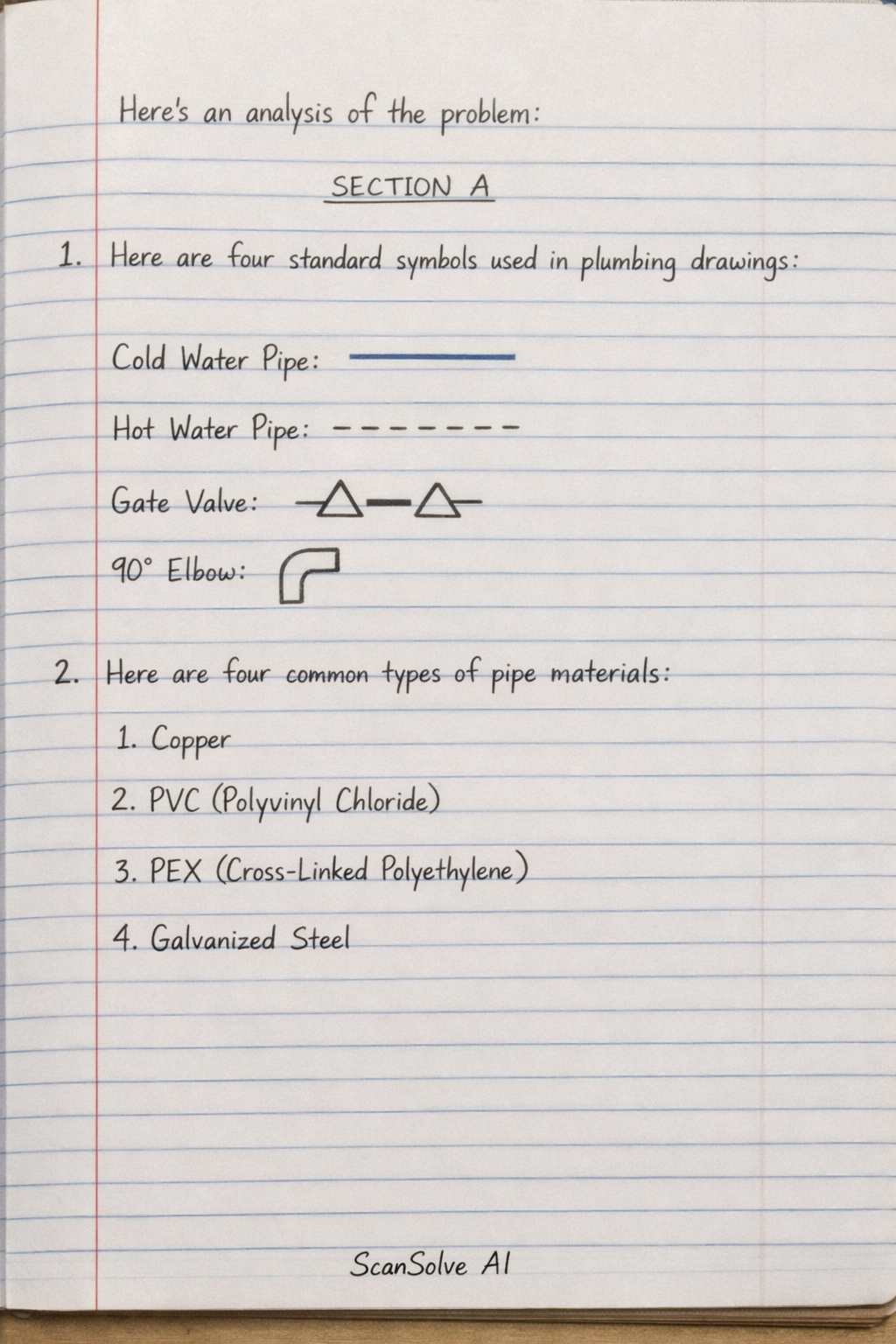
Here are four standard symbols used in plumbing drawings:
- Cold Water Pipe: A single solid line (often blue in color drawings).
- Hot Water Pipe: A single dashed line (often red in color drawings).
- Gate Valve: A symbol resembling a triangle with a line through its apex, or two triangles pointing towards each other with a line in between.
- 90-degree Elbow: A curved line representing the bend in the pipe.
2. Pipes are commonly used in plumbing industry. State four types of material used in manufacturing of pipes that a plumber is likely to use. (2 marks)
Here are four common types of pipe materials:
- Copper: Durable, corrosion-resistant, and commonly used for water supply lines.
- PVC (Polyvinyl Chloride): Lightweight, inexpensive, and often used for drainage, waste, and vent (DWV) systems, and sometimes cold water supply.
- PEX (Cross-linked Polyethylene): Flexible, easy to install, and widely used for both hot and cold water supply lines.
- Galvanized Steel: Steel pipes coated with zinc to prevent rust, historically used for water supply but less common now due to corrosion issues over time.
3. Correct handling of tools enhances safety during installation exercise. State four practices associated with maintaining pipe work tools (2 marks).
Here are four practices for maintaining pipework tools:
- Cleaning: Always clean tools thoroughly after each use to remove dirt, grease, and debris.
- Storage: Store tools in a dry, organized manner, such as in a toolbox or on a tool rack, to prevent damage and corrosion.
- Inspection: Regularly inspect tools for wear, damage, or defects before and after use, replacing or repairing them as needed.
- Lubrication: Apply appropriate lubricants to moving parts of tools (e.g., pipe threaders, adjustable wrenches) to ensure smooth operation and prevent rust.
4. A plumber is assigned to install a simple domestic pipework system. State four factors to be considered to ensure correct installation of the pipework system. (2 marks)
Here are four factors for correct pipework installation:
- Adherence to Codes: Ensure all work complies with local plumbing codes and building regulations.
- Pipe Sizing: Select appropriate pipe diameters to ensure adequate water flow and pressure to all fixtures.
- Proper Support: Install adequate hangers and supports to prevent sagging, stress on joints, and vibration.
- Jointing Techniques: Use correct and secure jointing methods (e.g., soldering, solvent welding, crimping) appropriate for the pipe material and application.
5. A small house has two bathrooms and a kitchen. List four reasons why flow rate calculation are important in designing a pipework system. (2 marks)
Here are four reasons why flow rate calculations are important:
- Adequate Pressure: Ensures sufficient water pressure at all fixtures, even when multiple are in use simultaneously.
- Pipe Sizing: Helps determine the correct diameter of pipes to meet the demand without excessive velocity or pressure drop.
- Preventing Water Hammer: Proper flow rate design minimizes sudden pressure changes that can cause noisy and damaging water hammer.
- System Efficiency: Optimizes the performance of water heaters and other appliances, contributing to energy efficiency and comfort.
SECTION B
6. During on site installation, a plumber encounters complex pipe routing. Explain five negative impacts of improper pipe alignment on system functionality (5 marks).
Here are five negative impacts of improper pipe alignment on system functionality:
- Reduced Flow Efficiency: Misaligned pipes create unnecessary bends and restrictions, leading to increased friction and turbulence. This reduces the overall water flow rate and pressure throughout the system, making fixtures perform poorly.
- Increased Risk of Leaks: Improper alignment places undue stress on pipe joints, fittings, and connections. This constant strain can weaken the seals and materials over time, significantly increasing the likelihood of leaks and costly water damage.
- Water Hammer and Noise: Poorly aligned pipes can contribute to erratic water flow and sudden pressure changes, resulting in water hammer. This not only creates loud banging noises but can also damage pipes, fittings, and appliances over time.
- Drainage Issues (for waste systems): In drainage, waste, and vent (DWV) systems, improper alignment can lead to incorrect pipe slopes. This causes waste to accumulate, leading to blockages, slow drainage, and potential sewage backups.
- Premature Wear and Tear on Components: When a system is improperly aligned, pumps and other components may have to work harder to move water against increased resistance. This extra strain can shorten the lifespan of these expensive components, leading to earlier replacement.
7. Material scheduling is a crucial step when preparing a bill of materials for a residential water supply system. Describe five ways cost estimation of materials affects project planning and resource management. (5 marks)
Here are five ways cost estimation of materials affects project planning and resource management:
- Budget Allocation: Accurate material cost estimation forms the foundation for setting a realistic project budget. It ensures that sufficient funds are allocated specifically for materials, preventing unexpected financial shortfalls during the project.
- Procurement Strategy: Detailed cost estimates guide the procurement process by informing decisions on purchasing quantities, supplier selection, and negotiation tactics. This allows for bulk discounts, timely ordering, and selection of cost-effective materials without compromising quality.
- Project Timeline: Precise material cost estimation helps in scheduling material deliveries. Delays in ordering due to budget uncertainties can push back the project timeline, leading to increased labor costs and missed deadlines.
- Resource Allocation (Labor and Equipment): Knowing the material costs allows project managers to better allocate funds for other critical resources like labor and equipment. It ensures that all necessary resources are available when materials arrive, optimizing workflow and efficiency.
- Risk Management: Identifying potential material cost overruns early through accurate estimation enables proactive risk management. Contingency plans can be developed, and alternative materials or suppliers can be considered to mitigate financial risks and keep the project on track.
Was this helpful?
Still stuck on this one?
Ask a follow-up, and the answer starts from this question.
Got a different question?Ask your own question
More Business/Management Questions
QWhat are three types of working drawings used in plumbing, two types of pipe joints, and the…QDefine siphonage, ductile, creep, tensile strength, malleable and state two systems of domestic hot…QWhat are the key safety terms and practices in plumbing, including PVC pipe usage and hazard…QObserve and record different pipe materials (PVC, HDPE, Ductile Iron, Steel). Identify visible signs…QInterpret the pipework drawing in Figure 1, identify and quantify pipework materials, and cut and…
Handwritten Step-by-Step Solution
Get this as a handwritten image on WhatsApp — like a tutor wrote it for you.
Try on WhatsApp