
We read your photo as:
What are the key safety terms and practices in plumbing, including PVC pipe usage and hazard identification?
Business/Management
ScanSolve AI Answer
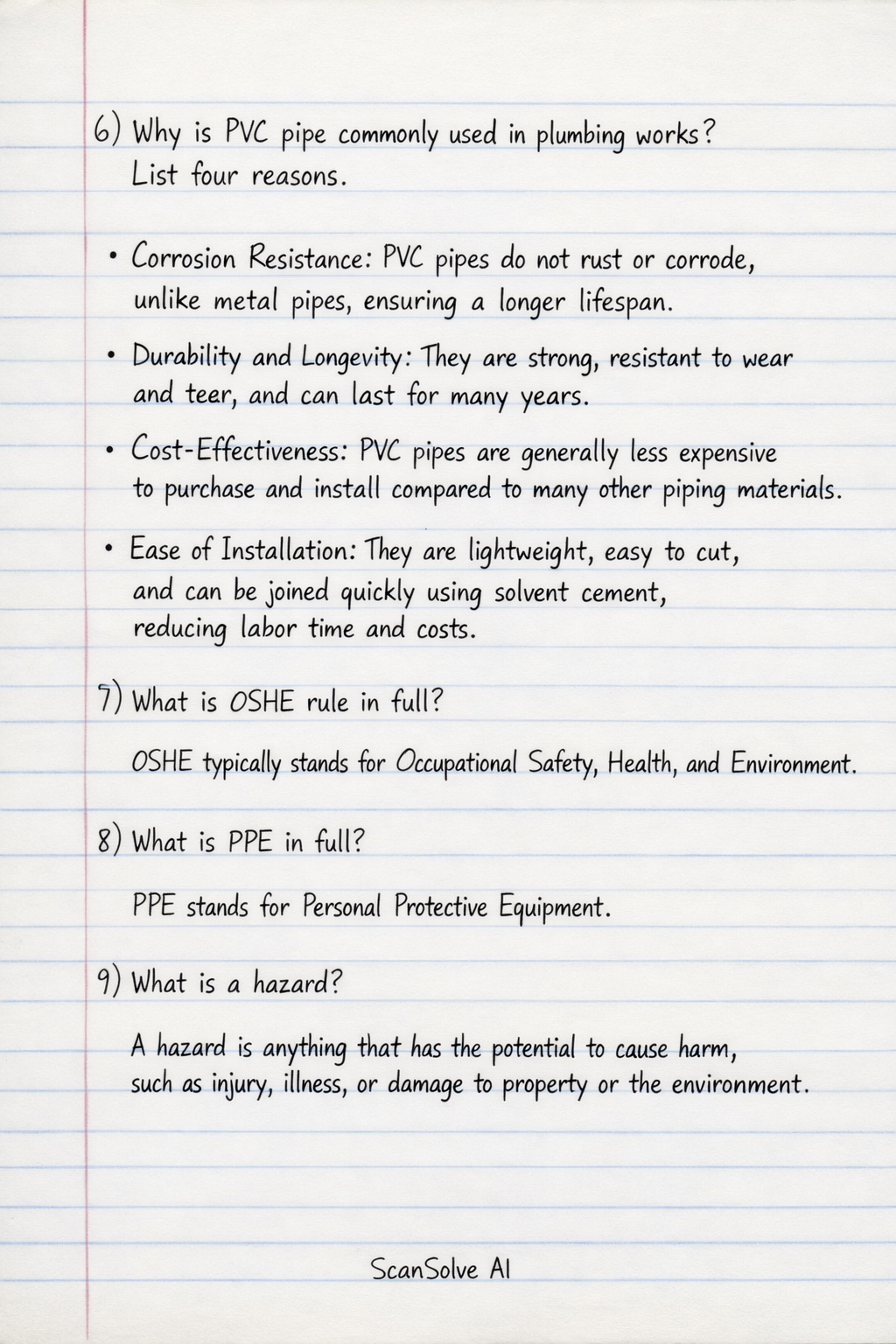
- Why is PVC pipe commonly used in plumbing works? List four reasons.
- Corrosion Resistance: PVC pipes do not rust or corrode, unlike metal pipes, ensuring a longer lifespan.
- Durability and Longevity: They are strong, resistant to wear and tear, and can last for many years.
- Cost-Effectiveness: PVC pipes are generally less expensive to purchase and install compared to many other piping materials.
- Ease of Installation: They are lightweight, easy to cut, and can be joined quickly using solvent cement, reducing labor time and costs.
-
What is OSHE rule in full? OSHE typically stands for Occupational Safety, Health, and Environment.
-
What is PPE in full? PPE stands for Personal Protective Equipment.
-
What is a hazard? A hazard is anything that has the potential to cause harm, such as injury, illness, or damage to property or the environment.
-
List examples of potential hazards in plumbing workplace/area.
- Physical hazards: Slips, trips, and falls (due to wet surfaces, tools, or uneven ground), cuts from sharp tools or pipes, burns from hot water or soldering equipment, and electrical shock.
- Chemical hazards: Exposure to solvents, glues, cleaning agents, lead from old pipes or solder, and asbestos from old insulation.
- Biological hazards: Contact with sewage, mold, bacteria, or viruses.
- Ergonomic hazards: Injuries from heavy lifting, awkward postures, or repetitive motions.
- Confined spaces: Working in poorly ventilated areas like crawl spaces or trenches, leading to oxygen deficiency or exposure to hazardous gases.
- State ways to prevent the hazards listed above.
- Physical hazards: Maintain a clean and organized workspace, use appropriate ladders and scaffolding, wear cut-resistant gloves, use insulated tools, and implement lockout/tagout procedures for electrical work.
- Chemical hazards: Use chemicals in well-ventilated areas, wear appropriate PPE (gloves, respirators, eye protection), and consult Safety Data Sheets (SDS).
- Biological hazards: Wear gloves and masks when dealing with sewage, practice good personal hygiene, and disinfect tools and work areas regularly.
- Ergonomic hazards: Use proper lifting techniques, take regular breaks, utilize ergonomic tools, and adjust work positions to minimize strain.
- Confined spaces: Follow confined space entry procedures, ensure adequate ventilation, use gas detectors, and have a rescue plan in place.
Was this helpful?
Still stuck on this one?
Ask a follow-up, and the answer starts from this question.
Got a different question?Ask your own question
More Business/Management Questions
QWhat are three types of working drawings used in plumbing, two types of pipe joints, and the…QDistinguish between health and safety in a plumbing workshop. List three PPEs and justify their use…QExplain the difference between workplace health and safety. List three types of PPE for a plumbing…QSketch four standard symbols for cold/hot water supply systems and state four types of pipe…QObserve and record different pipe materials (PVC, HDPE, Ductile Iron, Steel). Identify visible signs…
Handwritten Step-by-Step Solution
Get this as a handwritten image on WhatsApp — like a tutor wrote it for you.
Try on WhatsApp