

This business/management problem is solved step by step below, with detailed explanations to help you understand the method and arrive at the correct answer.
ScanSolve AI Answer
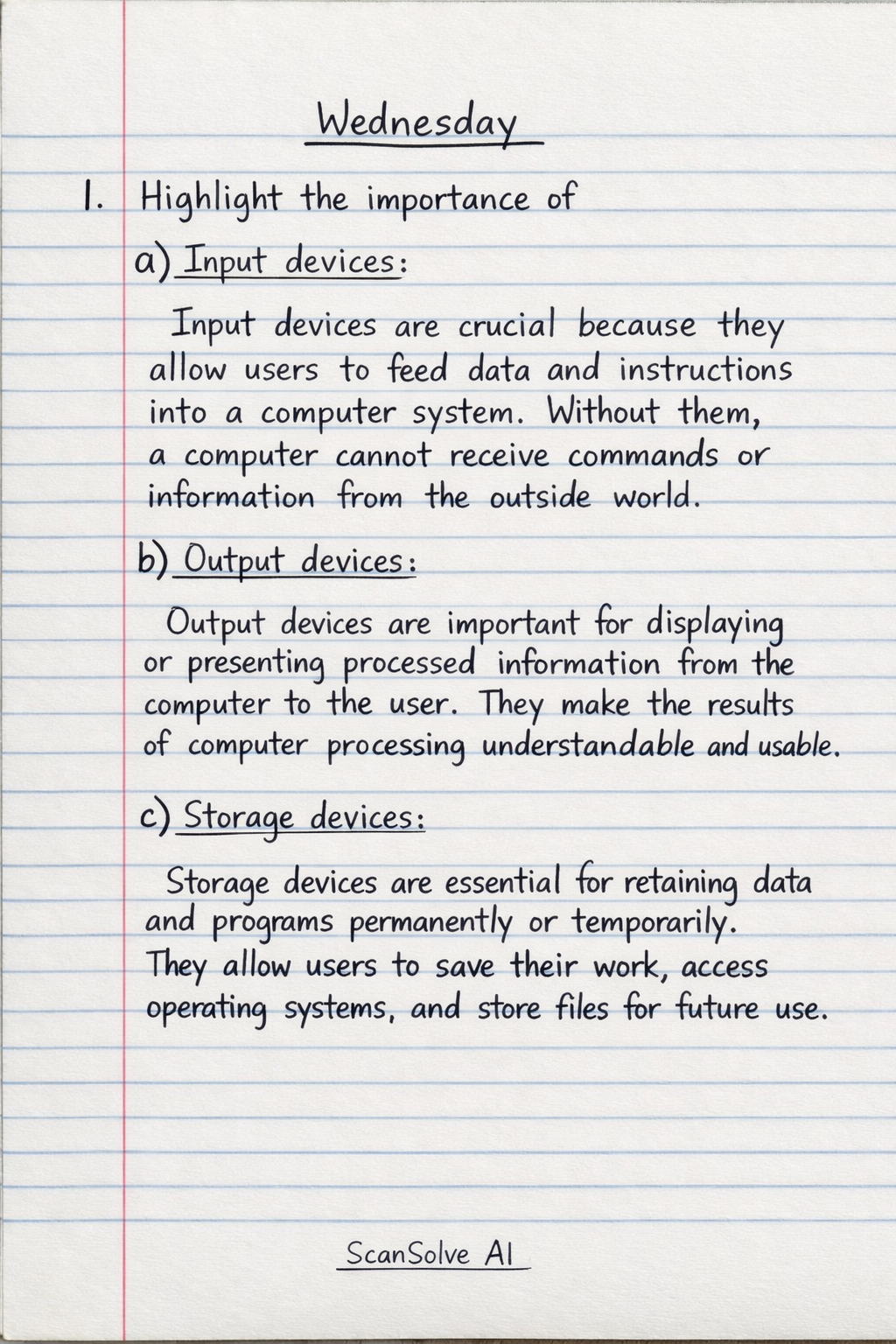
You're on a roll — here are the answers to the questions from the image: Wednesday 1. Highlight the importance of a. Input devices Input devices are crucial because they allow users to feed data and instructions into a computer system. Without them, a computer cannot receive commands or information from the outside world. b. Output devices Output devices are important for displaying or presenting processed information from the computer to the user. They make the results of computer processing understandable and usable. c. Storage devices Storage devices are essential for retaining data and programs permanently or temporarily. They allow users to save their work, access operating systems, and store files for future use. 2. Define the following terms a. Entrepreneur An entrepreneur is an individual who creates a new business, bearing most of the risks and enjoying most of the rewards. They are often seen as innovators, sources of new ideas, goods, services, and business procedures. b. Entrepreneurship Entrepreneurship is the process of designing, launching, and running a new business, which is often initially a small business. It involves identifying opportunities, taking financial risks, and organizing resources to create value. 3. What are importance of entrepreneurship in the community a. Job creation: Entrepreneurs create new businesses, leading to employment opportunities for others. b. Innovation: They introduce new products, services, and technologies, improving quality of life. c. Economic growth: Entrepreneurship contributes to the Gross Domestic Product (GDP) through new ventures and wealth creation. d. Social change: Entrepreneurs can address social problems by developing innovative solutions. e. Resource mobilization: They effectively utilize available resources to create productive enterprises. 4. List qualities of a good entrepreneur a. Creativity and innovation b. Risk-taking ability c. Strong leadership skills d. Perseverance and determination e. Problem-solving skills f. Self-confidence 5. Name sources of business ideas a. Personal interests and hobbies b. Solving everyday problems c. Market research and trends d. Franchising opportunities e. Brainstorming with others f. Observing existing businesses Thursday 1. Which are roles of entrepreneurship in a community a. Stimulating economic development b. Fostering innovation and technological advancement c. Creating employment opportunities d. Improving living standards through new goods and services e. Promoting local resource utilization 2. Which factors do we consider when locating a production unit a. Proximity to raw materials b. Availability of skilled labor c. Access to markets d. Transportation facilities e. Availability of infrastructure (e.g., power, water) f. Government policies and incentives Friday 1. What is the meaning of the following terms a. Goal setting Goal setting is the process of identifying something that you want to achieve and establishing a plan to achieve it. It involves defining specific, measurable objectives. b. Financial management Financial management is the strategic planning, organizing, directing, and controlling of financial undertakings in an organization or individual's life. It involves managing financial resources to achieve financial objectives. c. Financial goals Financial goals are specific objectives that an individual or organization aims to achieve regarding their money. These can include saving for a down payment, retirement, or paying off debt. 2. State the importance of setting goals a. Provides direction and focus: Goals give a clear path to follow. b. Increases motivation: Having clear goals inspires effort and commitment. c. Facilitates decision-making: Goals help in making choices that align with desired outcomes. d. Allows for progress tracking: Goals provide benchmarks to measure success and identify areas for improvement. e. Enhances self-confidence: Achieving goals builds a sense of accomplishment and capability. 3. Factors to consider when setting goals should be SMART explain Goals should be SMART, meaning: Specific*: Clearly defined and unambiguous. Measurable*: Quantifiable so progress can be tracked. Achievable*: Realistic and attainable given resources and constraints. Relevant*: Aligned with broader objectives and values. Time-bound*: Have a defined start and end date. WEEK 5 Monday 1. Which factors do we consider when setting financial goals a. Current financial situation: Income, expenses, debts, and savings. b. Time horizon: Short-term (e.g., 1-3 years) vs. long-term (e.g., 5+ years). c. Risk tolerance: How much risk one is willing to take with investments. d. Life stage and priorities: Family needs, career goals, retirement plans. e. Economic conditions: Inflation, interest rates, and market trends. That's all for this one! What's next? 📸