
We read your photo as:
What are the key concepts and importance of marketing, consumer behavior, and pricing strategies?
ScanSolve AI Answer
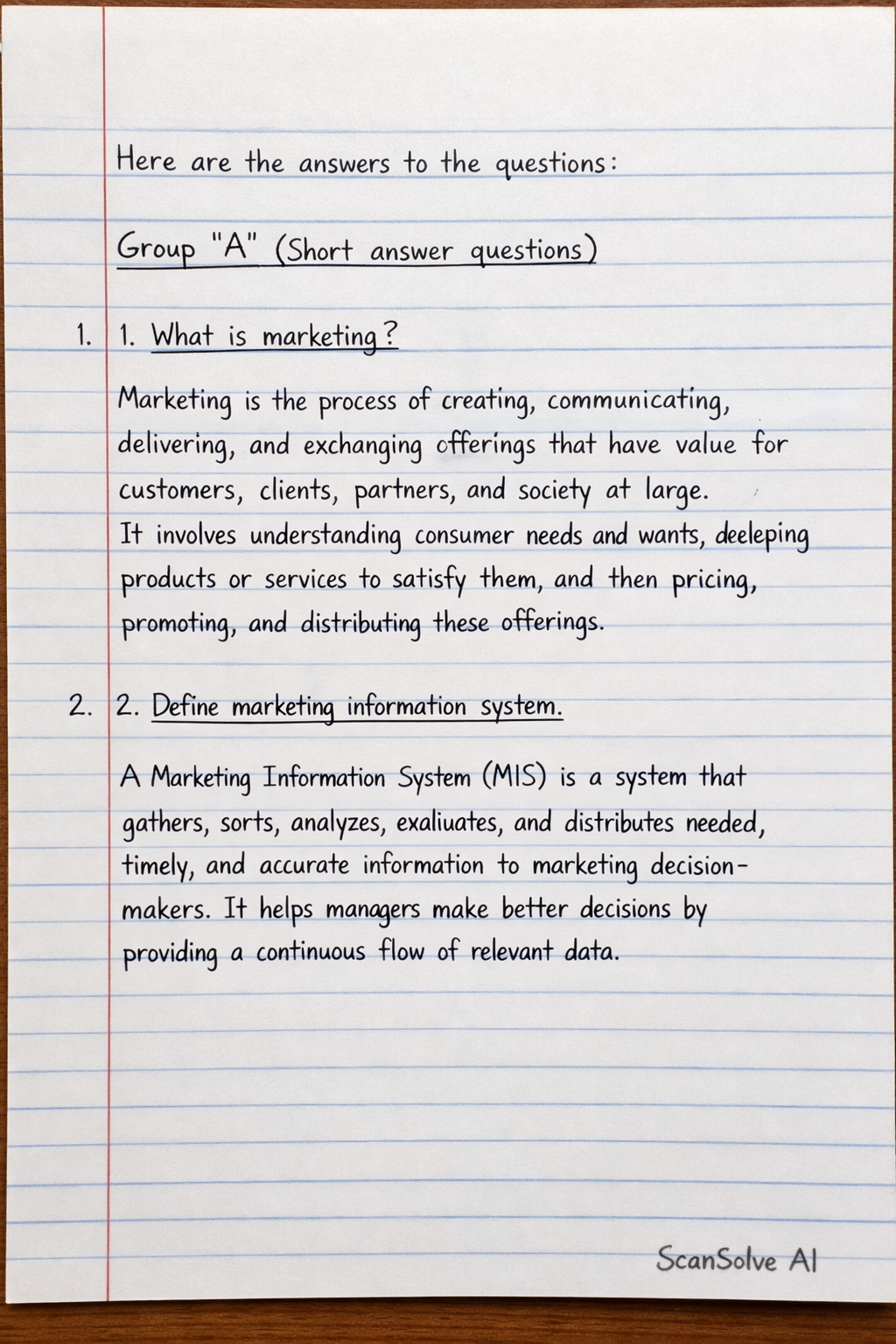
Here are the answers to the questions:
Group 'A' (Short answer questions)
-
What is marketing? Marketing is the process of creating, communicating, delivering, and exchanging offerings that have value for customers, clients, partners, and society at large. It involves understanding consumer needs and wants, developing products or services to satisfy them, and then pricing, promoting, and distributing these offerings.
-
Define marketing information system. A Marketing Information System (MIS) is a system that gathers, sorts, analyzes, evaluates, and distributes needed, timely, and accurate information to marketing decision-makers. It helps managers make better decisions by providing a continuous flow of relevant data.
-
Describe in brief any two importance of consumer behavior.
- Product Development: Understanding consumer behavior helps businesses design and develop products or services that meet specific customer needs and preferences, increasing the likelihood of market acceptance.
- Marketing Strategy: It enables marketers to tailor their strategies (pricing, promotion, distribution) to specific target segments, making campaigns more effective and efficient by resonating with consumer motivations and purchasing habits.
-
Elaborate competition-oriented pricing method. Competition-oriented pricing involves setting prices primarily based on competitors' prices, rather than on costs or customer demand. Companies might price their products above, below, or at par with competitors, depending on their market position, product differentiation, and strategic objectives. This method is common in highly competitive markets where products are similar.
-
What is branding? Branding is the process of creating a unique name, image, and identity for a product or company in the consumers' minds. It involves developing a brand name, logo, design, and messaging that differentiate it from competitors and communicate its value proposition, fostering recognition and loyalty.
-
Describe green marketing. Green marketing refers to the marketing of products and services that are environmentally safe or sustainable. It involves promoting products based on their environmental benefits, such as being eco-friendly, recyclable, energy-efficient, or produced through sustainable practices, appealing to environmentally conscious consumers.
Group 'B' (Long answer questions)
-
Define direct marketing. Describe any four features of direct marketing. Direct marketing is a type of marketing that communicates directly with target customers to obtain an immediate response and foster lasting customer relationships. It bypasses intermediaries and aims to elicit a direct action, such as an order, a visit to a store, or a request for information.
Four features of direct marketing are:
- Non-public: The message is normally addressed to a specific person, making it a private form of communication.
- Customizable: Messages can be prepared to appeal to specific individuals or segments, allowing for personalization based on customer data.
- Immediate and Interactive: Direct marketing often aims for an immediate response from the customer and allows for two-way communication, such as through phone calls or online interactions.
- Measurable: The effectiveness of direct marketing campaigns can be easily measured by tracking response rates, sales generated, or leads acquired, allowing for precise ROI calculation.
-
What is promotion? Explain any four objectives of promotion. Promotion refers to the various activities undertaken by a company to communicate the merits of its products and persuade target customers to buy them. It is one of the four Ps of the marketing mix and includes advertising, personal selling, sales promotion, and public relations.
Four objectives of promotion are:
- Inform: To inform target customers about new products, features, prices, or where to buy. This is especially crucial for new products or when adding new features to existing ones, helping to build initial awareness.
- Persuade: To convince customers to purchase the product or service, often by highlighting its benefits, differentiating it from competitors, or encouraging a switch from a rival brand. This objective is vital in competitive markets.
- Remind: To keep the brand in the customer's mind, especially for mature products. This helps reinforce past purchasing decisions and maintain brand loyalty, ensuring customers remember the product when they need it.
- Build Relationships: To foster long-term relationships with customers by creating a positive brand image, engaging with them, and building trust and loyalty over time, which can lead to repeat purchases and advocacy.
-
Describe marketing environment. Elaborate micro marketing environment. The marketing environment consists of the external forces and actors that affect a company's ability to develop and maintain successful relationships with its target customers. It includes both micro and macro environmental factors that marketers must monitor and adapt to.
The micro marketing environment consists of the actors close to the company that affect its ability to serve its customers. These forces are more directly controllable or influenceable by the company. Key components include:
- The Company: Internal departments such as management, finance, R&D, purchasing, operations, and accounting, all of which must work in harmony with marketing to provide customer value.
- Suppliers: Firms that provide the resources needed by the company to produce its goods and services. Supplier issues can significantly impact production and customer satisfaction.
- Marketing Intermediaries: Firms that help the company to promote, sell, and distribute its products to final buyers. These include resellers, physical distribution firms, marketing services agencies, and financial intermediaries.
- Competitors: Other companies offering similar products or services to the same target market. Marketers must gain strategic advantage by positioning their offerings strongly against competitors' offerings.
- Publics: Any group that has an actual or potential interest in or impact on an organization's ability to achieve its objectives. This includes financial publics, media publics, government publics, citizen-action publics, local publics, general public, and internal publics.
- Customers: The most important actors in the microenvironment. These include consumer markets, business markets, reseller markets, government markets, and international markets.
-
What is niche marketing? Describe features of niche marketing. Niche marketing is a marketing strategy that focuses on a very specific, well-defined, and often small segment of the market. Instead of targeting a broad audience, companies using niche marketing aim to serve the unique needs and preferences of a specialized group of customers.
Features of niche marketing include:
- Specific Target Audience: It targets a narrowly defined customer group with distinct needs, preferences, or demographics that are not adequately served by mainstream offerings.
- Less Competition: Due to its specialized nature, niche markets often face less direct competition compared to broader markets, allowing niche players to establish a stronger market position.
- Higher Profit Margins: Customers in niche markets are often willing to pay a premium for products or services that perfectly meet their unique needs, leading to potentially higher profit margins for the niche marketer.
- Strong Customer Loyalty: By deeply understanding and catering to the specific needs of their niche, companies can build strong relationships and foster high customer loyalty within their segment.
- Specialized Expertise: Niche marketers often develop deep expertise in their specific area, allowing them to offer highly customized solutions and superior value to their target customers.
- Limited Market Size: While profitable, the overall market size for a niche product or service is inherently smaller than for mass-market products, which can limit growth potential if the niche is too small.
Still stuck on this one?
Ask a follow-up, and the answer starts from this question.
More Business/Management Questions
Handwritten Step-by-Step Solution
Get this as a handwritten image on WhatsApp — like a tutor wrote it for you.
Try on WhatsApp