
We read your photo as:
What are the solutions to questions 8-12 related to sustainable building?
ScanSolve AI Answer
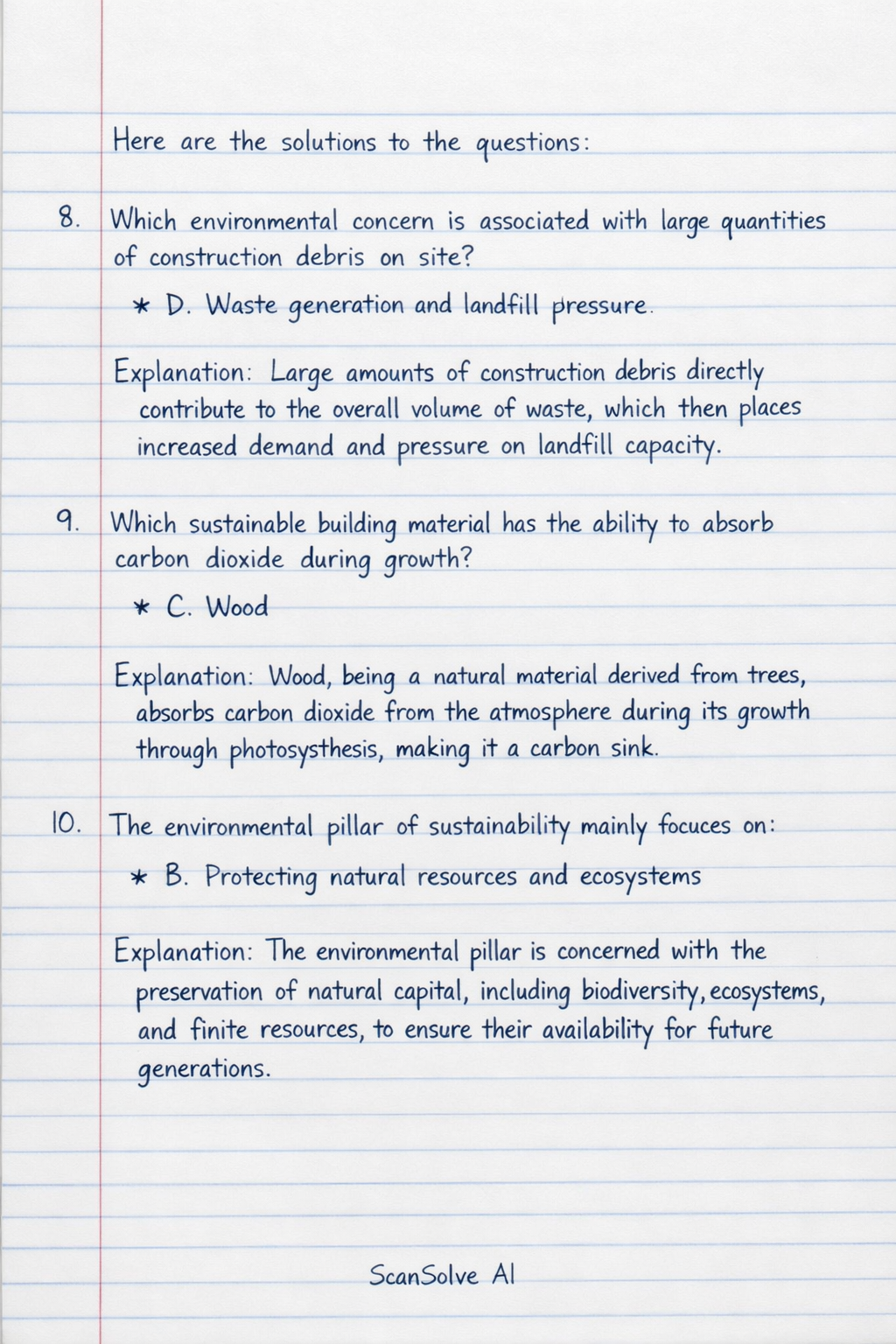
Here are the solutions to the questions:
-
Which environmental concern is associated with large quantities of construction debris on site?
- D. Waste generation and landfill pressure
- Explanation: Large amounts of construction debris directly contribute to the overall volume of waste, which then places increased demand and pressure on landfill capacity.
-
Which sustainable building material has the ability to absorb carbon dioxide during growth?
- C. Wood
- Explanation: Wood, being a natural material derived from trees, absorbs carbon dioxide from the atmosphere during its growth through photosynthesis, making it a carbon sink.
-
The environmental pillar of sustainability mainly focuses on:
- B. Protecting natural resources and ecosystems
- Explanation: The environmental pillar is concerned with the preservation of natural capital, including biodiversity, ecosystems, and finite resources, to ensure their availability for future generations.
-
A contractor chooses locally sourced materials instead of imported ones. This primarily reduces:
- B. Transportation energy and emissions
- Explanation: Sourcing materials locally minimizes the distance they need to be transported, thereby reducing the fuel consumption and greenhouse gas emissions associated with transportation.
-
Which stage of a building material life cycle involves mining or harvesting raw materials?
- C. Extraction stage
- Explanation: The extraction stage is the initial phase of a material's life cycle, where raw materials are obtained from the earth through mining, quarrying, or harvesting.
-
Construction waste can be significantly reduced through:
- A. Proper site planning and recycling practices
- Explanation: Effective site planning can minimize material off-cuts and errors, while robust recycling programs divert waste materials from landfills, reducing overall waste generation.
-
Which sustainable material is widely known for its rapid growth and high strength-to-weight ratio?
- A. Bamboo
- Explanation: Bamboo is a fast-growing grass with exceptional tensile strength and a lightweight nature, making it a highly renewable and efficient building material.
-
Which practice best improves indoor environmental quality in sustainable buildings?
- C. Using low-emission materials
- Explanation: Low-emission materials (e.g., low-VOC paints, adhesives, and finishes) release fewer volatile organic compounds and other pollutants into the indoor air, significantly improving air quality and occupant health.
-
The ability of an economy to maintain long-term production and livelihoods refers to:
- C. Economic sustainability
- Explanation: Economic sustainability focuses on maintaining capital, ensuring long-term economic growth, and supporting livelihoods without depleting natural resources or causing social instability.
-
Which sustainability concept considers environmental, social and economic performance simultaneously?
- A. Triple bottom line
- Explanation: The Triple Bottom Line (TBL) framework evaluates performance based on three interconnected pillars: environmental (planet), social (people), and economic (profit), aiming for holistic sustainability.
Still stuck on this one?
Ask a follow-up, and the answer starts from this question.
More Business/Management Questions
Handwritten Step-by-Step Solution
Get this as a handwritten image on WhatsApp — like a tutor wrote it for you.
Try on WhatsApp