
We read your photo as:
Define visual communication and explain the characteristics of good visual media and features of the communication process. Discuss challenges in establishing school multimedia centers in Kenya.
Business/Management
ScanSolve AI Answer
QUESTION ONE
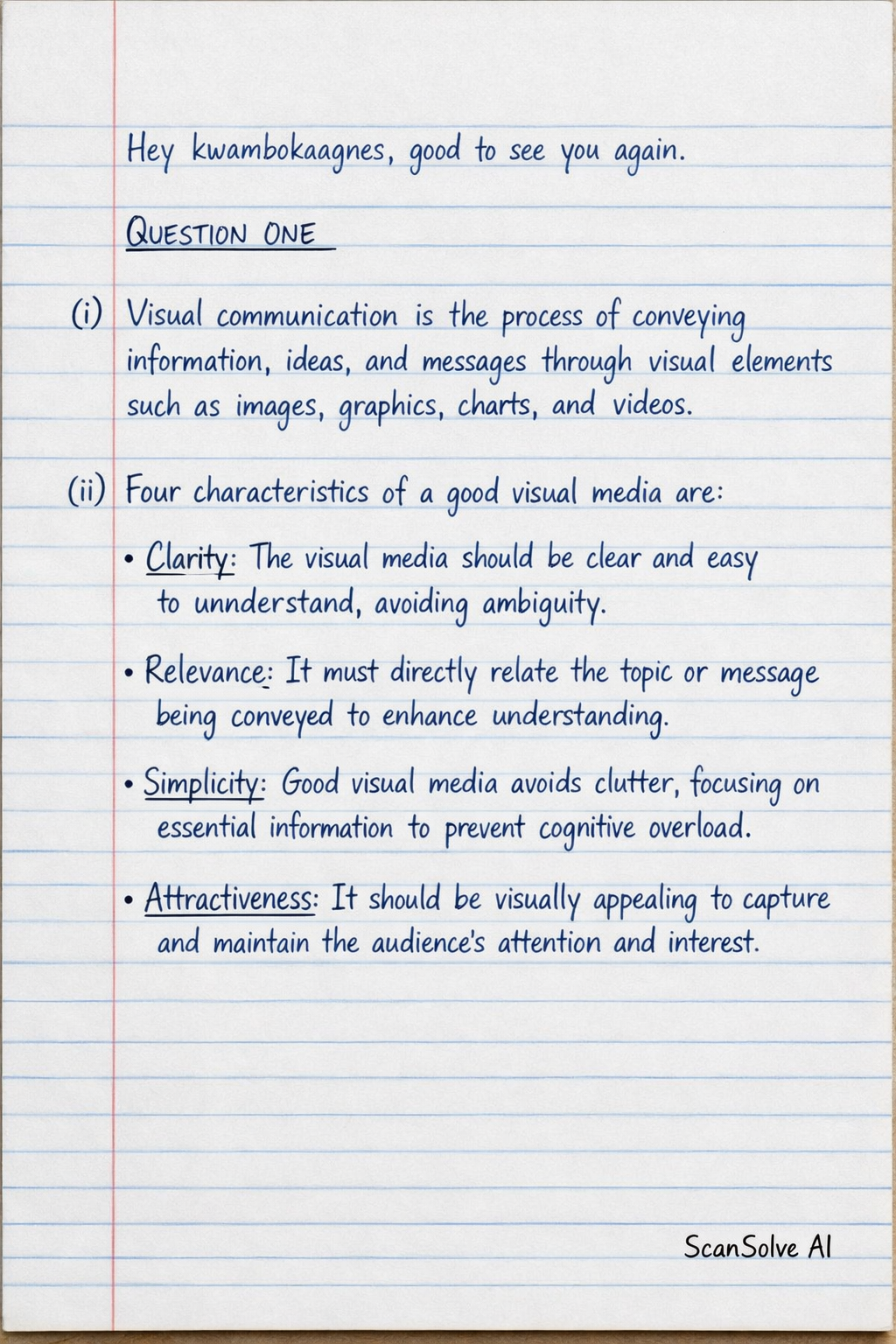
i) Visual communication is the process of conveying information, ideas, and messages through visual elements such as images, graphics, charts, and videos.
ii) Four characteristics of a good visual media are:
- Clarity: The visual media should be clear and easy to understand, avoiding ambiguity.
- Relevance: It must directly relate to the topic or message being conveyed to enhance understanding.
- Simplicity: Good visual media avoids clutter, focusing on essential information to prevent cognitive overload.
- Attractiveness: It should be visually appealing to capture and maintain the audience's attention and interest.
iii) Four features of the communication process are:
- Sender: This is the individual or entity who initiates the communication by formulating and sending a message.
- Message: The actual information, idea, or feeling that the sender intends to convey to the receiver.
- Channel: The medium or pathway through which the message travels from the sender to the receiver, such as spoken words, written text, or visual aids.
- Receiver: The person or group for whom the message is intended, who then interprets or decodes the message.
iv) Establishing school multi-media centres remains a challenge in Kenya due to several factors:
- High Cost of Equipment: The initial investment for computers, projectors, software, and internet infrastructure is often prohibitive for many schools, especially those in rural areas.
- Lack of Infrastructure: Many schools, particularly outside urban centers, lack reliable electricity and consistent internet connectivity, which are essential for operating multi-media centers.
- Inadequate Training for Teachers: There is often a shortage of teachers trained in the effective use and integration of multi-media technology into the curriculum.
- Maintenance and Repair Issues: Sourcing spare parts and finding skilled technicians for maintenance and repair of equipment can be difficult and expensive, leading to non-functional equipment.
v) A range of media resources commonly found in a typical school multi-media centre includes:
- Computers/Laptops
- Projectors (LCD/DLP)
- Interactive Whiteboards
- Printers and Scanners
- Internet access (Wi-Fi)
- Educational software and applications
- Digital cameras
- Audio systems (speakers, microphones)
vi) Five shortcomings of using a radio as a teaching and learning media are:
- Lack of Visuals: Radio is an audio-only medium, which limits the ability to present visual information, demonstrations, or complex diagrams that are crucial for understanding certain subjects.
- One-Way Communication: It typically offers no immediate feedback mechanism, making it difficult for teachers to assess student comprehension or for students to ask questions in real-time.
- Fixed Pace: The broadcast pace is predetermined and cannot be adjusted to suit individual learning speeds, meaning some learners may find it too fast or too slow.
- Distractions: Learners can easily be distracted by background noise or other activities in their environment, reducing their focus on the lesson.
- Lack of Personalization: Radio broadcasts cannot cater to diverse learning styles or individual needs of students, as the content is generic and delivered to a mass audience.
Was this helpful?
Still stuck on this one?
Ask a follow-up, and the answer starts from this question.
Got a different question?Ask your own question
More Business/Management Questions
QDefine visual communication and discuss its characteristics, features of the communication process…QDefine the term "Digital Media". Mention five (5) challenges of Digital media in Nigeria. Outline…QDiscuss five major characteristics of missionary education in Kenya.QDiscuss four major educational changes that have taken place in Kenya since independence.Q[29/04, 5:52 pm] Dylan: By use of relevant examples from the education system in Kenya, examine ways…
Handwritten Step-by-Step Solution
Get this as a handwritten image on WhatsApp — like a tutor wrote it for you.
Try on WhatsApp