
We read your photo as:
An instrument called a mass spectrometer can be used to determine the masses and relative abundances of different isotopes of an element. Find out how a mass spectrometer works and design a poste
ScanSolve AI Answer
Step-by-step solution
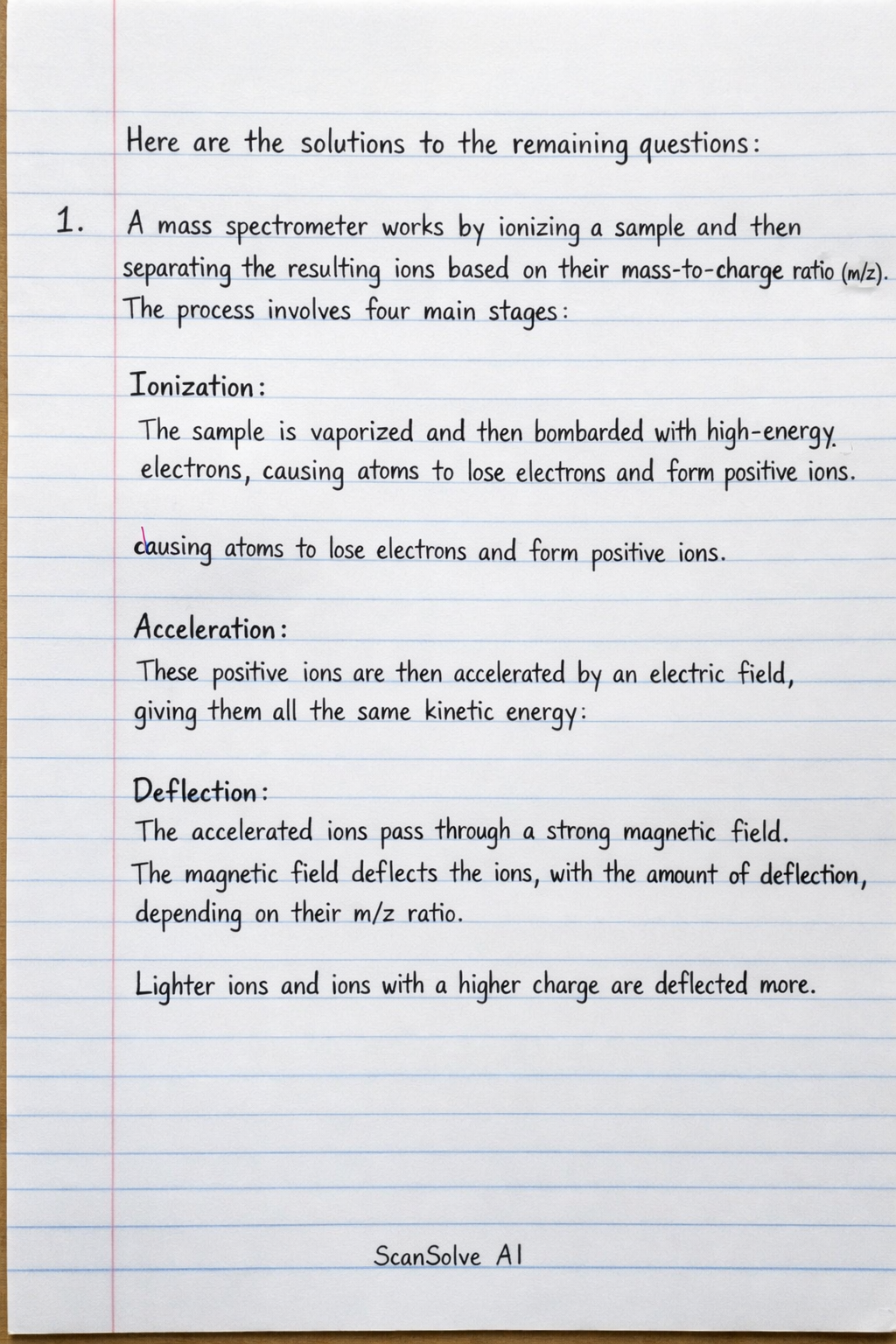
3 stepsHere are the solutions to the remaining questions:
1. An instrument called a mass spectrometer can be used to determine the masses and relative abundances of different isotopes of an element. Find out how a mass spectrometer works and design a poster to illustrate your findings.
A mass spectrometer works by ionizing a sample and then separating the resulting ions based on their mass-to-charge ratio (m/z). The process involves four main stages:
- Ionization: The sample is vaporized and then bombarded with high-energy electrons, causing atoms to lose electrons and form positive ions.
- Acceleration: These positive ions are then accelerated by an electric field, giving them all the same kinetic energy.
- Deflection: The accelerated ions pass through a strong magnetic field. The magnetic field deflects the ions, with the amount of deflection depending on their m/z ratio. Lighter ions and ions with a higher charge are deflected more.
- Detection: A detector records the arrival of the ions, measuring their relative abundance. The data is then processed to produce a mass spectrum, which plots relative abundance against m/z.
5. List at least five uses of radioisotopes.
Here are five uses of radioisotopes:
- Medical diagnosis: Used as tracers (e.g., Technetium-99m) to image organs and detect abnormalities.
- Medical therapy: Used in radiotherapy (e.g., Cobalt-60, Iodine-131) to treat cancer by destroying cancerous cells.
- Sterilization: Gamma radiation from isotopes like Cobalt-60 is used to sterilize medical equipment, food, and other products.
- Carbon dating: Carbon-14 is used to determine the age of ancient organic materials in archaeology and geology.
- Industrial gauges: Used to measure the thickness of materials, detect leaks in pipes, and monitor fluid levels.
6. Explain at least four uses of radioisotopes.
Here are four uses of radioisotopes with brief explanations:
- Medical tracers: Short-lived radioisotopes, such as Technetium-99m, are introduced into the body to track physiological processes. Their emitted radiation can be detected externally to create images of organs and identify diseases without invasive surgery.
- Cancer therapy: Radioisotopes like Cobalt-60 or Iodine-131 are used in radiation therapy. The high-energy radiation they emit targets and destroys rapidly dividing cancerous cells, shrinking tumors or preventing their growth.
- Sterilization: Gamma radiation from isotopes like Cobalt-60 is highly effective at killing bacteria, viruses, and other microorganisms. This is used to sterilize heat-sensitive medical instruments, pharmaceuticals, and even food products to extend shelf life.
- Carbon dating: Carbon-14 is a naturally occurring radioisotope with a known half-life. By measuring the ratio of Carbon-14 to Carbon-12 in organic artifacts, scientists can determine how long ago an organism died, providing a timeline for archaeological and geological findings.
7. Determine how to complete and balance simple nuclear reactions.
To complete and balance simple nuclear reactions, two fundamental conservation laws must be applied:
- Conservation of Mass Number (Nucleon Number): The sum of the mass numbers (superscripts) on the reactant side must equal the sum of the mass numbers on the product side.
- Conservation of Atomic Number (Proton Number/Charge): The sum of the atomic numbers (subscripts) on the reactant side must equal the sum of the atomic numbers on the product side.
To balance a reaction, identify the unknown particle (often represented by X) and determine its mass number (A) and atomic number (Z) by ensuring these conservation laws hold. Then, identify the element based on its atomic number Z.
Example: Alpha decay of Uranium-238:
Balance mass numbers
Balance atomic numbers
Identify the element with atomic number 90, which is Thorium (Th).
So, the balanced reaction is:
9. Explain how to complete and balance simple nuclear reaction.
(This question is a repeat of question 7. The explanation provided for question 7 covers this.)
10. Explain atomic mass unit, amu.
The atomic mass unit (amu), also known as the unified atomic mass unit (u) or Dalton (Da), is a standard unit of mass used to express atomic and molecular masses. It is defined as exactly of the mass of an unbound atom of carbon-12 in its ground state. This unit provides a convenient way to compare the masses of atoms and molecules, as the mass of a proton or neutron is approximately 1 amu.
11. State the expression for calculating the relative atomic mass of elements.
The expression for calculating the relative atomic mass of an element is the weighted average of the masses of its naturally occurring isotopes, taking into account their fractional abundances.
Where:
- denotes the sum of all naturally occurring isotopes.
- Isotope Mass is the mass number of a specific isotope.
- Fractional Abundance is the proportion of that isotope in a natural sample (e.g., if an isotope has 25% abundance, its fractional abundance is 0.25).
12. Explain how the relative atomic mass can be used to calculate the empirical formula of a substance.
The relative atomic mass of elements is crucial for determining the empirical formula of a substance, which represents the simplest whole-number ratio of atoms in a compound. The process typically involves these steps:
- Determine the mass of each element: If given percentage composition, assume a 100 g sample, so the percentages directly convert to grams of each element.
- Convert mass to moles: Divide the mass of each element by its respective relative atomic mass (found on the periodic table) to find the number of moles of each element.
- Find the simplest mole ratio: Divide the number of moles of each element by the smallest number of moles calculated in the previous step. This gives a ratio, which should be close to whole numbers.
- Obtain whole numbers: If the ratios are not whole numbers, multiply all ratios by the smallest integer that converts them into whole numbers. These whole numbers represent the subscripts in the empirical formula.
Example: A compound contains 40.0% Carbon, 6.7% Hydrogen, and 53.3% Oxygen.
- Masses: C = 40.0 g, H = 6.7 g, O = 53.3 g.
- Moles (using relative atomic masses: C=12.01, H=1.01, O=16.
Still stuck on this one?
Ask a follow-up, and the answer starts from this question.
More Chemistry Questions
Handwritten Step-by-Step Solution
Get this as a handwritten image on WhatsApp — like a tutor wrote it for you.
Try on WhatsApp