
We read your photo as:
Convert 0.8671875 to base 8 and base 16.
Chemistry
ScanSolve AI Answer
Step-by-step solution
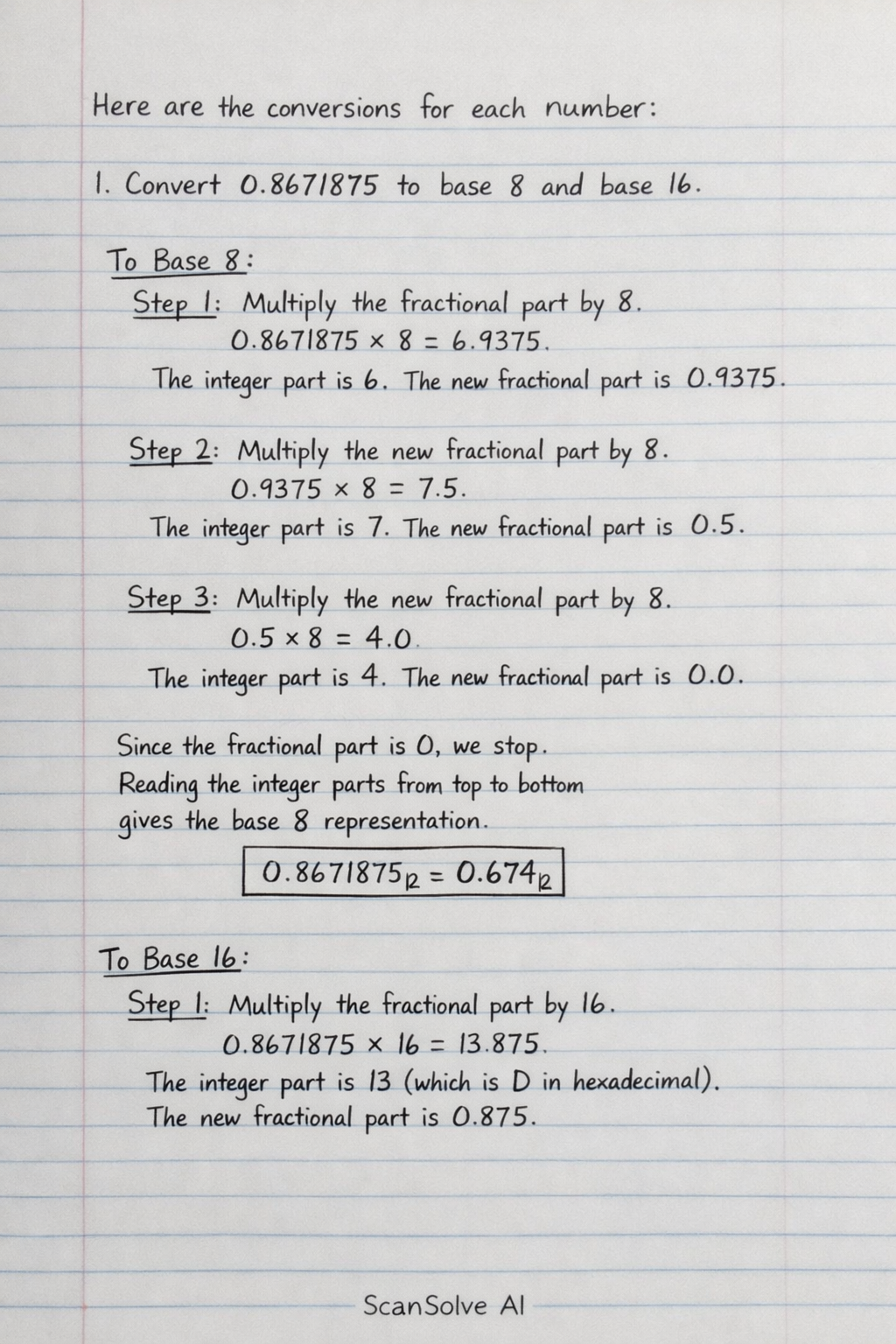
16 stepsHere are the conversions for each number:
1. Convert 0.8671875 to base 8 and base 16.
- To Base 8:
Multiply the fractional part by 8.
$$ 0.8671875 \times 8 = 6.9375 $$ The integer part is 6. The new fractional part is 0.9375.Multiply the new fractional part by 8.
$$ 0.9375 \times 8 = 7.5 $$ The integer part is 7. The new fractional part is 0.5.Multiply the new fractional part by 8.
$$ 0.5 \times 8 = 4.0 $$ The integer part is 4. The new fractional part is 0.0. Since the fractional part is 0, we stop. Reading the integer parts from top to bottom gives the base 8 representation. $$ 0.8671875_{10} = \boxed{0.674_8} $$- To Base 16:
Multiply the fractional part by 16.
$$ 0.8671875 \times 16 = 13.875 $$ The integer part is 13 (which is D in hexadecimal). The new fractional part is 0.875.Multiply the new fractional part by 16.
$$ 0.875 \times 16 = 14.0 $$ The integer part is 14 (which is E in hexadecimal). The new fractional part is 0.0. Since the fractional part is 0, we stop. Reading the integer parts from top to bottom gives the base 16 representation. $$ 0.8671875_{10} = \boxed{0.\text{DE}_{16}} $$2. Convert 0.53515625 to base 8 and base 16.
- To Base 8:
Multiply the fractional part by 8.
$$ 0.53515625 \times 8 = 4.28125 $$ The integer part is 4. The new fractional part is 0.28125.Multiply the new fractional part by 8.
$$ 0.28125 \times 8 = 2.25 $$ The integer part is 2. The new fractional part is 0.25.Multiply the new fractional part by 8.
$$ 0.25 \times 8 = 2.0 $$ The integer part is 2. The new fractional part is 0.0. Since the fractional part is 0, we stop. $$ 0.53515625_{10} = \boxed{0.422_8} $$- To Base 16:
Multiply the fractional part by 16.
$$ 0.53515625 \times 16 = 8.5625 $$ The integer part is 8. The new fractional part is 0.5625.Multiply the new fractional part by 16.
$$ 0.5625 \times 16 = 9.0 $$ The integer part is 9. The new fractional part is 0.0. Since the fractional part is 0, we stop. $$ 0.53515625_{10} = \boxed{0.89_{16}} $$3. Convert 0.626953125 to base 8 and base 16.
- To Base 8:
Multiply the fractional part by 8.
$$ 0.626953125 \times 8 = 5.015625 $$ The integer part is 5. The new fractional part is 0.015625.Multiply the new fractional part by 8.
$$ 0.015625 \times 8 = 0.125 $$ The integer part is 0. The new fractional part is 0.125.Multiply the new fractional part by 8.
$$ 0.125 \times 8 = 1.0 $$ The integer part is 1. The new fractional part is 0.0. Since the fractional part is 0, we stop. $$ 0.626953125_{10} = \boxed{0.501_8} $$- To Base 16:
Multiply the fractional part by 16.
$$ 0.626953125 \times 16 = 10.03125 $$ The integer part is 10 (which is A in hexadecimal). The new fractional part is 0.03125.Multiply the new fractional part by 16.
$$ 0.03125 \times 16 = 0.5 $$ The integer part is 0. The new fractional part is 0.5.Multiply the new fractional part by 16.
$$
0.5 \times 16 = 8.0
$$
The integer part is 8. The new fractional part is 0.0.
Since the fractional part is 0, we stop.
$$
0.626953125_{10} = \boxed{0.\text{A08}_{16}}
$$
Was this helpful?
Still stuck on this one?
Ask a follow-up, and the answer starts from this question.
Got a different question?Ask your own question
More Chemistry Questions
Handwritten Step-by-Step Solution
Get this as a handwritten image on WhatsApp — like a tutor wrote it for you.
Try on WhatsApp