
We read your photo as:
1 Define the term reaction rate.
ScanSolve AI Answer
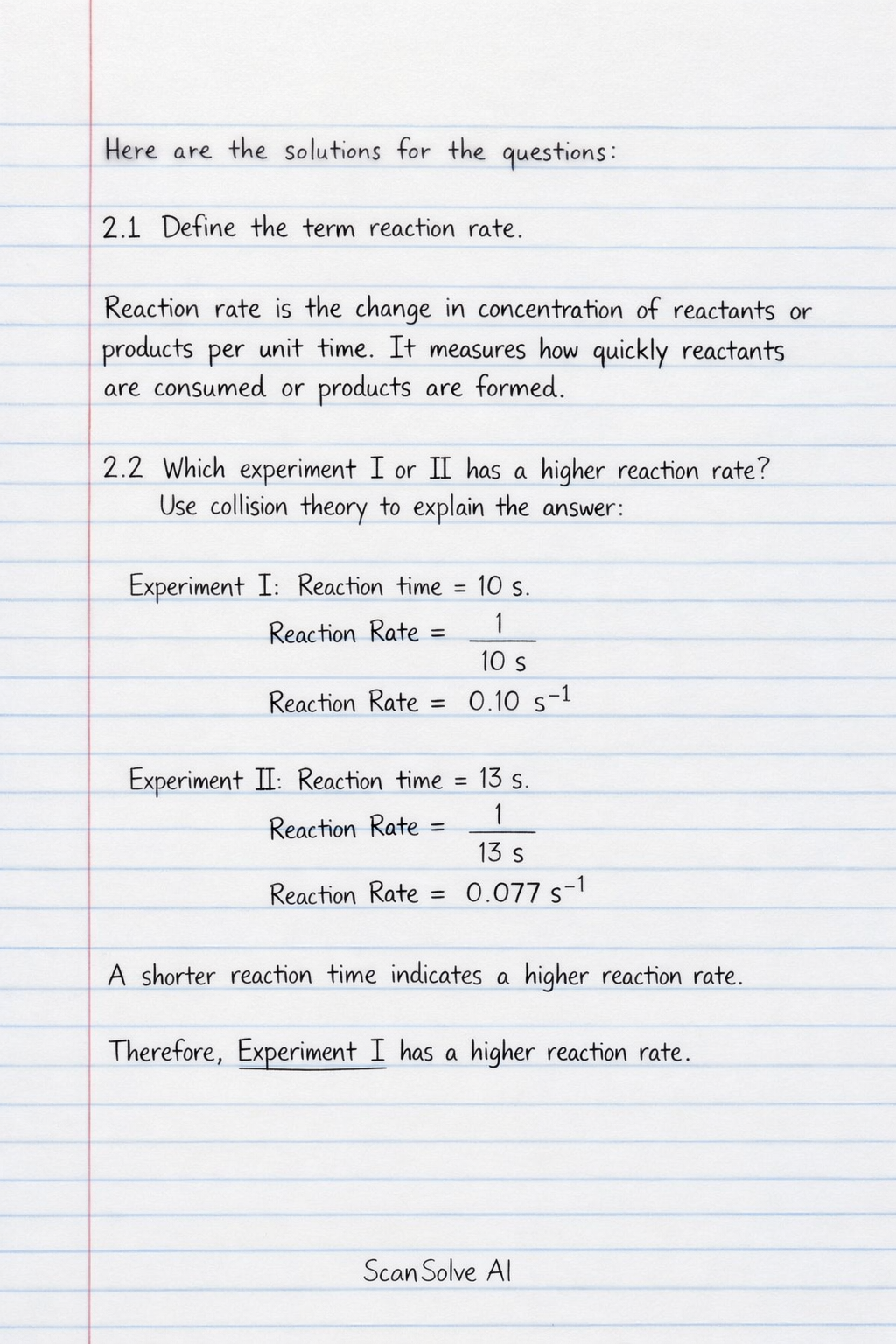
Here are the solutions for the questions:
2.1 Define the term reaction rate.
Reaction rate is the change in concentration of reactants or products per unit time. It measures how quickly reactants are consumed or products are formed.
2.2 Which experiment I or II has a higher reaction rate? Use collision theory to explain the answer.
- Experiment I has a reaction time of 10 s.
- Experiment II has a reaction time of 13 s. A shorter reaction time indicates a higher reaction rate. Therefore, Experiment I has a higher reaction rate.
According to collision theory, for a reaction to occur, reactant particles must collide with sufficient energy (activation energy) and correct orientation.
In Experiment I, zinc is in powder form, while in Experiment II, it is in granule form. Powdered zinc has a larger surface area than granular zinc. A larger surface area means more zinc particles are exposed to the hydrochloric acid, leading to a greater frequency of collisions between reactant particles. This results in a higher frequency of effective collisions, thus increasing the reaction rate.
2.3 Write down the factor responsible for the difference in the reaction rates of experiment I and III.
- Experiment I: Reaction time = 10 s.
- Experiment III: Reaction time = 8 s. Experiment III has a faster reaction rate than Experiment I. Both experiments use the same concentration of H₂SO₄ (0.3 mol·dm⁻³), the same temperature (26 °C), and both are described as using "powder" for the state of division of Zn. However, for Experiment III to be faster, there must be a factor that increases the rate. Assuming the "powder" in Experiment III is finer than in Experiment I, the factor responsible is the surface area of zinc.
2.4 Explain how the factor named in QUESTION 2.3 affects the reaction rate.
A larger surface area of zinc means that more zinc particles are exposed and available to react with the hydrochloric acid particles. This increases the frequency of collisions between the reactant particles. A higher frequency of collisions leads to a higher frequency of effective collisions, which in turn increases the reaction rate.
2.5 Consider experiments II and IV.
2.5.1 How does the value of Q in experiment IV compares to the reaction time (13s) in experiment II. Choose from HIGHER THAN, LOWER THAN or EQUAL TO.
- Experiment II: Concentration = 0.3 mol·dm⁻³, Reaction time = 13 s.
- Experiment IV: Concentration = 1.5 mol·dm⁻³, Reaction time = Q. All other conditions (temperature and state of division of Zn) are the same. Experiment IV has a higher concentration of H₂SO
Still stuck on this one?
Ask a follow-up, and the answer starts from this question.
More Chemistry Questions
Handwritten Step-by-Step Solution
Get this as a handwritten image on WhatsApp — like a tutor wrote it for you.
Try on WhatsApp