
We read your photo as:
Nuclear Chemistry
ScanSolve AI Answer
Answers
2 partsStep-by-step solution
2 stepsHere are the solutions to the questions:
1. Nuclear Chemistry
-
(i) Identify the particles emitted in steps A and B.
- Step A: The mass number decreases by 4 () and the atomic number decreases by 2 (). This corresponds to the emission of an alpha particle. Particle A:
- Step B: The mass number remains unchanged () and the atomic number increases by 1 (). This corresponds to the emission of a beta particle. Particle B:
-
(ii) If a beta particle is emitted in stage C, give the atomic number and mass number of the isotope X.
- Stage C: (beta particle)
- For the mass number of X:
- For the atomic number of X:
- Atomic number:
- Mass number:
-
(iii) If the activity of is reduced to 25% in 48 days. What is the half-life of ?
Step 1: Determine the number of half-lives.
If the activity is reduced to 25%, it means it has undergone two half-lives:
So, half-lives.Step 2: Calculate the half-life.
Total time =
Part d
The mass spectrum of a vaporized sample of chromium shows the following data
| Mass of isotope | Relative abundance |
|---|---|
| 50 | 0.04 |
| 52 | 0.84 |
| 53 | 0.1 |
| 54 | 0.02 |
- Calculate the relative atomic mass of chromium. The relative atomic mass is the sum of (mass of isotope relative abundance) for all isotopes.
Part e2
The following data were obtained from the reaction below
| Experiment | [NO] mol dm⁻³ | [H₂] mol dm⁻³ | Relative rate of reaction |
|---|---|---|---|
| 1 | 0.1 | 0.1 | 1 |
| 2 | 0.3 | 0.1 | 9 |
| 3 | 0.3 | 0.2 | 18 |
- (i) Determine the order with respect to NO.
Compare Experiment 1 and Experiment 2, where [H₂] is kept constant.
From Exp 1 to Exp 2: [NO] increases from 0.1 to 0.3 (factor of $\frac{0.3}{0.1} = 3$). Rate increases from 1 to 9 (factor of $\frac{9}{1} = 9$). Since $3^2 = 9$, the order with respect to NO is 2. Order with respect to NO: $\boxed{2}$- (ii) Determine the order with respect to H₂.
Compare Experiment 2 and Experiment 3, where [NO] is kept constant.
From Exp 2 to Exp 3:
[H₂] increases from 0.1 to 0.2 (factor of $\frac{0.2}{0.1} = 2$).
Rate increases from 9 to 18 (factor of $\frac{18}{9} = 2$).
Since $2^1 = 2$, the order with respect to H₂ is 1.
Order with respect to H₂: $\boxed{1}$
Try one yourself
A new problem that tests the same skill.
Still stuck on this one?
Ask a follow-up, and the answer starts from this question.
More Chemistry Questions
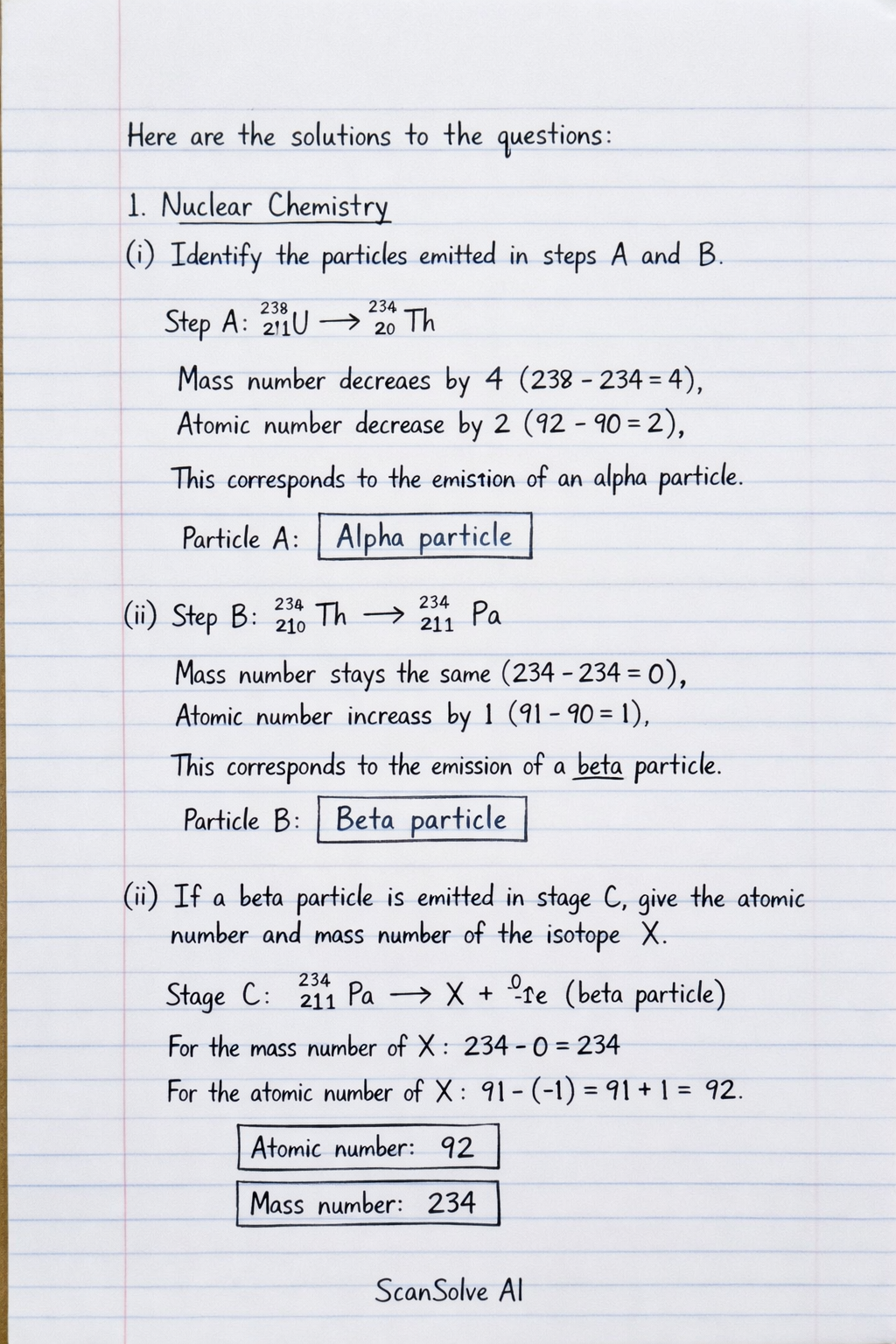
Handwritten Step-by-Step Solution
Get this as a handwritten image on WhatsApp — like a tutor wrote it for you.
Try on WhatsApp