
We read your photo as:
1 The volume of hydrogen gas (H2) produced at 120 s in experiment 1 compared to that of experiment 2? 2.2 Why is the total volume of hydrogen gas produced the same in both experiments? 2.3 Explain the
ScanSolve AI Answer
This answer stops before the end.
It was cut off when it was first written. Ask ScanSolve this question again for the full working.
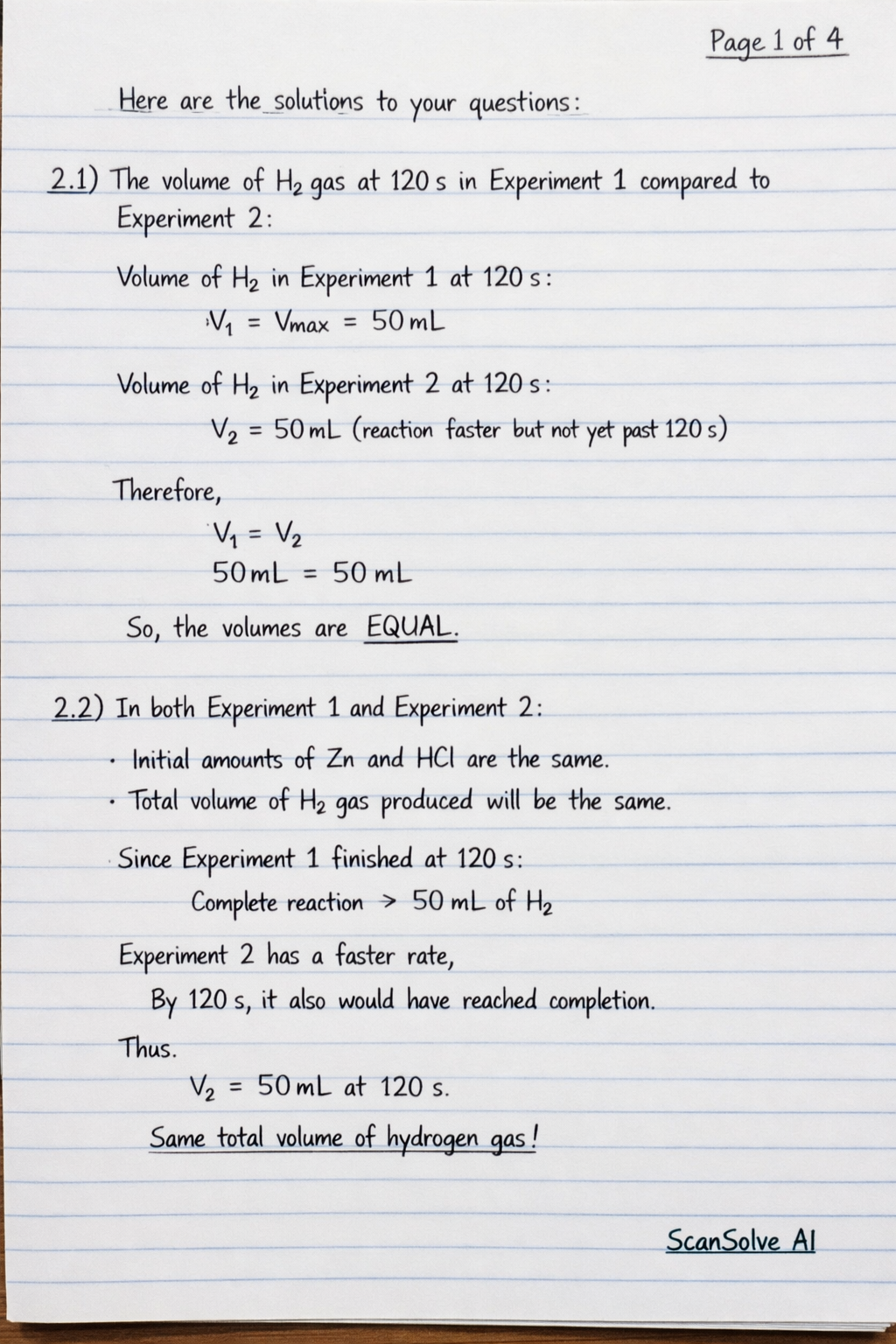
Here are the solutions to your questions:
2.1 The volume of hydrogen gas () produced at in experiment 1 compared to that of experiment 2 is EQUAL TO.
2.2 In both experiments 1 and 2, the initial amounts of reactants (zinc and hydrochloric acid) are assumed to be the same. Therefore, the total volume of hydrogen gas produced when the reaction goes to completion will be the same. Since experiment 1 has completed by (as shown by the plateau on the graph), and experiment 2 has a faster reaction rate, experiment 2 would also have completed by and produced the same total volume of hydrogen gas.
2.3 Experiment 2 has a higher reaction rate.
According to the collision theory, a higher reaction rate is due to an increased frequency of effective collisions. In experiment 2, zinc is in powder form, which means it has a larger surface area compared to the zinc granules in experiment 1. A larger surface area exposes more zinc particles to the hydrochloric acid, leading to a greater number of collisions between reactant particles per unit time. This results in a higher frequency of effective collisions, thus increasing the reaction rate.
2.4.1 The factor responsible for the difference in the rate of reactions in experiments 1 and 3 is the concentration of HCl.
2.4.2 According to the collision theory, a higher concentration of hydrochloric acid (as in experiment 3 compared to experiment 1) means there are more particles per unit volume. This increases the frequency of collisions between the particles and the zinc particles. A higher frequency of collisions leads to a higher frequency of effective collisions (collisions with sufficient energy and correct orientation), which in turn increases the overall reaction rate.
2.5 To calculate the percentage purity of zinc, we first determine the mass of pure zinc that reacted.
Step 1: Write the balanced chemical equation for the reaction.
Step 2: Determine the volume of produced from the graph for experiment 1.
From the graph, the maximum volume of produced is .
Step 3: Calculate the moles of produced.
Given molar gas volume at is .
Step 4: Use stoichiometry to find the moles of pure Zn that reacted.
From the balanced equation, of produces of .
Step 5: Calculate the mass of pure Zn that reacted.
The molar mass of is approximately .
Still stuck on this one?
Ask a follow-up, and the answer starts from this question.
More Chemistry Questions
Handwritten Step-by-Step Solution
Get this as a handwritten image on WhatsApp — like a tutor wrote it for you.
Try on WhatsApp