
We read your photo as:
1a) Define half-life. 1b) If 20 g of a radioactive isotope decays to 2.5 g in 100 years, what is its half-life? 2i) State Gay-Lussac's Law and write the balanced equation for the synthesis of ammonia.
ScanSolve AI Answer
Step-by-step solution
4 steps1a) The term half-life refers to the time required for half of the radioactive nuclei in a sample to undergo radioactive decay.
1b)
Determine the number of half-lives ().
The formula for radioactive decay is , where is the final mass, is the initial mass, and is the number of half-lives.
To find , we recognize that .
Calculate the half-life ().
The total time () is related to the number of half-lives () and the half-life () by the formula .
2i)
The balanced chemical equation is:According to Gay-Lussac's Law of Combining Volumes, the ratio of the volumes of reacting gases and gaseous products is given by their stoichiometric coefficients, assuming constant temperature and pressure.
Determine the volume of Nitrogen used.
From the equation, 3 volumes of H react with 1 volume of N.
Determine the volume of Ammonia produced.
From the equation, 3 volumes of H produce 2 volumes of NH.
2ii)
The reaction is exothermic ().
If the temperature is lowered from to :- According to Le Chatelier's principle, lowering the temperature for an exothermic reaction will shift the equilibrium position to the right, favoring the formation of more ammonia (products).
- However, lowering the temperature also decreases the kinetic energy of the reactant molecules, which leads to fewer effective collisions and thus a slower reaction rate.
Still stuck on this one?
Ask a follow-up, and the answer starts from this question.
More Chemistry Questions
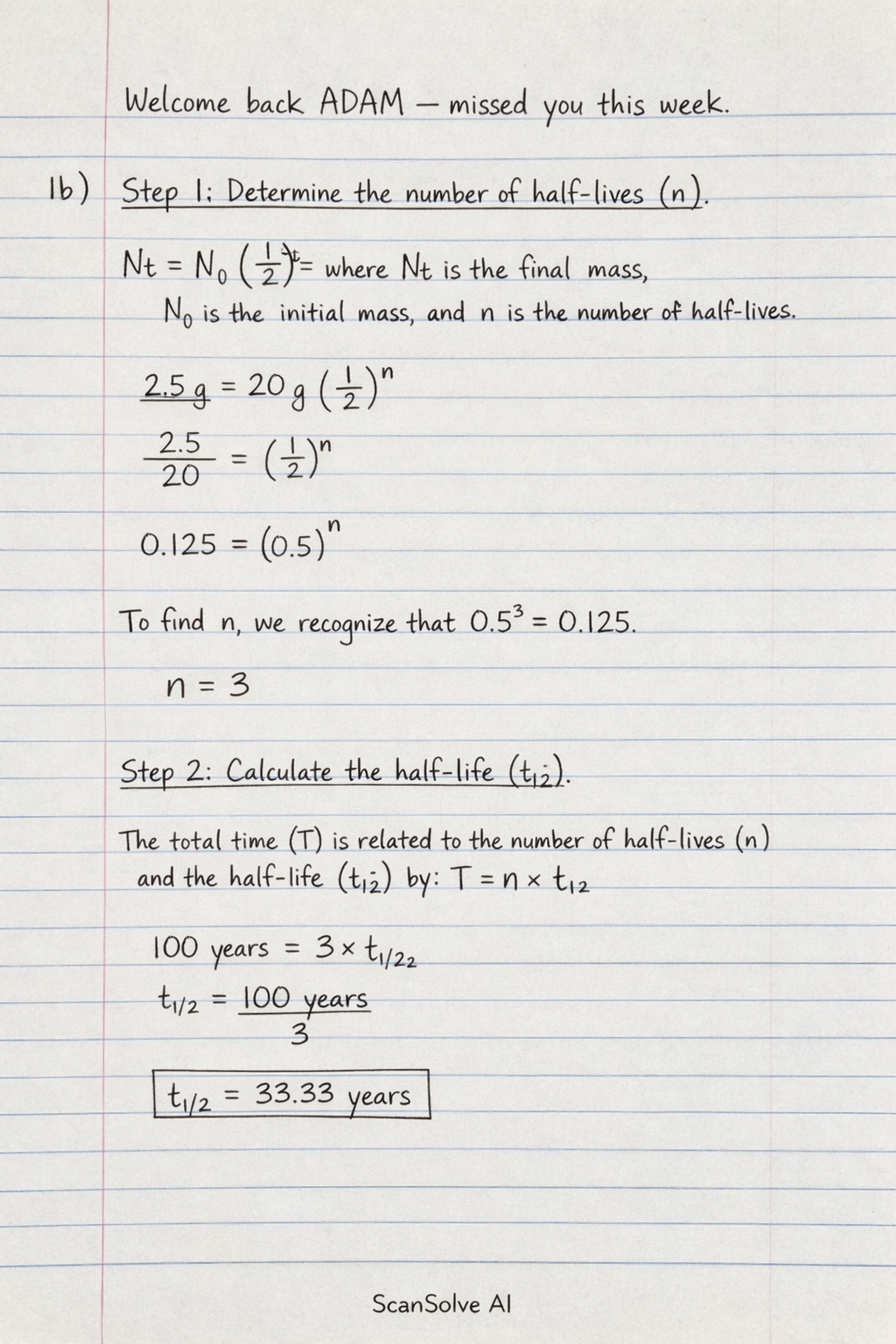
Handwritten Step-by-Step Solution
Get this as a handwritten image on WhatsApp — like a tutor wrote it for you.
Try on WhatsApp