
We read your photo as:
2.1.1 Identify molecule Y.
ScanSolve AI Answer
Step-by-step solution
5 stepsHere are the solutions to the questions:
2.1.1 Identify molecule Y.
Messenger RNA (mRNA)
2.1.2 Describe the process that resulted in the formation of molecule Y.
The DNA double helix (Molecule X) unwinds and unzips, separating the two strands.
RNA polymerase binds to the template strand (Strand 1) and moves along it.
Free RNA nucleotides pair with complementary bases on the DNA template strand (adenine with uracil, thymine with adenine, cytosine with guanine, guanine with cytosine).
RNA polymerase links these RNA nucleotides together to form a single strand of mRNA (Molecule Y).
The mRNA molecule detaches from the DNA, and the DNA reforms its double helix.
2.1.3 Give ONE structural difference between molecule X and molecule Y.
Molecule X (DNA) contains deoxyribose sugar, while Molecule Y (mRNA) contains ribose sugar.2.1.4 Give the sequence of bases at triplet Z on strand 2.
The mRNA sequence shown is A G A U A C C C A.
The triplet Z on Strand 2 corresponds to the mRNA codon UAC.
If the mRNA codon is UAC, the complementary bases on the template Strand 1 would be ATG.
Since Strand 2 is complementary to Strand 1, the bases at triplet Z on Strand 2 would be TAC.2.1.5 Identify the first and last amino acids coded for by this section of molecule Y.
The mRNA sequence is A G A U A C C C A.
The codons are read in triplets from left to right:- First codon: AGA, which codes for Arginine.
- Last codon: CCA, which codes for Proline. First amino acid: Arginine, Last amino acid: Proline.
Still stuck on this one?
Ask a follow-up, and the answer starts from this question.
More Chemistry Questions
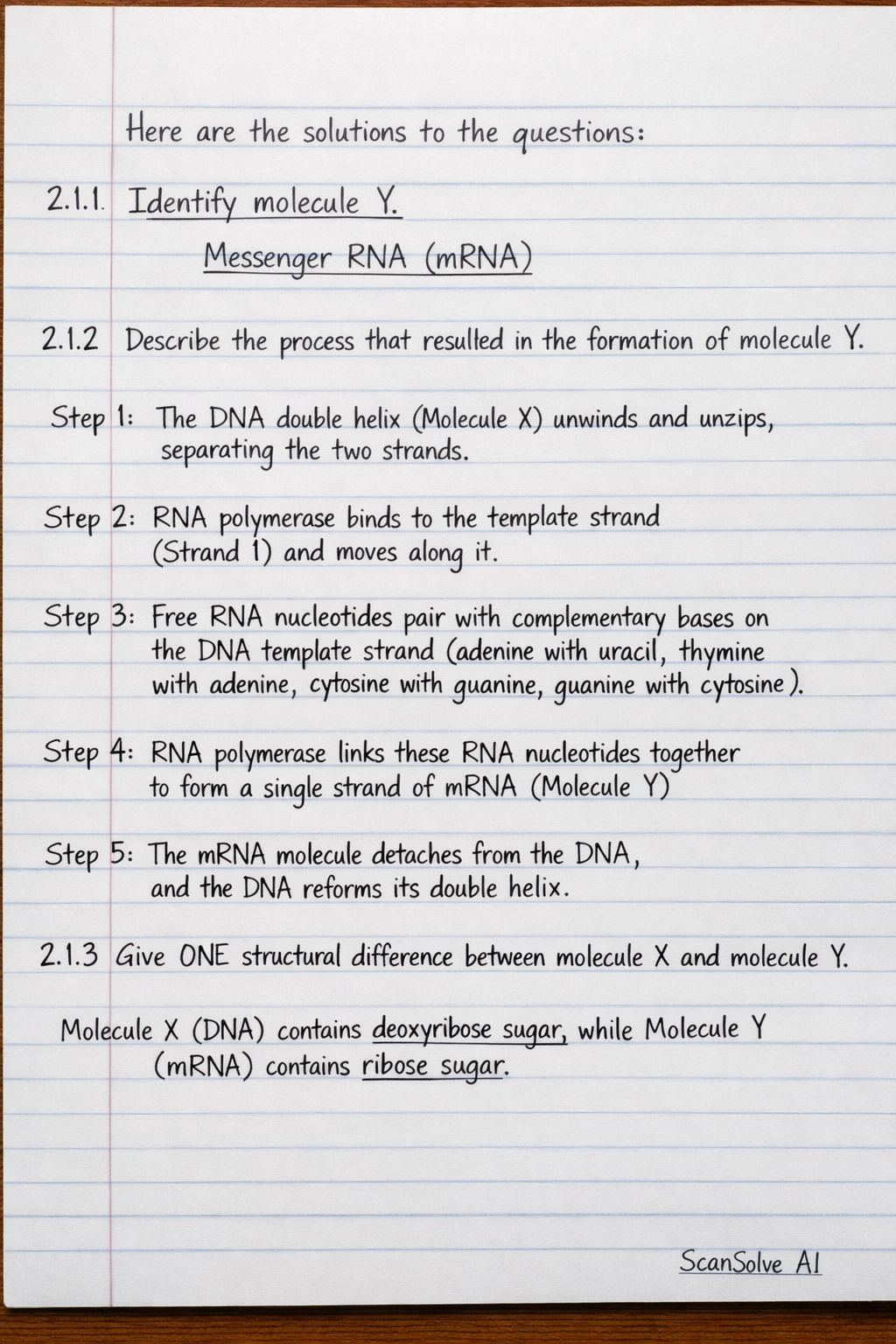
Handwritten Step-by-Step Solution
Get this as a handwritten image on WhatsApp — like a tutor wrote it for you.
Try on WhatsApp