

This chemistry question involves key chemical concepts and calculations. The detailed solution below walks through each step, from identifying the reaction type to computing the final answer.
ScanSolve AI Answer
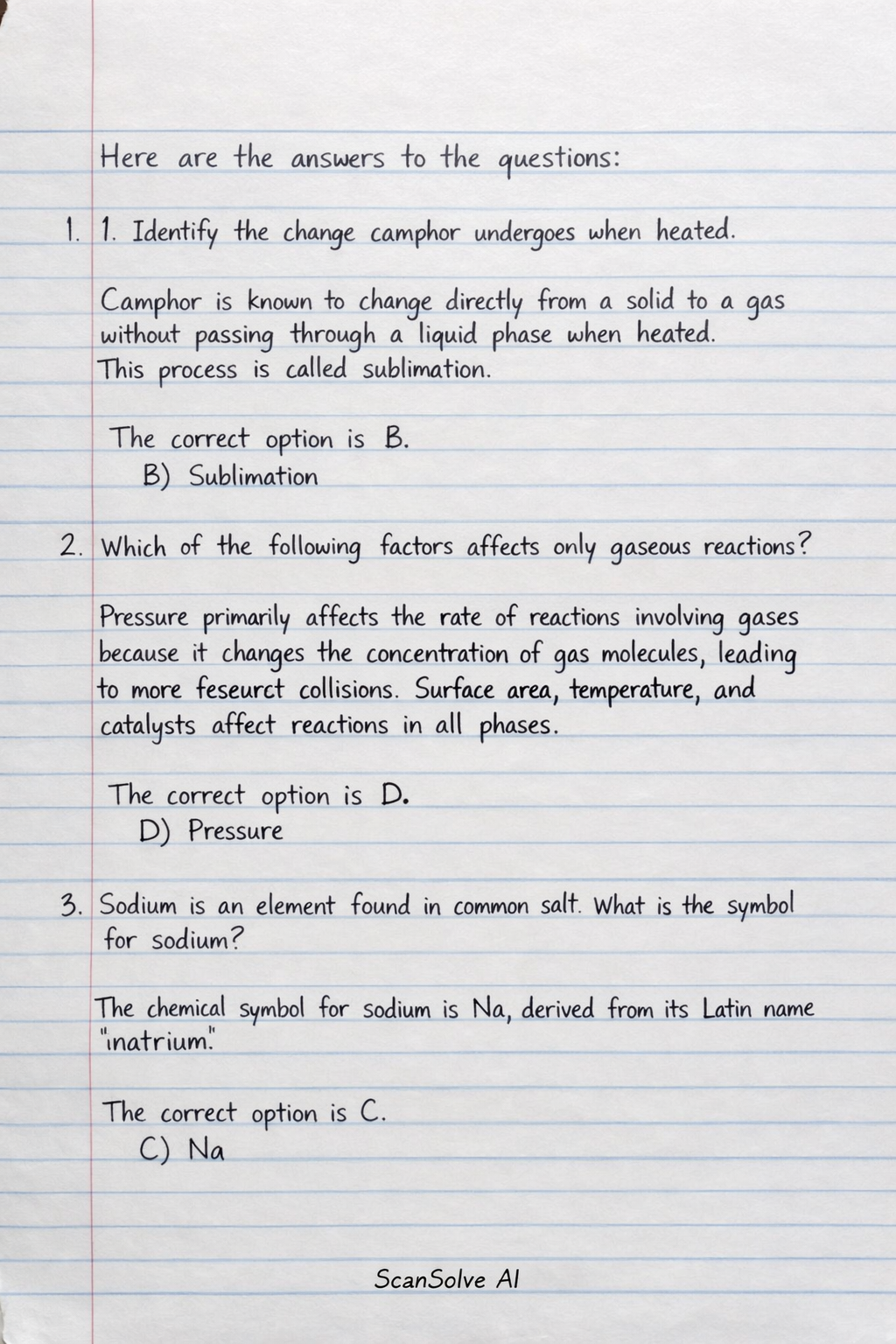
Here are the answers to the questions: 1. Identify the change camphor undergoes when heated. Camphor is known to change directly from a solid to a gas without passing through a liquid phase when heated. This process is called sublimation. The correct option is B. B) Sublimation 2. Which of the following factors affects only gaseous reactions? Pressure primarily affects the rate of reactions involving gases because it changes the concentration of gas molecules, leading to more frequent collisions. Surface area, temperature, and catalysts affect reactions in all phases. The correct option is D. D) Pressure 3. Sodium is an element found in common salt. What is the symbol for sodium? The chemical symbol for sodium is Na, derived from its Latin name natrium. The correct option is C. C) Na 4. What is the shape of a molecule of carbon dioxide? Carbon dioxide (CO_2) has a central carbon atom double-bonded to two oxygen atoms. There are no lone pairs on the central carbon atom. According to VSEPR theory, this arrangement results in a linear molecular geometry. The correct option is B. B) Linear 5. Oxidation can be defined as; Oxidation is commonly defined as the loss of electrons, an increase in oxidation number, or the gain of oxygen. Among the given options, "loss of electrons" is a fundamental definition. The correct option is A. A) Loss of electrons 6. Determine the molar mass of NaHCO_3. (H=1, C=12, O=16, Na=23) To find the molar mass, sum the atomic masses of all atoms in the formula: Molar mass of NaHCO_3 = (1 × Na) + (1 × H) + (1 × C) + (3 × O) Molar mass of NaHCO_3 = (1 × 23) + (1 × 1) + (1 × 12) + (3 × 16) Molar mass of NaHCO_3 = 23 + 1 + 12 + 48 Molar mass of NaHCO_3 = 84 g/mol The correct option is B. B) 84 7. What is a substance that produces hydrogen ions (H^+) in solution is called? According to the Arrhenius definition, an acid is a substance that produces hydrogen ions (H^+) when dissolved in water. The correct option is A. A) An acid 8. Determine the number of protons and neutrons in Cl. The atomic number (Z) represents the number of protons. For chlorine, the atomic number is 17, so it has 17 protons. The mass number (A) is the sum of protons and neutrons. For chlorine, the mass number is 35. Number of neutrons = Mass number - Number of protons Number of neutrons = 35 - 17 = 18 The correct option is B. B) 17 protons, 18 neutrons 9. Why is a dry sample of chlorine prepared in the laboratory collected by upward displacement of air? Upward displacement of air (collecting gas by displacing air downwards) is used for gases that are denser than air. Chlorine gas is denser than air. The correct option is D. D) It is denser than air 10. Give a use of carbon monoxide. Carbon monoxide is a strong reducing agent and is used in the industrial extraction of metals, particularly in blast furnaces to reduce iron oxides. The correct option is D. D) It is used in the industrial extraction of metals 11. The following is true about the principle of conservation of energy EXCEPT The principle of conservation of energy states that energy cannot be created or destroyed, only transformed from one form to another. Therefore, the total energy of a closed system remains constant. The statement "Energy cannot change forms" contradicts this principle. The correct option is C. C) Energy cannot change forms 12. When is dynamic equilibrium of a reaction said to be attained? Dynamic equilibrium is attained when the rate of the forward reaction becomes equal to the rate of the backward (reverse) reaction, and the concentrations of reactants and products remain constant. The correct option is C. C) When the rate of forward and backward reaction is the same 13. Identify a metal which is used to make kitchen utensils and also in the construction of aircrafts. Aluminum (Al) is a lightweight, corrosion-resistant metal widely used for kitchen utensils and extensively in the aerospace industry for aircraft construction due to its high strength-to-weight ratio. The correct option is B. B) Al That's 2 down. 3 left today — send the next one.