
We read your photo as:
A hydrocarbon underwent an experiment. (i) Determine its chemical formula and relative molecular mass. (ii) Draw its structural formula. (iii) Describe a method for its preparation.
ScanSolve AI Answer
This question refers to previous parts (i) and "the above experiment" which are not provided in the image. Therefore, a complete answer for some parts cannot be given. I will address what can be answered and state where information is missing.
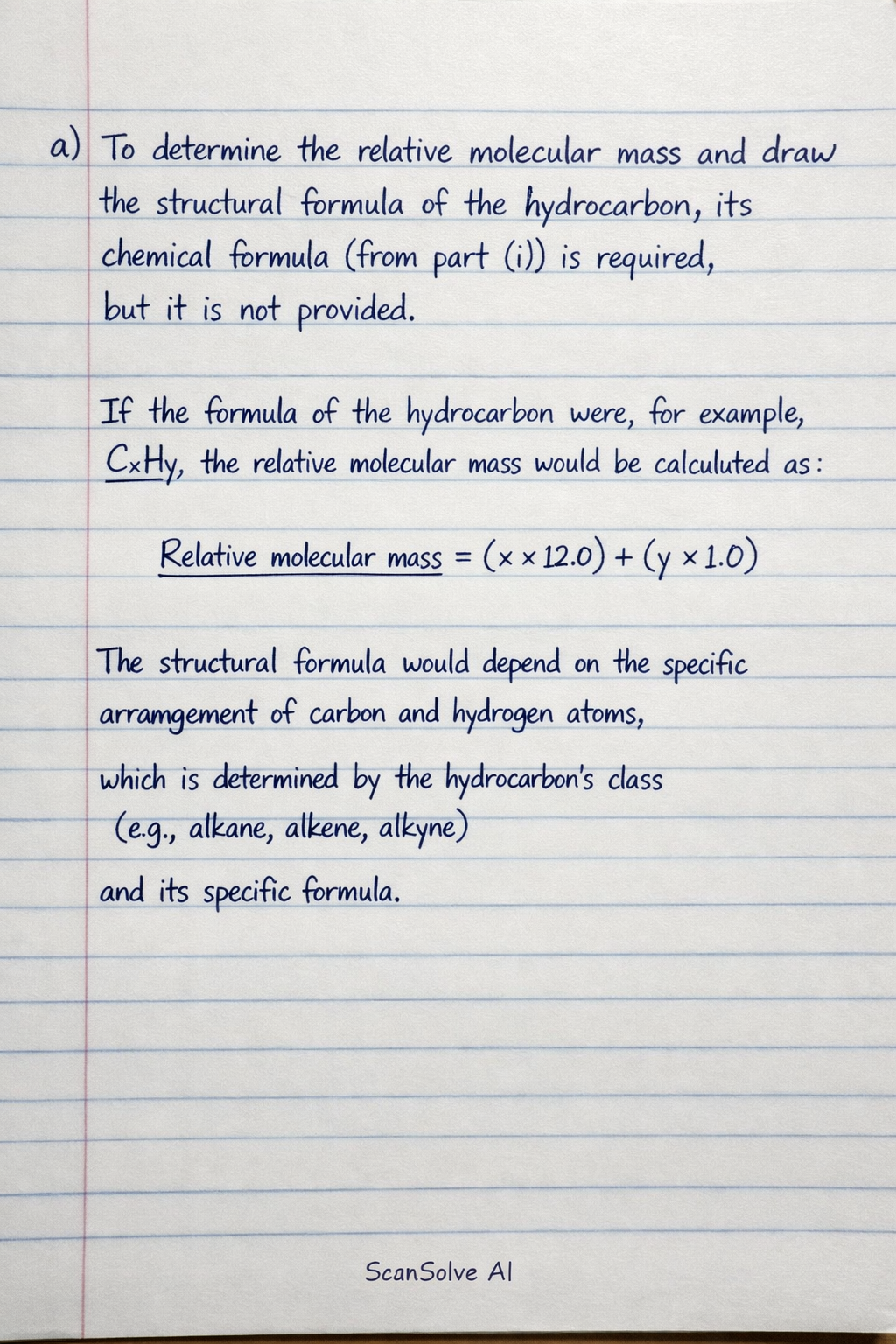
a) To determine the relative molecular mass and draw the structural formula of the hydrocarbon, its chemical formula (from part (i)) is required, but it is not provided.
If the formula of the hydrocarbon were, for example, , the relative molecular mass would be calculated as:
The structural formula would depend on the specific arrangement of carbon and hydrogen atoms, which is determined by the hydrocarbon's class (e.g., alkane, alkene, alkyne) and its specific formula.
b) Assuming "it" refers to a hydrocarbon from part (a), hydrocarbons are generally organic compounds made only of carbon and hydrogen. They are typically prepared through processes like the cracking of larger hydrocarbons, fractional distillation of crude oil, or specific organic synthesis reactions (e.g., Wurtz reaction for alkanes). The action of an ammonium salt (e.g., ammonium chloride, ) with a base (e.g., sodium hydroxide, ) typically produces ammonia gas (), not hydrocarbons. Therefore, it is unlikely that a hydrocarbon would be prepared in the laboratory by the action of an ammonium salt.
c) Assuming "the above experiment" refers to a general gas collection experiment, as the specific experiment is not described, one can tell that a gas is collected by:
- Observation of the collection method: If the gas is collected over water, bubbles will be seen displacing the water in the collection vessel. If collected by upward or downward delivery of air, the gas will fill the collection container.
- Physical properties: Observing any distinct color (e.g., brown for nitrogen dioxide, yellow-green for chlorine) or odor (e.g., pungent for ammonia, rotten egg for hydrogen sulfide) can indicate the presence of a gas.
- Chemical tests: Performing specific chemical tests can confirm the presence and identity of the collected gas. For example:
- Carbon dioxide () turns limewater milky.
- Hydrogen () burns with a 'pop' sound when a lit splint is introduced.
- Oxygen () relights a glowing splint.
- Ammonia () turns damp red litmus paper blue.
d) An equation for the reaction cannot be provided as "the above experiment" is not described.
Still stuck on this one?
Ask a follow-up, and the answer starts from this question.
More Chemistry Questions
Handwritten Step-by-Step Solution
Get this as a handwritten image on WhatsApp — like a tutor wrote it for you.
Try on WhatsApp