
We read your photo as:
A) Hydrogen bond and Electrovalent bond
Chemistry
ScanSolve AI Answer
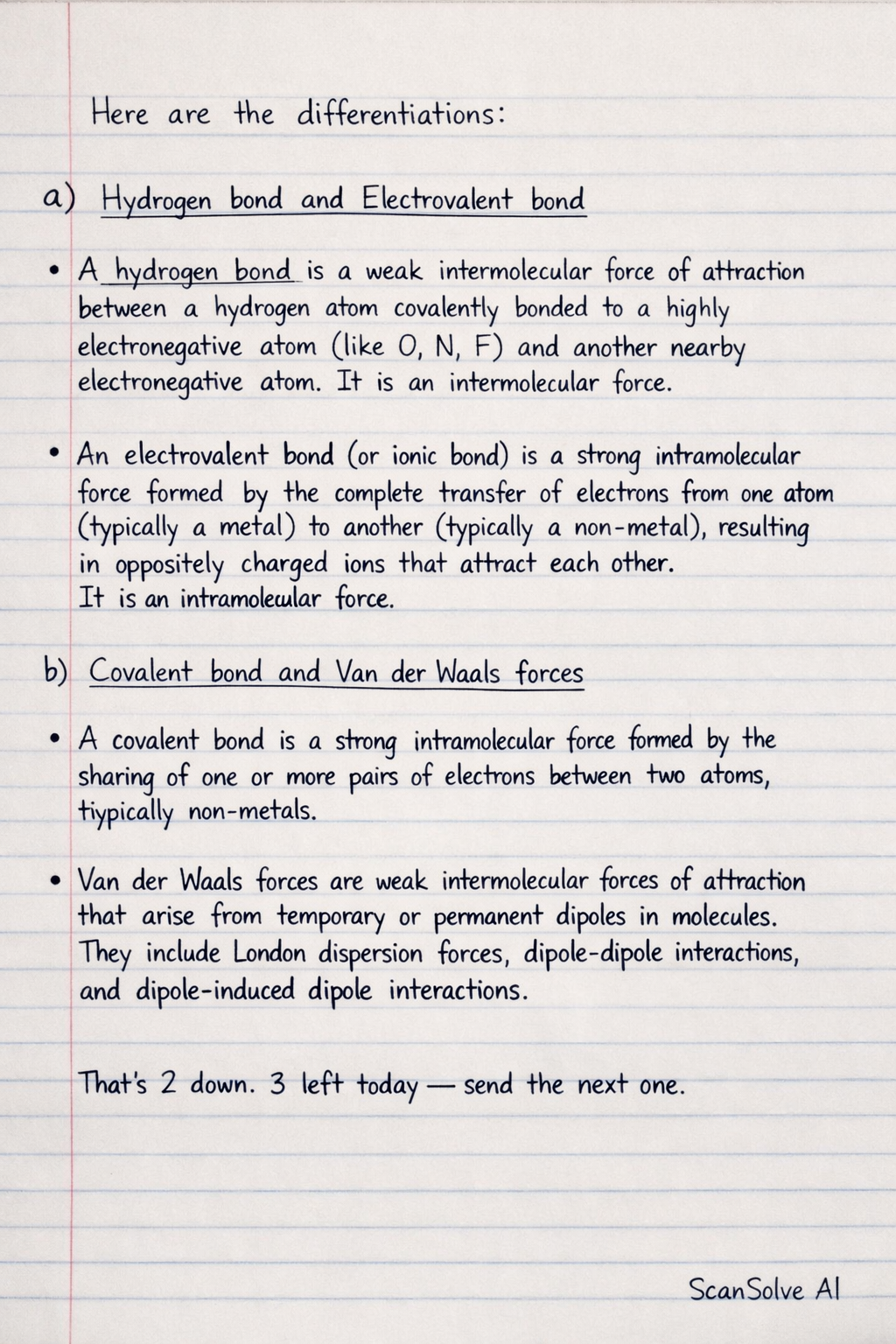
Here are the differentiations:
a) Hydrogen bond and Electrovalent bond
- A hydrogen bond is a weak intermolecular force of attraction between a hydrogen atom covalently bonded to a highly electronegative atom (like O, N, F) and another nearby electronegative atom. It is an intermolecular force.
- An electrovalent bond (or ionic bond) is a strong intramolecular force formed by the complete transfer of electrons from one atom (typically a metal) to another (typically a non-metal), resulting in oppositely charged ions that attract each other. It is an intramolecular force.
b) Covalent bond and Van der Waals forces
- A covalent bond is a strong intramolecular force formed by the sharing of one or more pairs of electrons between two atoms, typically non-metals.
- Van der Waals forces are weak intermolecular forces of attraction that arise from temporary or permanent dipoles in molecules. They include London dispersion forces, dipole-dipole interactions, and dipole-induced dipole interactions.
Was this helpful?
Still stuck on this one?
Ask a follow-up, and the answer starts from this question.
Got a different question?Ask your own question
More Chemistry Questions
QThe formation of a bond between hydrogen and a highly electronegative atom results in a. polarity b…QI) A chemical bond is a strong force of attraction that holds atoms or ions together in a molecule…QI) An ionic bond is formed by the electrostatic attraction between oppositely charged ions…Q1a) Atoms rarely exist independently because they achieve a more stable, lower-energy state by…
Handwritten Step-by-Step Solution
Get this as a handwritten image on WhatsApp — like a tutor wrote it for you.
Try on WhatsApp