
We read your photo as:
Identify the reactants and reaction conditions.
ScanSolve AI Answer
Answer
Step-by-step solution
5 stepsIdentify the reactants and reaction conditions.
The reaction involves propene () and hydrogen chloride (HCl) in the presence of peroxide. This is an addition reaction of a hydrogen halide to an alkene.
Understand Markovnikov's rule and the peroxide effect.
- Normally, the addition of HCl to an unsymmetrical alkene like propene follows Markovnikov's rule. This means the hydrogen atom adds to the carbon of the double bond with more hydrogen atoms, and the chlorine atom adds to the carbon with fewer hydrogen atoms. For propene, this would yield 2-chloropropane.
- The peroxide effect (anti-Markovnikov addition) occurs when HBr adds to an alkene in the presence of peroxides. In this case, the hydrogen adds to the carbon with fewer hydrogens, and the bromine adds to the carbon with more hydrogens. This effect is not observed for HCl or HI because the free radical mechanism is not energetically favorable.
Determine the product based on the likely intent of the question.
Although the peroxide effect does not apply to HCl in reality, some questions may simplify this concept and imply anti-Markovnikov addition for any HX in the presence of peroxides. Assuming the question intends for anti-Markovnikov addition due to the presence of peroxide:
- Propene is .
- In anti-Markovnikov addition, the hydrogen from HCl adds to the second carbon (CH), and the chlorine adds to the first carbon ().
Name the product.
The product formed is 1-chloropropane. The name "3-Chloropropane" refers to the same molecule as 1-chloropropane, as numbering starts from the end closest to the substituent.
Select the correct option.
Based on the assumption of anti-Markovnikov addition, the product is 1-chloropropane, which corresponds to option c.
The final answer is
Try one yourself
A new problem that tests the same skill.
Still stuck on this one?
Ask a follow-up, and the answer starts from this question.
More Chemistry Questions
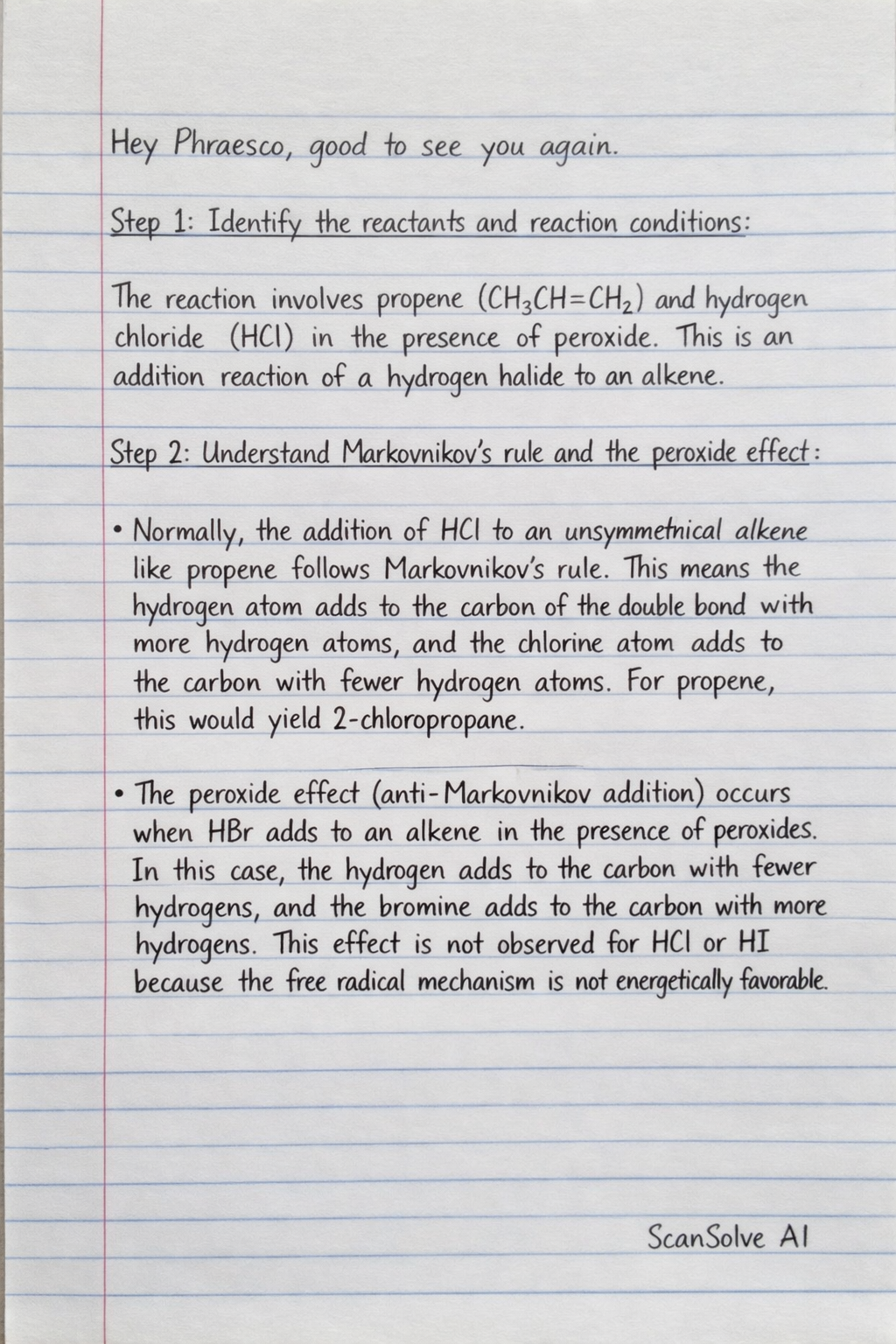
Handwritten Step-by-Step Solution
Get this as a handwritten image on WhatsApp — like a tutor wrote it for you.
Try on WhatsApp