
This chemistry question involves key chemical concepts and calculations. The detailed solution below walks through each step, from identifying the reaction type to computing the final answer.
ScanSolve AI Answer
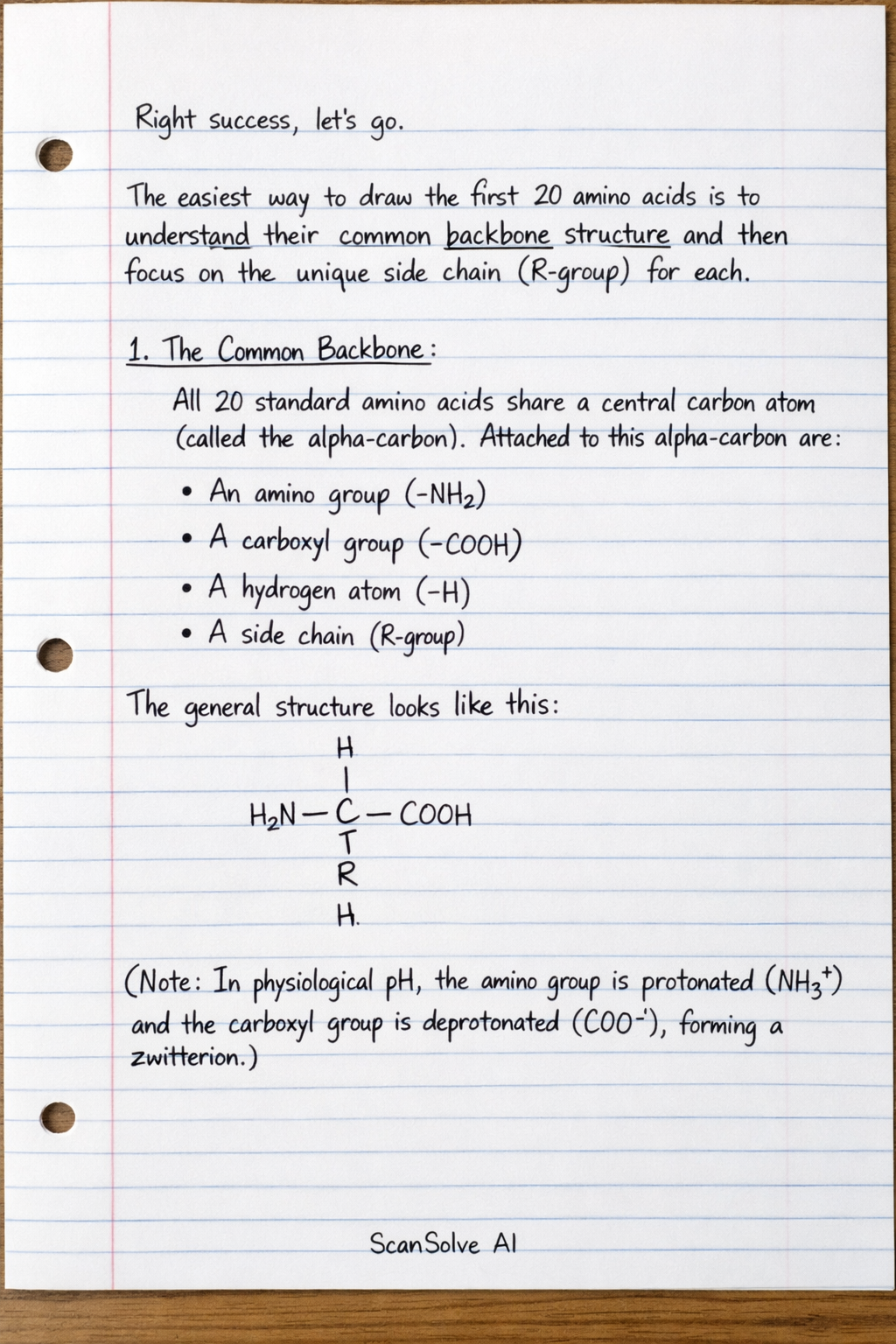
Right sucess, let's go. The easiest way to draw the first 20 amino acids is to understand their common backbone structure and then focus on the unique side chain (R-group) for each. 1. The Common Backbone: All 20 standard amino acids share a central carbon atom (called the alpha-carbon). Attached to this alpha-carbon are: An amino group* (-NH_2) A carboxyl group* (-COOH) A hydrogen atom* (-H) A side chain* (R-group) The general structure looks like this: c H \\ | \\ H_2N - RC - COOH \\ | \\ H (Note: In physiological pH, the amino group is protonated (NH_3^+) and the carboxyl group is deprotonated (COO^-), forming a zwitterion.) 2. The R-Group Variation: The only part that changes from one amino acid to another is the R-group. To draw all 20, you essentially draw the common backbone 20 times and then attach the specific R-group for each. To learn them efficiently, focus on memorizing the structure of each R-group. You can categorize them by their chemical properties (e.g., nonpolar aliphatic, aromatic, polar uncharged, acidic, basic) as this helps group similar structures. For example, Glycine has the simplest R-group, which is just a hydrogen atom. Alanine has a methyl group (-CH_3) as its R-group. The key is to master the backbone, then systematically learn the R-groups. Send me the next one 📸