
We read your photo as:
A laboratory setup is used to prepare and collect nitrogen gas. Answer the following questions about the experiment.
ScanSolve AI Answer
Here are the solutions to the questions:
2. The setup below was used to prepare and collect nitrogen gas in the laboratory. Study it and use it to answer the questions that follow.
a) What property of nitrogen allows it to be collected as shown?
Answer: Nitrogen is insoluble in water.
b) State and explain the observation made in the combustion tube during the experiment.
Observation: The black solid turns reddish-brown.
Explanation: Copper (II) oxide, which is black, is reduced to reddish-brown copper metal by ammonia gas.
c) State another observation that is made in the boiling tube during the process.
Answer: Colorless liquid droplets are formed on the cooler parts of the boiling tube.
d) State and explain the observation made if residue G was added to warm dilute sulphuric (VI) acid.
Observation: No observable change.
Explanation: Residue G is copper metal, which is less reactive than hydrogen and therefore does not react with dilute sulphuric (VI) acid.
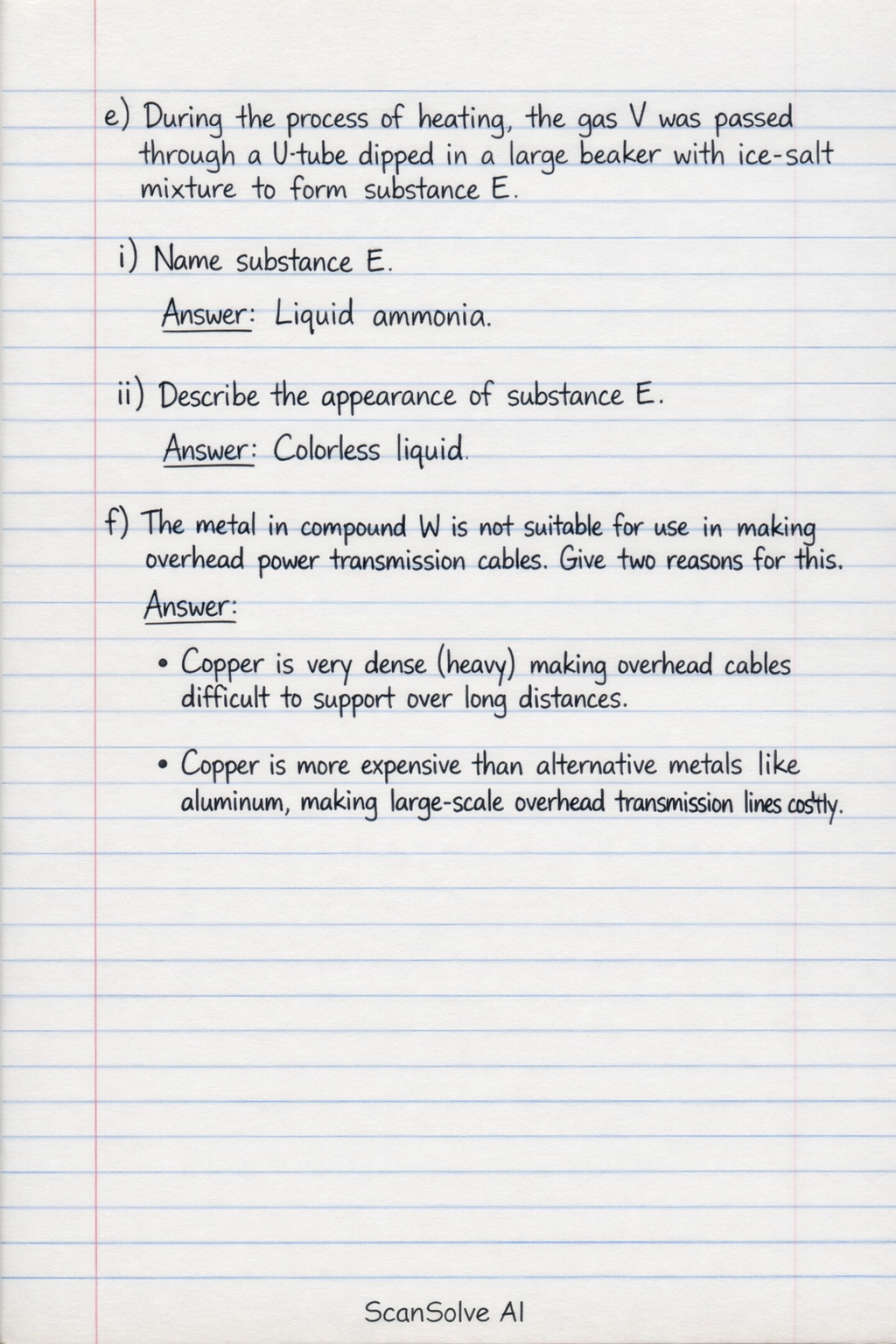
e) During the process of heating, the gas V was passed through a U-tube dipped in a large beaker with ice-salt mixture to form substance E.
i) Name substance E
Answer: Liquid ammonia
ii) Describe the appearance of substance E.
Answer: Colorless liquid
f) The metal in compound W is not suitable for use in making overhead power transmission cables. Give two reasons for this.
Answer:
- Copper is very dense (heavy), making overhead cables difficult to support over long distances.
- Copper is more expensive than alternative metals like aluminum, making large-scale overhead transmission lines costly.
Still stuck on this one?
Ask a follow-up, and the answer starts from this question.
More Chemistry Questions
Handwritten Step-by-Step Solution
Get this as a handwritten image on WhatsApp — like a tutor wrote it for you.
Try on WhatsApp