
We read your photo as:
Explain why a polystyrene cup is used and write the ionic equation for the reaction between zinc and copper (II) sulfate.
Chemistry
ScanSolve AI Answer
Step-by-step solution
4 stepsa) A polystyrene cup was used instead of a glass beaker because polystyrene is a good thermal insulator. This minimizes heat loss to the surroundings, ensuring that the measured temperature change is as accurate as possible for determining the heat of reaction.
b) The reaction is between zinc metal and copper (II) sulfate solution.
Write the balanced molecular equation.
Write the full ionic equation by dissociating aqueous ionic compounds.
Identify and cancel out spectator ions (ions that appear unchanged on both sides).
In this case, is the spectator ion.
Write the net ionic equation.
Was this helpful?
Still stuck on this one?
Ask a follow-up, and the answer starts from this question.
Got a different question?Ask your own question
More Chemistry Questions
QExplain the reaction between zinc and copper sulfate, the reason for balancing chemical equations…QExplain why there was a reaction between zinc metal and a salt solution for copper sulphateQWhen 6.5g of Zinc powder are added to 250cm of 0.1M copper 2 sulphate solution in a plastic…QWrite a balanced chemical equation for the reaction between copper(II) sulfate and barium(II)…QWrite the balanced chemical equation for the reaction between zinc metal and dilute sulphuric acid…
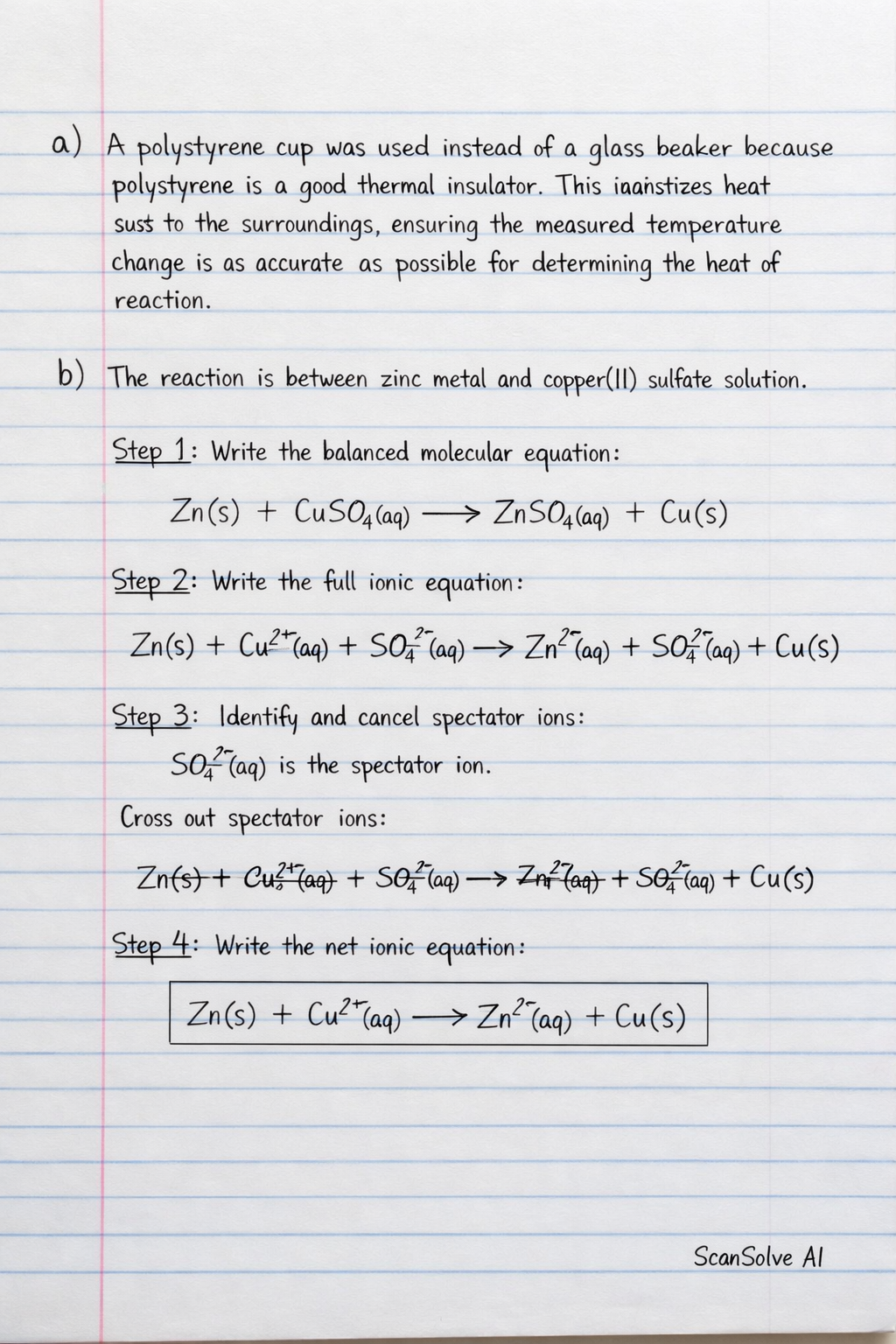
Handwritten Step-by-Step Solution
Get this as a handwritten image on WhatsApp — like a tutor wrote it for you.
Try on WhatsApp