
We read your photo as:
Describe the electrolysis of aqueous copper(II) sulfate with inert electrodes.
ScanSolve AI Answer
Step-by-step solution
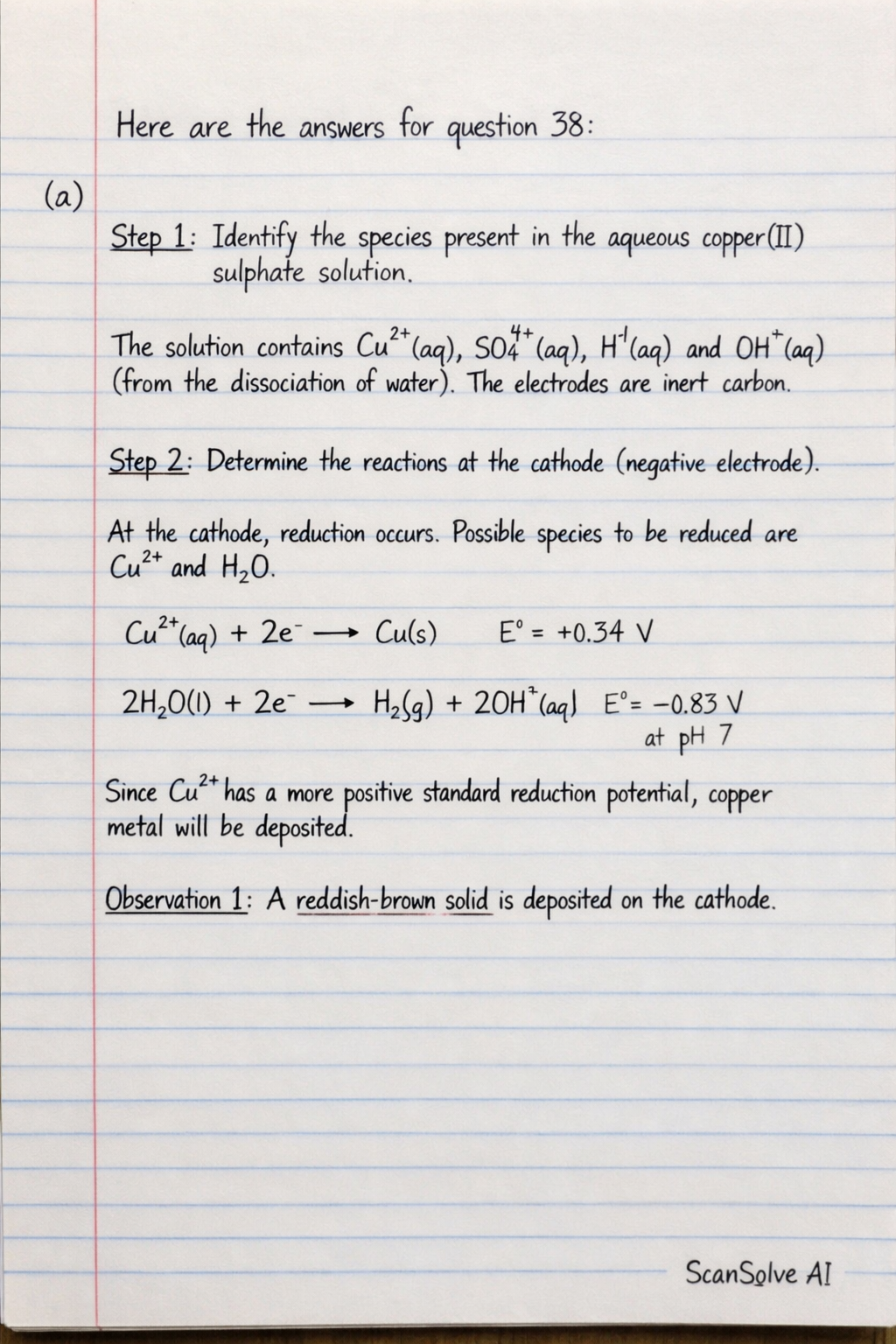
7 stepsHere are the answers for question 38:
Part a· 4 steps
Identify the species present in the aqueous copper(II) sulphate solution.
The solution contains , , , and (from the dissociation of water). The electrodes are inert carbon.
Determine the reactions at the cathode (negative electrode).
At the cathode, reduction occurs. Possible species to be reduced are and .
()
( at pH 7)
Since has a more positive standard reduction potential, copper metal will be deposited.
Observation 1: A reddish-brown solid is deposited on the cathode.Determine the reactions at the anode (positive electrode).
At the anode, oxidation occurs. Possible species to be oxidized are and (or ).
(requires very high potential)
()
Water is more easily oxidized than sulphate ions.
Observation 2: Colorless gas bubbles are produced at the anode.Consider changes to the solution.
As ions are removed from the solution, the characteristic blue color of copper(II) sulphate will fade.
Observation 3: The blue color of the solution fades.Any two of these observations are acceptable.
The two observations are:- A reddish-brown solid is deposited on the cathode.
- Colorless gas bubbles are produced at the anode.
Part b· 3 steps
Write the half-reactions occurring at each electrode.
At the cathode:
At the anode:Analyze the effect of the reactions on the solution's composition.
At the anode, water is oxidized, producing oxygen gas and hydrogen ions (). The ions are released into the solution.
Explain the change in pH.
The accumulation of ions in the solution increases the concentration of hydrogen ions. An increase in concentration makes the solution more acidic. Therefore, the pH of the resultant solution will decrease.
Explanation: The pH of the resultant solution will decrease. This is because water is oxidized at the anode, producing hydrogen ions (). The increase in concentration makes the solution more acidic, leading to a lower pH.
Still stuck on this one?
Ask a follow-up, and the answer starts from this question.
More Chemistry Questions
Handwritten Step-by-Step Solution
Get this as a handwritten image on WhatsApp — like a tutor wrote it for you.
Try on WhatsApp