We read your photo as:

A solution of sulfuric acid of concentration 0.100 mol/dm³ is reacted with 25.0 cm³ of a base XOH. 12.0 cm³ of the acid is required to neutralize the base. What is the concentration of XOH in mol/dm³?

Chemistry

ScanSolve AI Answer

This answer stops before the end.

It was cut off when it was first written. Ask ScanSolve this question again for the full working.

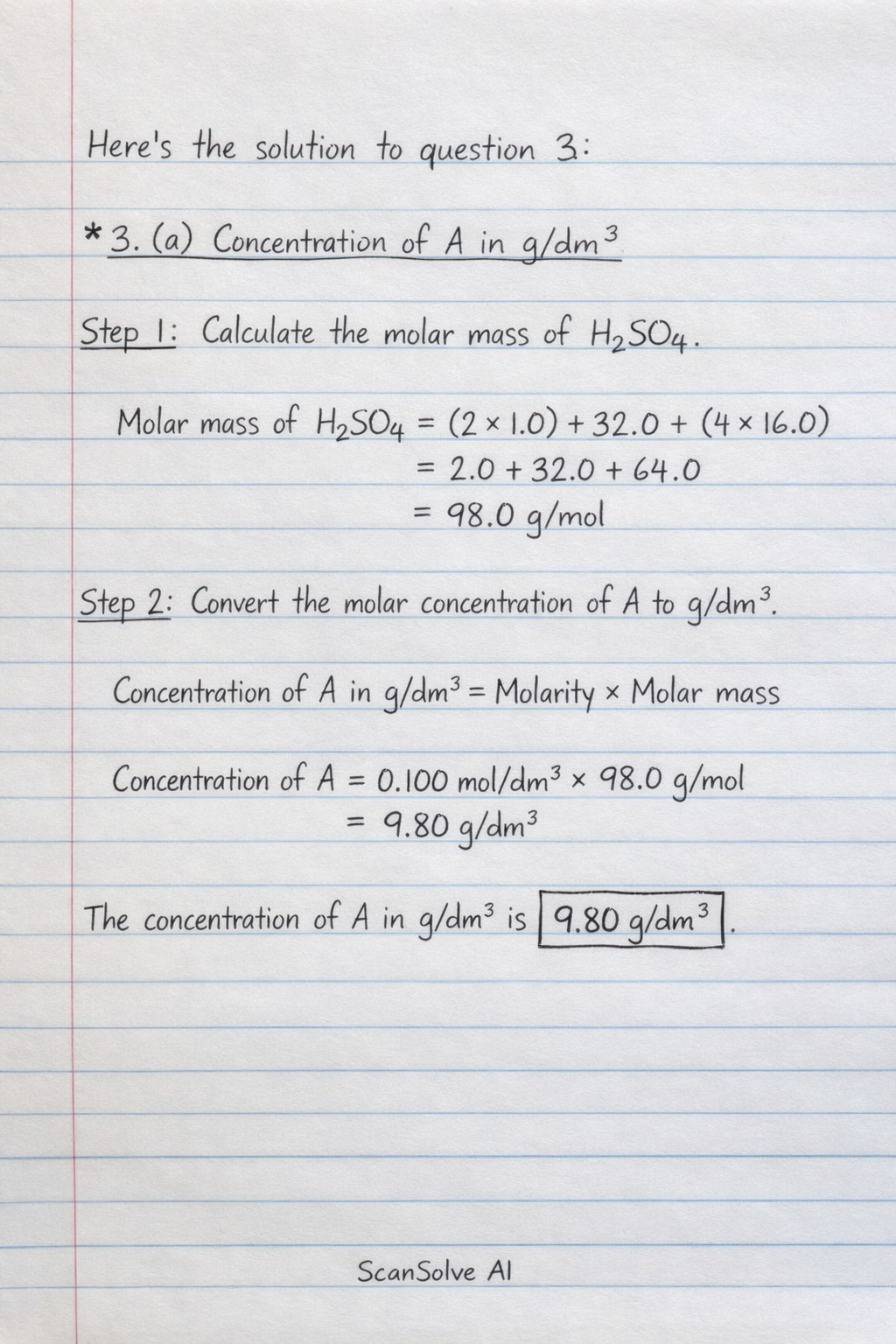
Here's the solution to question 3:

3. (a) Concentration of A in g/dm³

Step 1: Calculate the molar mass of H2SO4\text{H}_2\text{SO}_4.

Molar mass of H2SO4=(2×1.0)+32.0+(4×16.0)=2.0+32.0+64.0=98.0 g/mol\text{Molar mass of } \text{H}_2\text{SO}_4 = (2 \times 1.0) + 32.0 + (4 \times 16.0) = 2.0 + 32.0 + 64.0 = 98.0 \text{ g/mol}

Step 2: Convert the molar concentration of A to g/dm3\text{g/dm}^3.

Concentration of A in g/dm3=Molarity×Molar mass\text{Concentration of A in g/dm}^3 = \text{Molarity} \times \text{Molar mass} Concentration of A=0.100 mol/dm3×98.0 g/mol=9.80 g/dm3\text{Concentration of A} = 0.100 \text{ mol/dm}^3 \times 98.0 \text{ g/mol} = 9.80 \text{ g/dm}^3

The concentration of A in g/dm3\text{g/dm}^3 is 9.80 g/dm3\boxed{\text{9.80 g/dm}^3}.

3. (b) Concentration of B in mol/dm³

Step 1: Write the balanced chemical equation for the reaction.
Assuming XOH\text{XOH} is a monobasic hydroxide, the reaction with sulfuric acid is:

H2SO4(aq)+2XOH(aq)⟶X2SO4(aq)+2H2O(l)\text{H}_2\text{SO}_4(aq) + 2\text{XOH}(aq) \longrightarrow \text{X}_2\text{SO}_4(aq) + 2\text{H}_2\text{O}(l)

From the equation, the mole ratio of H2SO4:XOH\text{H}_2\text{SO}_4 : \text{XOH} is 1:21:2. So, nA=1n_A = 1 and nB=2n_B = 2.

Step 2: Use the titration formula to find the concentration of B.
Given:
CA=0.100 mol/dm3C_A = 0.100 \text{ mol/dm}^3
VA=12.0 cm3=0.012 dm3V_A = 12.0 \text{ cm}^3 = 0.012 \text{ dm}^3
VB=25.0 cm3=0.025 dm3V_B = 25.0 \text{ cm}^3 = 0.025 \text{ dm}^3

CAVAnA=CBVBnB\frac{C_A V_A}{n_A} = \frac{C_B V_B}{n_B} CB=CAVAnBVBnAC_B = \frac{C_A V_A n_B}{V_B n_A} CB=0.100 mol/dm3×0.012 dm3×20.025 dm3×1C_B = \frac{0.100 \text{ mol/dm}^3 \times 0.012 \text{ dm}^3 \times 2}{0.025 \text{ dm}^3 \times 1} CB=0.00240.025 mol/dm3C_B = \frac{0.0024}{0.025} \text{ mol/dm}^3 CB=0.096 mol/dm3C_B = 0.096 \text{ mol/dm}^3

The concentration of B in mol/dm3\text{mol/dm}^3 is 0.096 mol/dm3\boxed{\text{0.096 mol/dm}^3}.

3. (c) Moles of B in 25.0 cm³

Step 1: Use the concentration of B and the volume to calculate the moles.

Moles of B=Concentration of B×Volume of B\text{Moles of B} = \text{Concentration of B} \times \text{Volume of B} Moles of B=0.096 mol/dm3×0.025 dm3\text{Moles of B} = 0.096 \text{ mol/dm}^3 \times 0.025 \text{ dm}^3 Moles of B=0.0024 mol\text{Moles of B} = 0.0024 \text{ mol}

The moles of B in 25.0 cm325.0 \text{ cm}^3 is 0.0024 mol\boxed{\text{0.0024 mol}}.

3. (d) Relative atomic mass of X

Step 1: Calculate the moles of XOH\text{XOH} in 250 cm3250 \text{ cm}^3 of solution B.
The concentration of B is 0.096 mol/dm30.096 \text{ mol/dm}^3.
Volume of solution B = 250 cm3=0.250 dm3250 \text{ cm}^3 = 0.250 \text{ dm}^3.

Was this helpful?

Still stuck on this one?

Ask a follow-up, and the answer starts from this question.

Got a different question?Ask your own question
Handwritten step-by-step solution preview

Handwritten Step-by-Step Solution

Get this as a handwritten image on WhatsApp — like a tutor wrote it for you.

Try on WhatsApp