
We read your photo as:
A) State the Arrhenius equation and explain its application in chemical kinetics. b) Explain the use of simultaneous equations in chemistry with an example.
ScanSolve AI Answer
Step-by-step solution
13 stepsQUESTION ONE
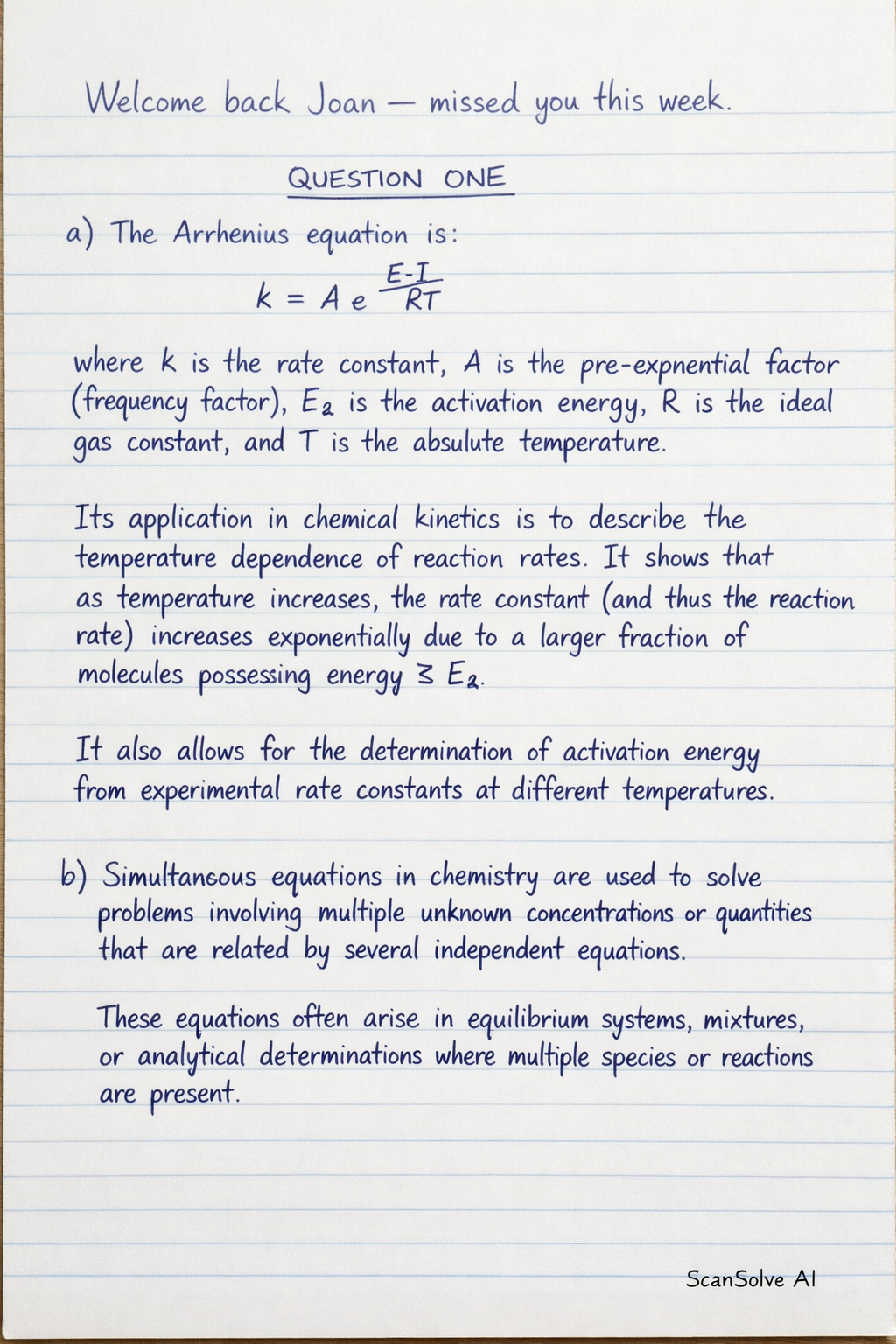
a) The Arrhenius equation is:
where is the rate constant, is the pre-exponential factor (frequency factor), is the activation energy, is the ideal gas constant, and is the absolute temperature.
Its application in chemical kinetics is to describe the temperature dependence of reaction rates. It shows that as temperature increases, the rate constant (and thus the reaction rate) increases exponentially due to a larger fraction of molecules possessing energy equal to or greater than the activation energy. It also allows for the determination of activation energy from experimental rate constants at different temperatures.
b) Simultaneous equations in chemistry are used to solve problems involving multiple unknown concentrations or quantities that are related by several independent equations. These equations often arise in equilibrium systems, mixtures, or analytical determinations where multiple species or reactions are present.
Example 1: Acid-Base Equilibria
In a solution containing a polyprotic acid (e.g., ), there are multiple dissociation steps, each with its own equilibrium constant (). To find the concentrations of all species (, , , , ), a set of simultaneous equations (mass balance, charge balance, and equilibrium constant expressions) must be solved.
Example 2: Mixture Analysis
If a mixture contains two components, A and B, and two different analytical methods are used, each providing a total measurement related to the concentrations of A and B, then two simultaneous equations can be set up to determine the individual concentrations of A and B. For instance, if method 1 measures and method 2 measures , these can be solved simultaneously.
c)
Rearrange the equation to make the subject.
Convert the time from minutes to seconds.
Substitute the given values ( m/s, m/s, s) into the rearranged equation to find the acceleration .
The acceleration is .
d)
Calculate the half-life () for a first-order decomposition.
For a first-order reaction, the half-life is given by:
Given and :
The half-life is .
Calculate the time to reach 15% of the initial concentration.
The integrated rate law for a first-order reaction is:
We want the time when .
Solve for .
The time to reach 15% of the initial concentration is .
QUESTION TWO
a)
Given data points (): 35.8, 36.4, 36.1, 36.0, 36.7.
Number of data points () = 5.Calculate the mean ().
The mean is .
Calculate the variance ().
The formula for sample variance is .
Calculate for each point:
Sum of squared differences: .The variance is .
Calculate the sample standard deviation ().
The sample standard deviation is .
b)
Given: Population standard deviation mL, average volume mL, number of titrations .
We need to find the 95% confidence interval for the true average volume.
For a 95% confidence interval, the z-score () is 1.96.Calculate the standard error of the mean.
Calculate the margin of error.
Construct the 95% confidence interval.
Lower bound:
Upper bound:
Rounding to two decimal places (consistent with ):
The 95% confidence interval is .c)
Given: Formic acid (HCOOH) is a weak acid.
.
Equation: .
Initial moles of formic acid = 0.1 moles. Assuming the volume is 1 L, then the initial concentration M.
Let .Substitute
Still stuck on this one?
Ask a follow-up, and the answer starts from this question.
More Chemistry Questions
Handwritten Step-by-Step Solution
Get this as a handwritten image on WhatsApp — like a tutor wrote it for you.
Try on WhatsApp