
We read your photo as:
A student is preparing soap from palm oil. The steps are given below. (a) Arrange the steps in the correct sequence. (b) Name the scientific principle underlying the preparation of soap. (c) Name the
ScanSolve AI Answer
Here are the solutions to the questions:
1. (a) Arrange the steps in the correct sequence.
The correct sequence for preparing soap from palm oil is:
IV. Dry cocoa pods are burnt into ash;
I. Water is added to the cocoa pod ash, stirred and filtered;
III. Palm oil is poured into a can and heated;
V. The solution is poured into hot oil;
II. The mixture is boiled and stirred for sometime and then allowed to cool;
VI. The crust that forms on top of the liquid is removed.
1. (b) Name the scientific principle underlying the preparation of soap.
The scientific principle is saponification.
1. (c) Name the substance that could be used to speed up the precipitation of the soap.
Sodium chloride (common salt) is used to speed up the precipitation of soap.
1. (d) State the step in which it is most appropriate to introduce the catalyst.
The catalyst (heat) is most appropriate in Step II (when the mixture is boiled and stirred).
1. (e) Name the chemical substance present in the solution of the cocoa pod ash.
The chemical substance present in the solution of the cocoa pod ash is potassium hydroxide.
1. (f) State two effects of impurities in the soap produced.
- Impurities can make the soap harsh on the skin.
- Impurities can reduce the lathering ability of the soap.
1. (g) Describe the test to confirm that the product is soap.
To confirm the product is soap, dissolve a small piece in water and rub it between your hands; it should form lather and feel slippery. Alternatively, test its pH with litmus paper; it should turn red litmus paper blue, indicating it is alkaline.
2. (a) Identify each of the organisms labelled A, B, C and D.
A. Caterpillar
B. Bird
C. Earthworm
D. Tick
2. (b) List the organism(s) that can be classified as:
(i) pests: A, B, D
(ii) parasite: D
2. (c) Name one crop or animal that is attacked by each of the organisms labelled B and D.
B. Maize (or other grains/fruits)
D. Cattle (or other livestock like goats, sheep)
2. (d) State the kind of damage that each of the organisms labelled A, B and C causes to its hosts.
A. Caterpillar: Eats leaves and fruits, causing defoliation and direct crop loss.
B. Bird: Eats seeds, grains, and fruits, causing direct crop loss.
C. Earthworm: Earthworms generally do not cause damage; instead, they improve soil aeration and fertility.
2. (e) State one adaptive feature of the organism labelled B which enables it to cause the damage stated in (d).
The beak of the bird (B) enables it to peck at and consume seeds, grains, and fruits.
2. (f) State two methods of controlling the organism labelled D.
- Dipping or spraying livestock with acaricides (chemicals that kill ticks).
- Rotational grazing to break the tick's life cycle by moving animals away from infested pastures.
Still stuck on this one?
Ask a follow-up, and the answer starts from this question.
More Chemistry Questions
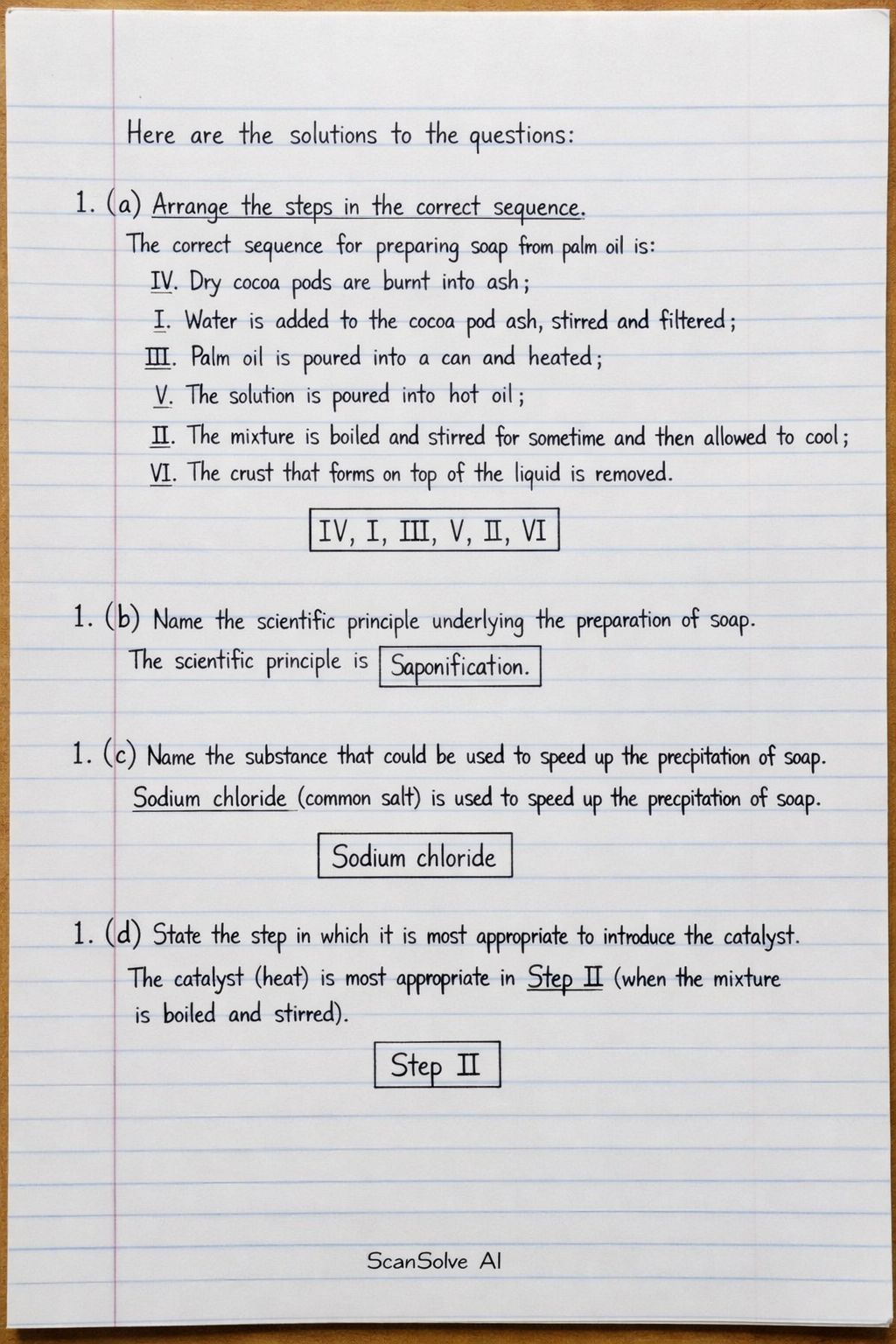
Handwritten Step-by-Step Solution
Get this as a handwritten image on WhatsApp — like a tutor wrote it for you.
Try on WhatsApp