
We read your photo as:
A student performs a titration. They use solution K to neutralise solution L. Use the data to determine the concentration of solution L in moles per litre.
ScanSolve AI Answer
This answer stops before the end.
It was cut off when it was first written. Ask ScanSolve this question again for the full working.
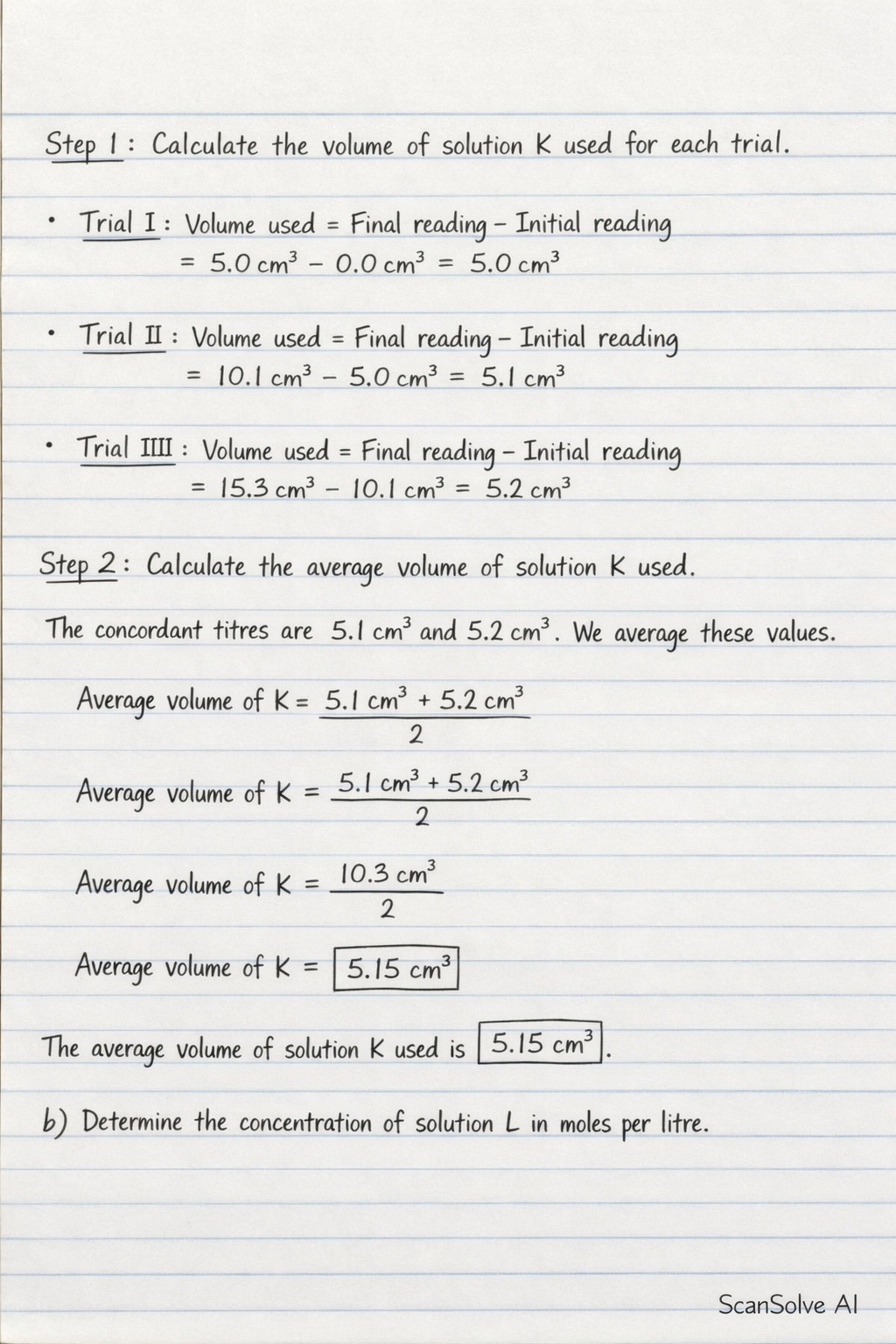
Step 1: Calculate the volume of solution K used for each trial.
- Trial I: Volume used = Final reading - Initial reading =
- Trial II: Volume used = Final reading - Initial reading =
- Trial III: Volume used = Final reading - Initial reading =
Step 2: Calculate the average volume of solution K used.
The concordant titres are and . We average these values.
The average volume of solution K used is .
b) Determine the concentration of solution L in moles per litre.
Step 1: Calculate the molar mass of sodium hydroxide (NaOH).
Given atomic masses: , , .
Step 2: Calculate the concentration of solution L (NaOH) in moles per litre.
Solution L contains of NaOH per litre.
The concentration of solution L is .
c) Determine the number of moles of solution L that reacted with solution K.
Step 1: Convert the volume of solution L from to litres.
The volume of solution L pipetted was .
Step 2: Calculate the number of moles of solution L.
Still stuck on this one?
Ask a follow-up, and the answer starts from this question.
More Chemistry Questions
Handwritten Step-by-Step Solution
Get this as a handwritten image on WhatsApp — like a tutor wrote it for you.
Try on WhatsApp