
We read your photo as:
A student dissolves 4.00 g of an unknown monoprotic acid in 1.00 L of water. They titrate this solution with 0.600 M NaOH, and the equivalence point is reached when 38.7 mL of NaOH is added. Calculate
ScanSolve AI Answer
Answers
2 partsStep-by-step solution
6 stepsHere are the answers to question 5 and 8.a.
Part 5· 4 steps
Calculate the moles of NaOH used.
The volume of NaOH is .
The molarity of NaOH is .Determine the moles of the unknown monoprotic acid.
A monoprotic acid (HA) reacts with NaOH in a 1:1 mole ratio:
Since of NaOH was needed to neutralize "the acid", we assume this refers to the total moles of acid present in the solution.
Calculate the molarity of the acid solution.
The of acid was dissolved in of water.
Rounding to three significant figures:
Calculate the molar mass of the unknown acid.
The mass of the unknown acid is .
Rounding to three significant figures:
Part 8
a
Write the electronic configuration for Se²⁻.
Selenium (Se) is element 34. Its neutral electron configuration is .
To form Se²⁻, two electrons are gained, filling the subshell.Write the electronic configuration for Fe²⁺.
Iron (Fe) is element 26. Its neutral electron configuration is .
To form Fe²⁺, two electrons are lost. For transition metals, electrons are removed from the highest principal energy level first, which is the subshell.
Try one yourself
A new problem that tests the same skill.
Still stuck on this one?
Ask a follow-up, and the answer starts from this question.
More Chemistry Questions
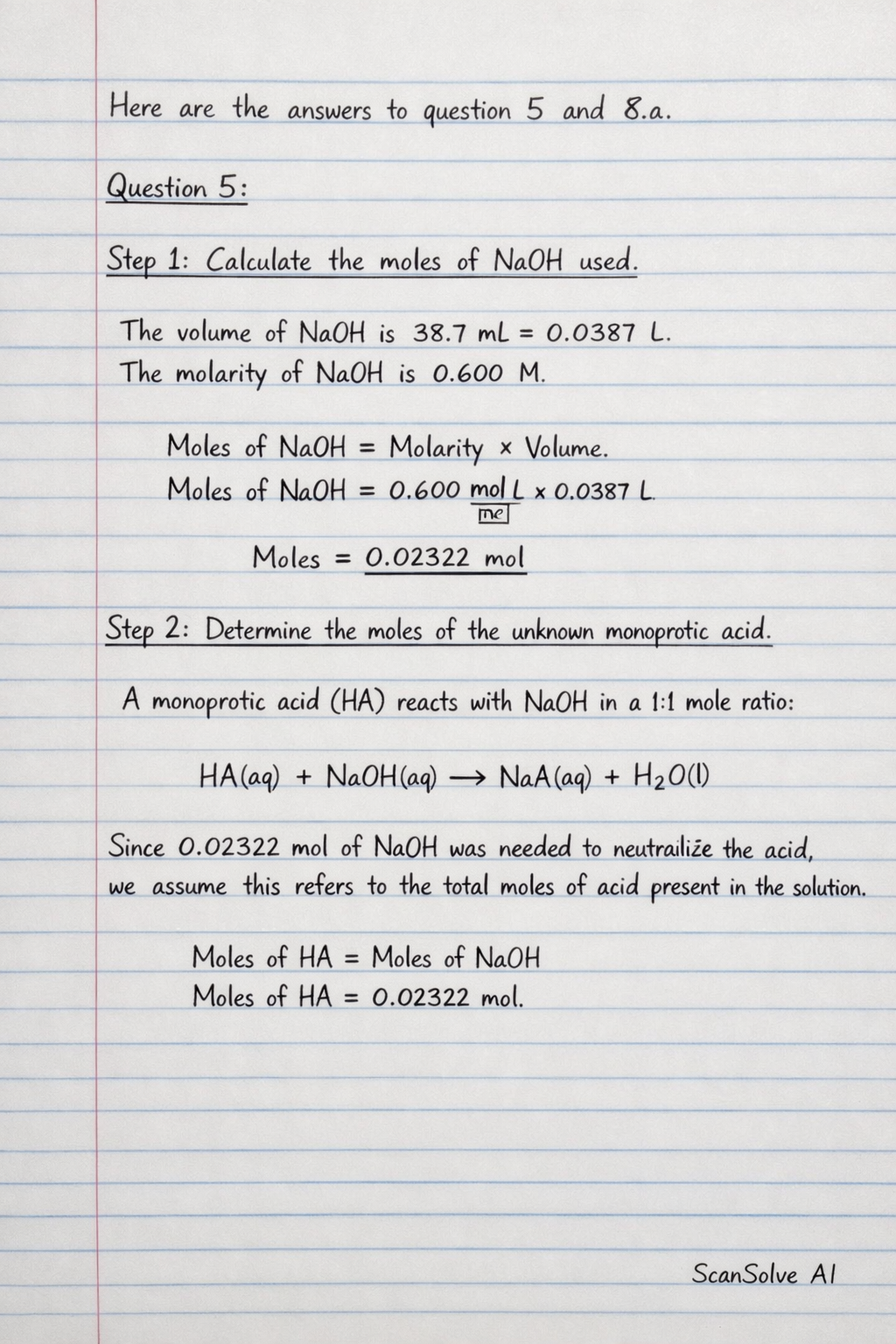
Handwritten Step-by-Step Solution
Get this as a handwritten image on WhatsApp — like a tutor wrote it for you.
Try on WhatsApp