
We read your photo as:
Calculate the original concentration of NaOH solution A given titration data with oxalic acid and a monobasic acid.
ScanSolve AI Answer
This answer stops before the end.
It was cut off when it was first written. Ask ScanSolve this question again for the full working.
Here's a breakdown of the calculations for your titration experiment.
Given Information:
- Solution A: Aqueous NaOH (original concentration unknown)
- Solution B: 0.05 mol/dm oxalic acid (HCO)
- Solution C: 0.1 mol/dm of a monobasic acid
- Dilution: 25.0 cm of original Solution A diluted to 250 cm (diluted Solution A).
Titration Data:
- Table 1 (Solution B vs. diluted Solution A):
- Volume of Solution B (oxalic acid) used = 25.0 cm
- Average titre (t) of diluted Solution A (NaOH) = 25.4 cm
- Table 2 (Solution C vs. diluted Solution A):
- Volume of Solution C (monobasic acid) used = 25.0 cm
- Average titre (t) of diluted Solution A (NaOH) = 13.0 cm
Calculations:
a) The concentration of diluted solution A using the titre, t.
Step 1: Write the balanced chemical equation for the reaction between oxalic acid (HCO) and sodium hydroxide (NaOH).
Oxalic acid is a dibasic acid, meaning it donates two protons.
The mole ratio of HCO : NaOH is .
Step 2: Calculate the moles of oxalic acid (Solution B) used.
Volume of Solution B =
Concentration of Solution B =
Step 3: Calculate the moles of NaOH (diluted solution A) that reacted.
Using the mole ratio from Step 1 (1 mole HCO reacts with 2 moles NaOH):
Step 4: Calculate the concentration of diluted solution A (NaOH).
Volume of diluted Solution A used (t) =
Still stuck on this one?
Ask a follow-up, and the answer starts from this question.
More Chemistry Questions
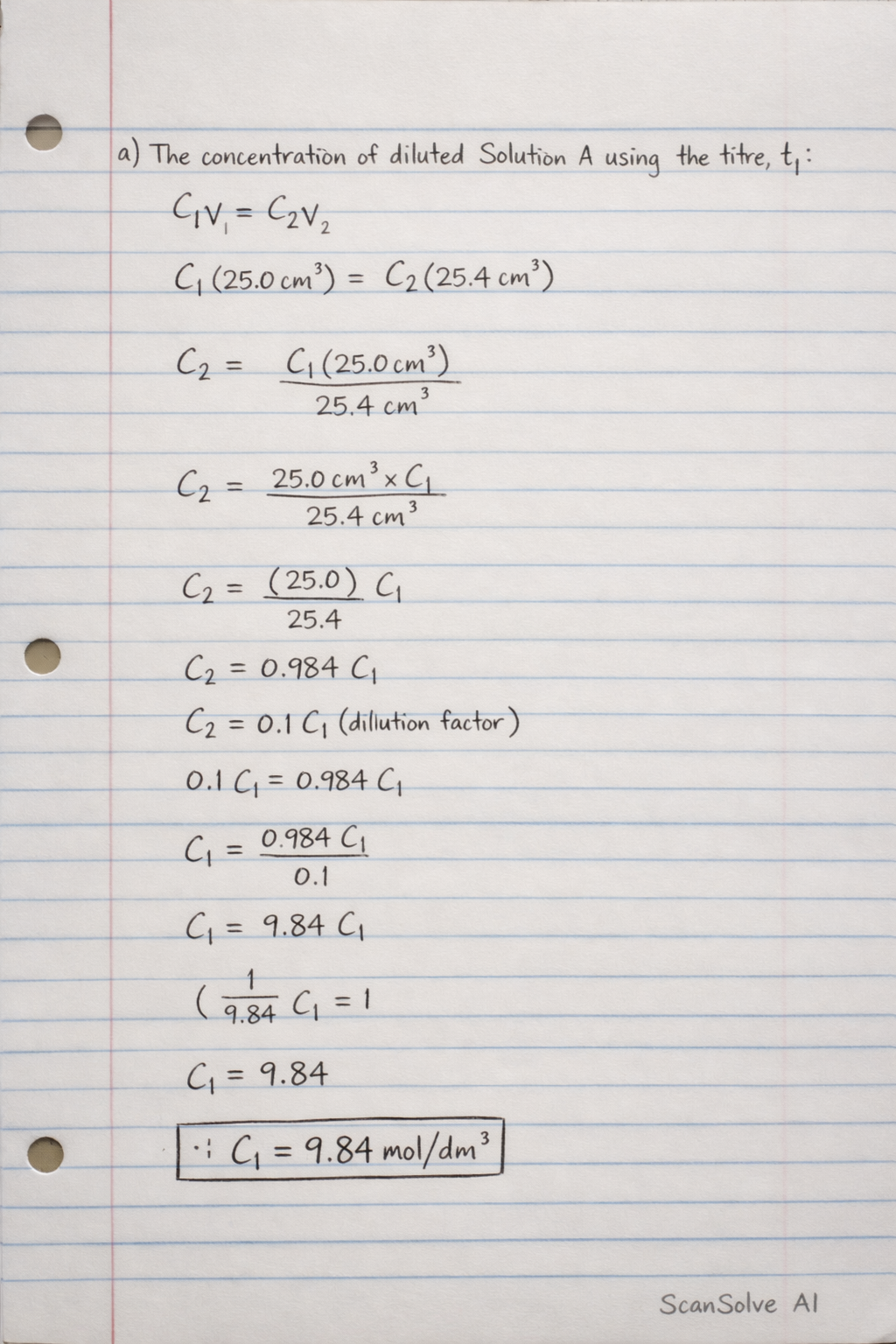
Handwritten Step-by-Step Solution
Get this as a handwritten image on WhatsApp — like a tutor wrote it for you.
Try on WhatsApp