
We read your photo as:
Calculate the amount of solid NaOH in the initial 0.1 M NaOH solution portion that was diluted.
ScanSolve AI Answer
Step-by-step solution
4 stepsHere are the solutions to your questions:
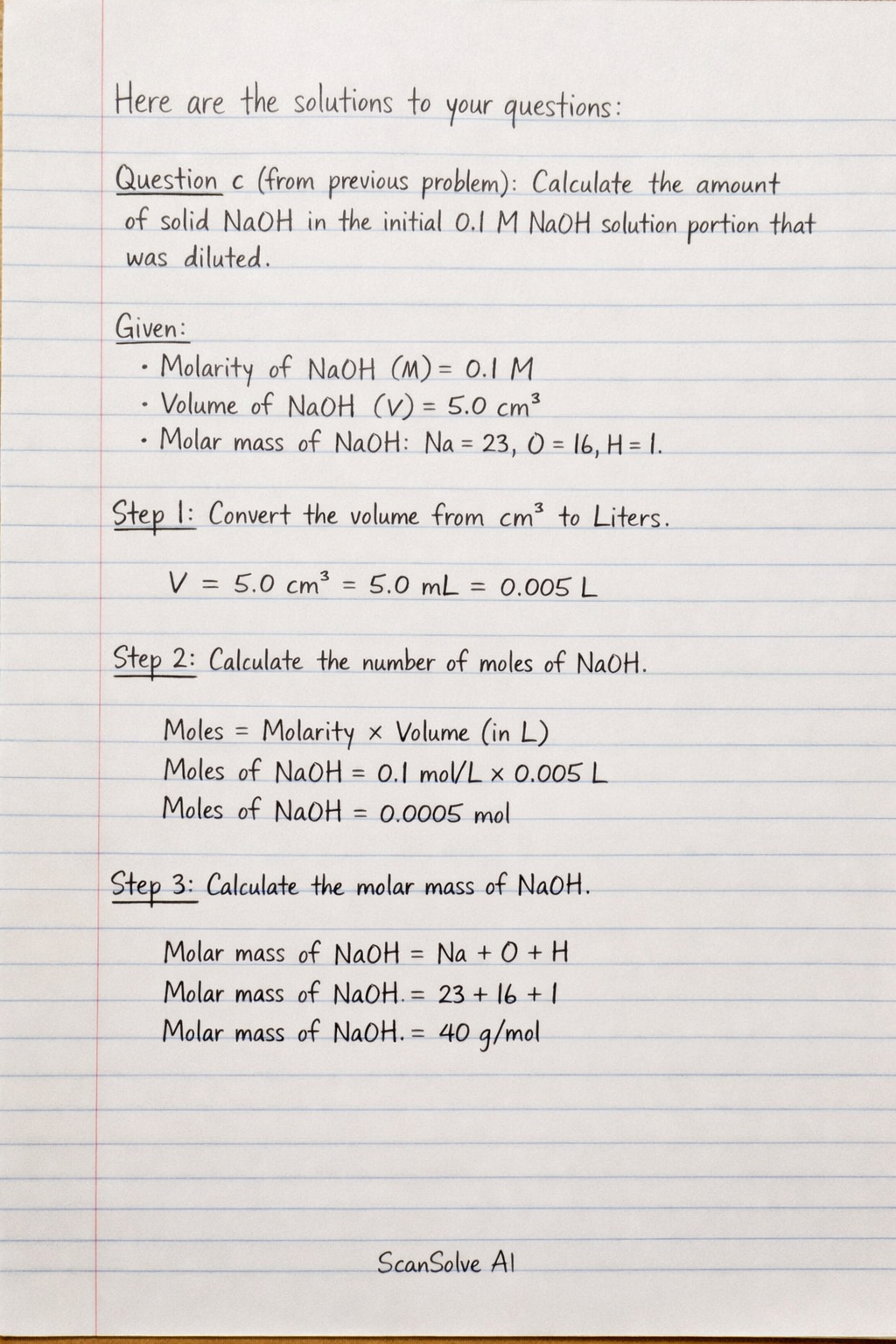
Question c (from previous problem): Calculate the amount of solid NaOH in the initial 0.1 M NaOH solution portion that was diluted.
Given:
- Molarity of NaOH solution () =
- Volume of NaOH solution () =
- Molar mass of NaOH: , ,
Convert the volume from to Liters.
Calculate the number of moles of NaOH.
Calculate the molar mass of NaOH.
Calculate the mass of NaOH.
Question 4: Study the diagrams below carefully
a) Identify the types of crops illustrated in A, B and C.
- A: Cocoyam
- B: Cassava
- C: Sweet potato
b) What type of storage organ does each of the crops A, B and C represent?
- A: Corm (modified stem)
- B: Tuberous root (modified adventitious root)
- C: Tuberous root (modified adventitious root)
c) Name the parts labeled I, II, III, IV, V and VI.
- I: Scaly leaves (or leaf scars)
- II: Cormel (or sucker)
- III: Main corm
- IV: Fibrous roots
- V: Tuberous root (or storage root)
- VI: Adventitious roots (or root hairs)
d) Tabulate three structural differences between the crops A and C.
Feature Crop A (Cocoyam) Crop C (Sweet potato) Type of organ Modified stem (corm) Modified root (tuberous root) External features Has scaly leaves/leaf scars and buds ("eyes") Has adventitious roots/root hairs; lacks scaly leaves Growth pattern Grows as a compact, often rounded, underground stem Grows as an elongated, irregular swollen root e) State the usual methods of propagation of each of the crops in B and C.
- B (Cassava): Stem cuttings
- C (Sweet potato): Stem cuttings (slips) or sprouts from the tuberous roots
Still stuck on this one?
Ask a follow-up, and the answer starts from this question.
More Chemistry Questions
Handwritten Step-by-Step Solution
Get this as a handwritten image on WhatsApp — like a tutor wrote it for you.
Try on WhatsApp