

This chemistry question involves key chemical concepts and calculations. The detailed solution below walks through each step, from identifying the reaction type to computing the final answer.
ScanSolve AI Answer
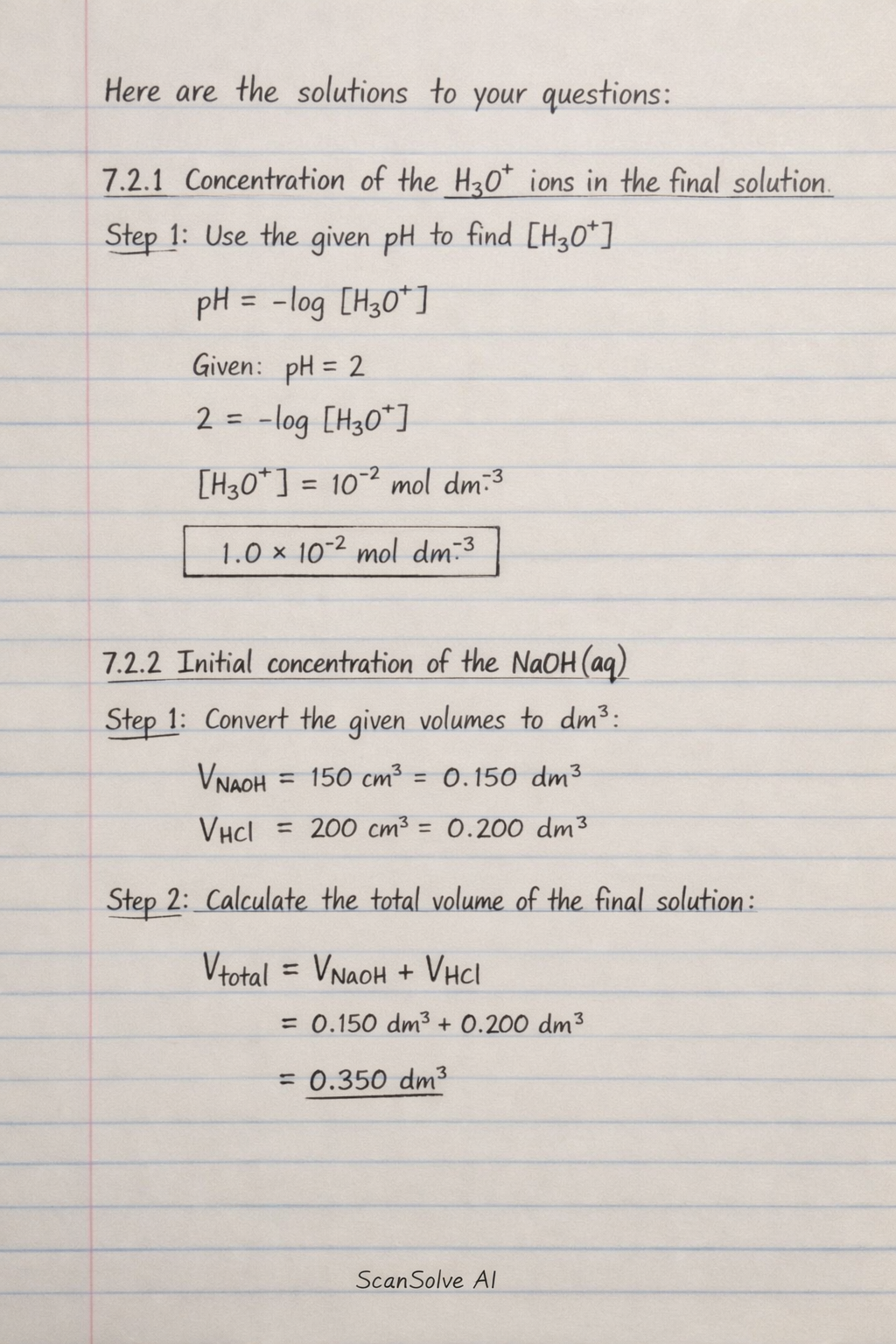
Here are the solutions to your questions: 7.2.1 Concentration of the H₃O⁺ ions in the final solution Step 1: Use the given pH of the final solution to calculate the concentration of H₃O⁺ ions. The relationship between pH and H₃O⁺ concentration is: pH = -[H_3O^+] Given pH = 2. 2 = -[H_3O^+] [H_3O^+] = 10^-2 mol · dm^-3 1.0 × 10^-2 mol · dm^-3 7.2.2 Initial concentration of the NaOH(aq) Step 1: Convert the given volumes to dm^3. V_NaOH = 150 cm^3 = 0.150 dm^3 V_HCl = 200 cm^3 = 0.200 dm^3 Step 2: Calculate the total volume of the final solution. V_total = V_NaOH + V_HCl = 0.150 dm^3 + 0.200 dm^3 = 0.350 dm^3 Step 3: Calculate the moles of H₃O⁺ (excess HCl) in the final solution. Using the concentration from 7.2.1: n_H_3O^+ (final) = [H_3O^+] × V_total n_H_3O^+ (final) = (1.0 × 10^-2 mol · dm^-3) × (0.350 dm^3) n_H_3O^+ (final) = 0.0035 mol Step 4: Calculate the initial moles of HCl. n_HCl (initial) = C_HCl × V_HCl n_HCl (initial) = (0.03 mol · dm^-3) × (0.200 dm^3) n_HCl (initial) = 0.006 mol Step 5: Calculate the moles of HCl that reacted with NaOH. n_HCl (reacted) = n_HCl (initial) - n_H_3O^+ (final) n_HCl (reacted) = 0.006 mol - 0.0035 mol n_HCl (reacted) = 0.0025 mol Step 6: Determine the initial moles of NaOH. From the balanced equation HCl(aq) + NaOH(aq) → NaCl(aq) + H_2O(l), the mole ratio of HCl to NaOH is 1:1. Therefore, the moles of NaOH that reacted are equal to the moles of HCl that reacted. Since NaOH was the limiting reactant, this is its initial number of moles. n_NaOH (initial) = n_HCl (reacted) = 0.0025 mol Step 7: Calculate the initial concentration of NaOH. C_NaOH (initial) = n_NaOH (initial)V_NaOH (initial) C_NaOH (initial) = 0.0025 mol0.150 dm^3 C_NaOH (initial) = 0.01666... mol · dm^-3 0.0167 mol · dm^-3 Last free one today — make it count tomorrow, or type /upgrade for unlimited.