
We read your photo as:
Outline the procedure for the titration of a strong base (NaOH) with an acid (HX), explain why it was repeated, and calculate the concentration of both solutions.
ScanSolve AI Answer
Answers
4 partsStep-by-step solution
9 stepsPart a
For the titration of a strong base (NaOH) with an acid (HX), a suitable indicator is **phenolphthalein
It changes color from colorless in acid to pink in alkaline solution at the endpoint.
Part b
The titration was repeated three times to obtain concordant results and ensure accuracy. Repeating the titration helps to minimize random errors and obtain a reliable average titre.
Part c(i)
Calculate the concentration of B (NaOH) in mol dm⁻³
Calculate the molar mass of NaOH.
Calculate the moles of NaOH in 250 cm³ of solution.
Calculate the concentration of NaOH in mol dm⁻³.
Part c(ii)
Calculate the concentration of A (HX) in mol dm⁻³
Identify the concordant titres and calculate the average titre.
The concordant titres are 22.20 cm³ and 22.10 cm³. The average titre given is 22.15 cm³.
Calculate the moles of NaOH used in the titration.
Determine the moles of HX from the stoichiometry.
From the equation , the mole ratio of HX : NaOH is 1:1.
Calculate the concentration of HX.
Part c(iii)
Calculate the molar mass of A (HX)
Use the given mass of HX in 1.0 dm³ and its calculated concentration.
Part c(iv)61.38
Calculate the relative atomic mass of X
Subtract the molar mass of hydrogen from the molar mass of HX.
Part d(i)
THREE precautions taken during the titration
- Ensure the burette is filled below the eye level to avoid splashing and ensure accurate reading.
- Read the burette at eye level to avoid parallax error.
- Rinse the burette with the acid (solution A) and the pipette with the base (solution B) before use to prevent dilution or contamination.
- Ensure no air bubbles are present in the burette tip.
- Add the titrant dropwise near the endpoint and swirl the flask constantly.
Part d(ii)
TWO laboratory apparatus used for the titration
- Burette (for dispensing the titrant, solution A)
- Pipette (for accurately measuring a fixed volume of solution B)
- Conical flask (for holding solution B and the indicator)
- Retort stand and clamp (to hold the burette)
Still stuck on this one?
Ask a follow-up, and the answer starts from this question.
More Chemistry Questions
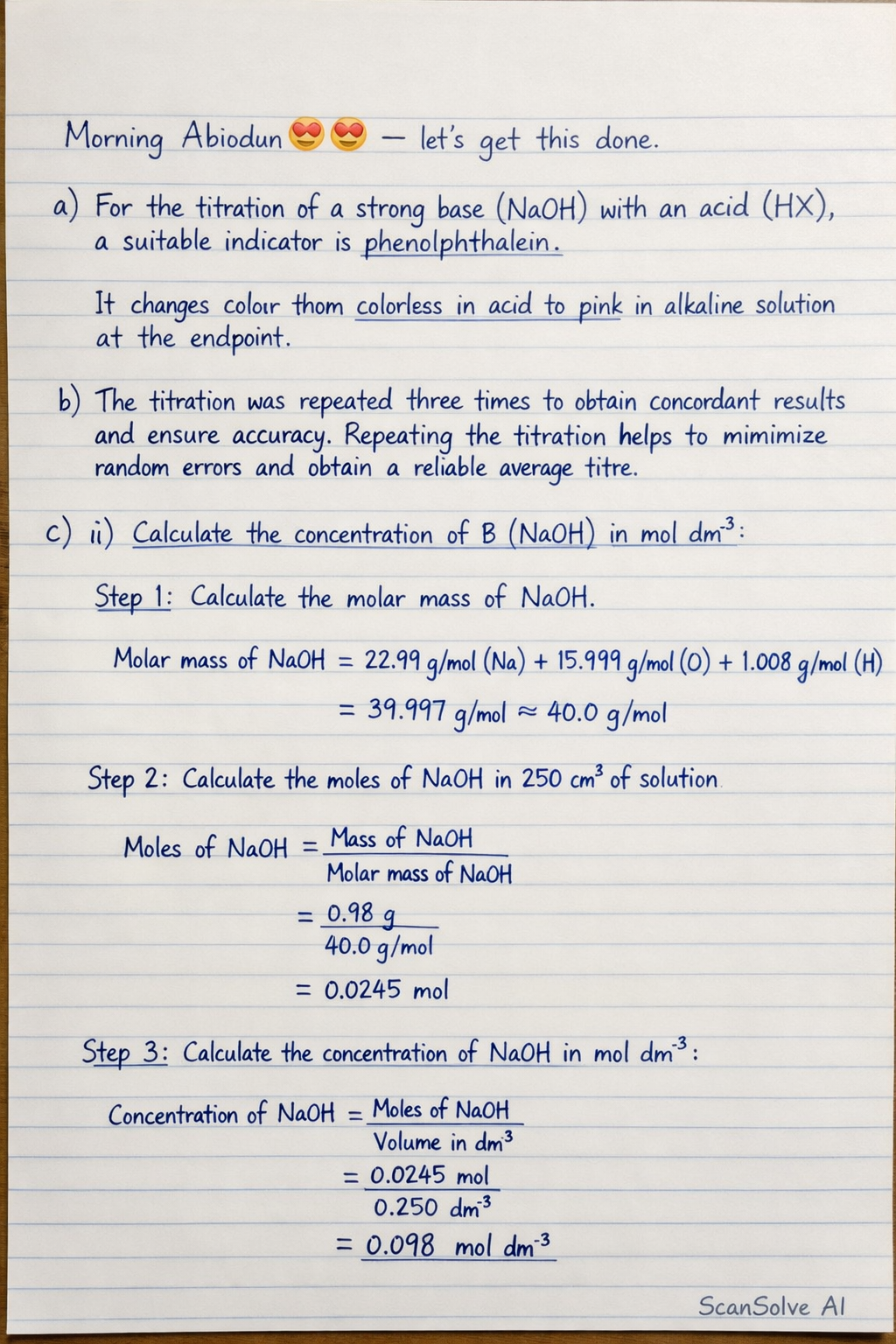
Handwritten Step-by-Step Solution
Get this as a handwritten image on WhatsApp — like a tutor wrote it for you.
Try on WhatsApp