
We read your photo as:
A titration was performed using 25.00 cm³ of an unknown acid (H₂Y) and a 0.10 mol dm⁻³ solution of sodium hydroxide (NaOH). The average titre of NaOH used was 22.50 cm³. Calculate the concentration of
ScanSolve AI Answer
Answers
4 partsStep-by-step solution
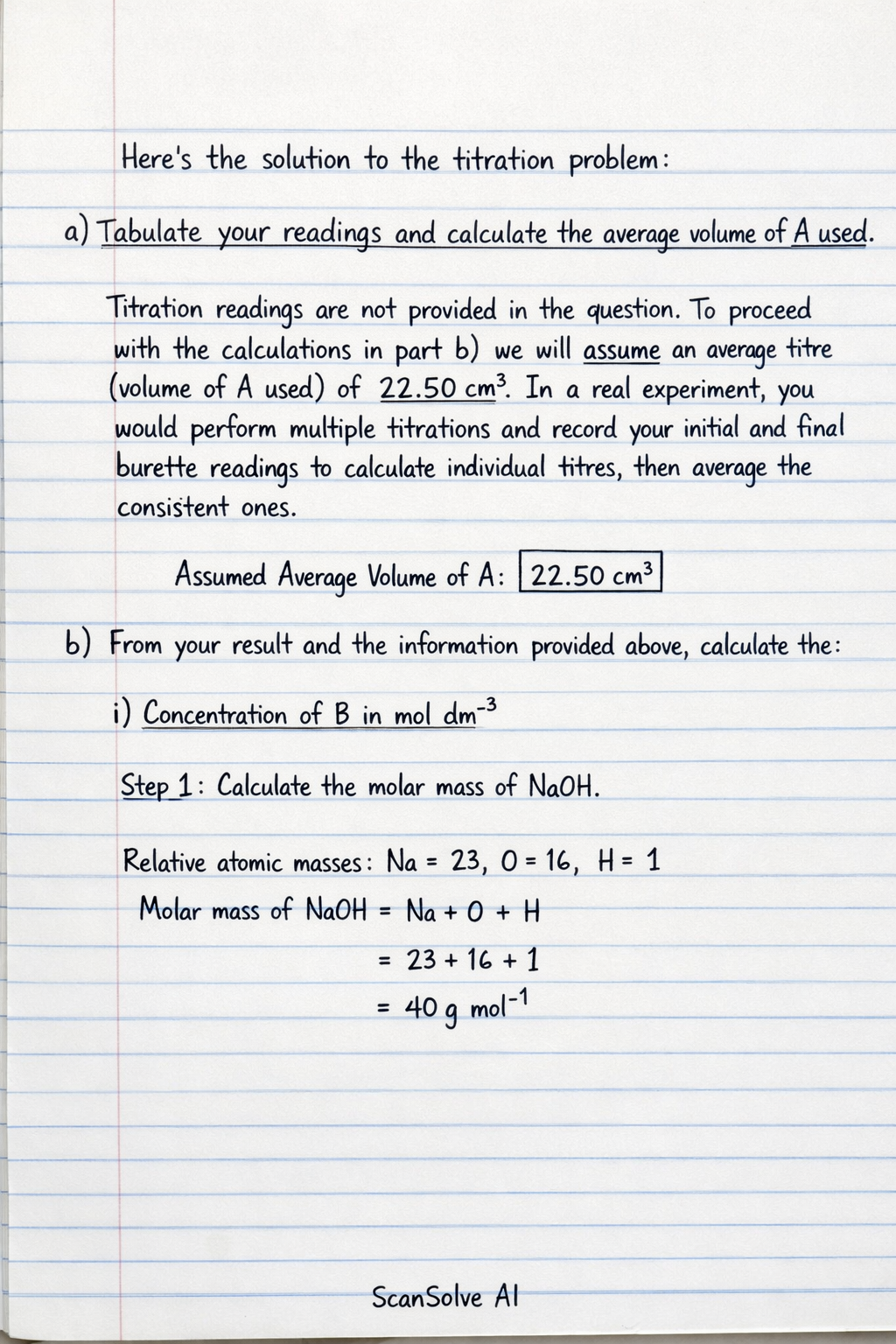
5 stepsHere's the solution to the titration problem:
Part a
Tabulate your readings and calculate the average volume of A used.
Titration readings are not provided in the question. To proceed with the calculations in part b), we will assume an average titre (volume of A used) of . In a real experiment, you would perform multiple titrations and record your initial and final burette readings to calculate individual titres, then average the consistent ones.
- Assumed Average Volume of A:
Part b(i)
Concentration of B in
From your result and the information provided above, calculate the
Calculate the molar mass of .
The relative atomic masses are , , .
Calculate the concentration of B () in .
The concentration of B is given as .
Part b(ii)
Concentration of A in
Identify the mole ratio from the balanced chemical equation.
The given equation is:
From the equation, the mole ratio of acid () to base () is .Apply the titration formula to find the concentration of A.
Given:
Concentration of B () = (from b(i))
Volume of B () =
Volume of A () = (assumed average titre from a)
Part b(iii)
Molar mass of
Use the mass concentration and molar concentration of A to find its molar mass.
The concentration of A is given as .
The concentration of A in is (from b(ii)).
Still stuck on this one?
Ask a follow-up, and the answer starts from this question.
More Chemistry Questions
Handwritten Step-by-Step Solution
Get this as a handwritten image on WhatsApp — like a tutor wrote it for you.
Try on WhatsApp