
We read your photo as:
A student was given a set of questions related to a science experiment involving Bunsen burner flames and fractional distillation of gases. The questions asked about specific observations and explanat
ScanSolve AI Answer
Answer
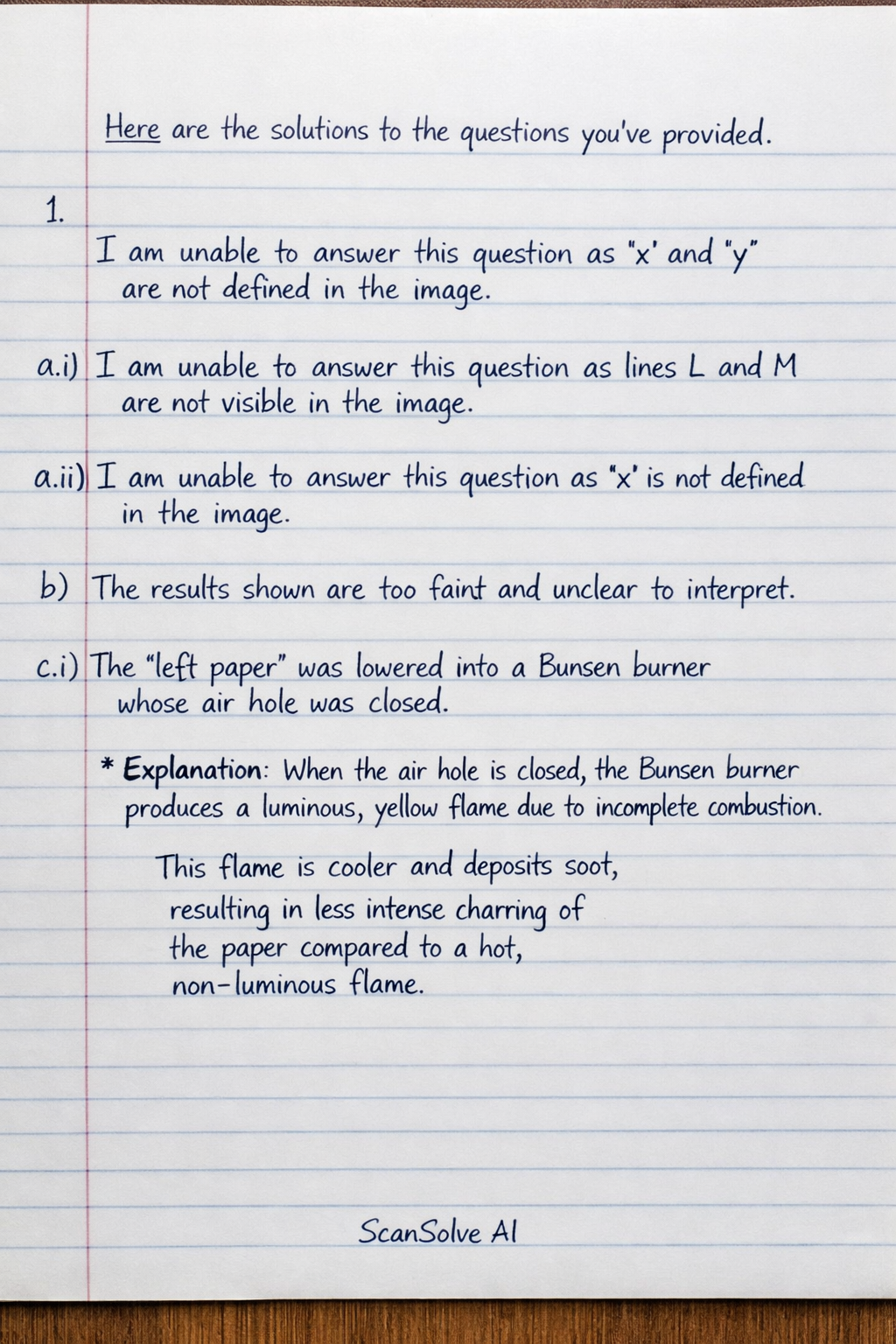
Here are the solutions to the questions you've provided.
1.
a.i) I am unable to answer this question as 'x' and 'y' are not defined in the image.
a.ii) I am unable to answer this question as lines L and M are not visible in the image.
a.iii) I am unable to answer this question as 'x' is not defined in the image.
b) The results shown are too faint and unclear to interpret.
c.i) The left paper was lowered into a Bunsen burner whose air hole was closed.
Explanation: When the air hole is closed, the Bunsen burner produces a luminous, yellow flame due to incomplete combustion. This flame is cooler and deposits soot, resulting in less intense charring of the paper compared to a hot, non-luminous flame.
c.ii)
- i) The gas mixture is passed through sodium hydroxide solution to remove acidic impurities, primarily carbon dioxide (), which would solidify at low temperatures and block pipes in the fractional distillation apparatus.
- ii) In the final stage, nitrogen () is distilled out first. Explanation: Nitrogen has a lower boiling point () than oxygen (). During fractional distillation, the substance with the lower boiling point vaporizes and distills off first.
- iii) Two commercial uses of oxygen gas are:
- Medical use (e.g., for patients with breathing difficulties).
- Welding and cutting metals (e.g., in oxy-acetylene torches).
3.
a. Identify
- i. White ppt I:
- ii. Solution II:
- iii. Residue I:
Try one yourself
A new problem that tests the same skill.
Still stuck on this one?
Ask a follow-up, and the answer starts from this question.
More Chemistry Questions
Handwritten Step-by-Step Solution
Get this as a handwritten image on WhatsApp — like a tutor wrote it for you.
Try on WhatsApp